
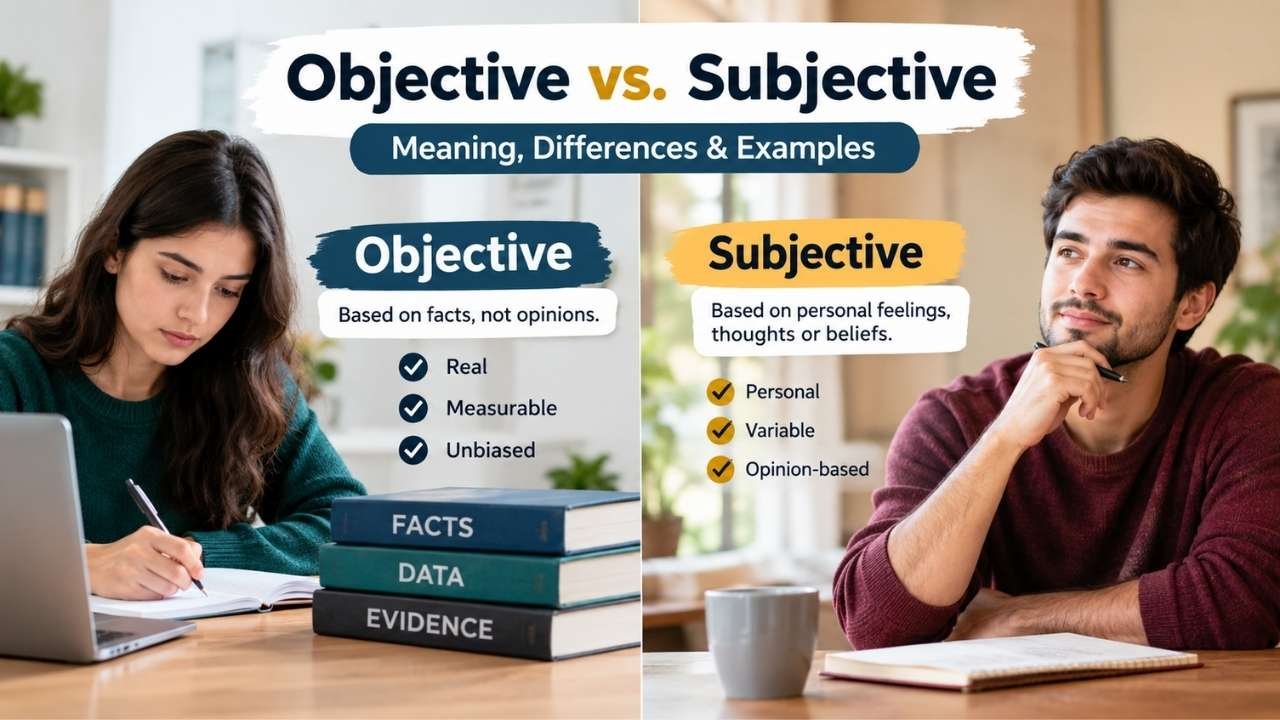
Choosing between objective vs subjective can be confusing because the two words are often used together, yet they mean very different things. Simply put, objective refers to information based on facts, evidence, and verifiable details, while subjective is influenced by personal opinions, feelings, experiences, or beliefs.
Understanding the difference between objective and subjective is important whether you’re writing an essay, reading the news, conducting research, or sharing your thoughts online.
In this guide, you’ll learn the objective vs subjective meaning, explore objective vs subjective examples, compare objective facts with subjective opinions, and discover how to identify each in real-life situations. By the end, you’ll confidently know when to use objective and subjective, avoid common mistakes, and communicate more clearly in both academic and everyday writing.
Quick Answer
Objective vs subjective refers to the difference between facts and personal opinions. Objective information is based on evidence, observation, and verifiable facts, while subjective information reflects feelings, beliefs, or personal experiences. Understanding this distinction helps you choose the right language in writing, research, journalism, and everyday communication, making your message clearer and more accurate.
What Does Objective Mean?

Objective means something based on facts, evidence, and observation instead of personal feelings or opinions. Objective information can usually be checked, measured, or proven with reliable sources.
This is why objective writing is common in academic writing, scientific research, journalism, and business reports, where accuracy matters. For example, “The Earth revolves around the Sun” is an objective statement because it is supported by scientific evidence.
Learning the objective meaning helps you understand the difference between objective and subjective more clearly. When you focus on facts instead of emotions, your writing becomes more trustworthy and professional. If you enjoy learning about English expressions, you can also read our guide on Thanks for the Heads Up to improve your everyday communication.
What Does Subjective Mean?
Subjective refers to ideas, thoughts, or statements that are influenced by personal feelings, opinions, beliefs, or experiences. Unlike objective information, subjective information cannot always be proven because different people may have different viewpoints.
For example, saying, “This is the best movie ever made,” is a subjective opinion because it depends on personal taste. Subjective writing is common in reviews, blogs, personal stories, and creative writing, where sharing emotions is important.
Understanding the subjective meaning helps you recognize when someone is expressing a personal perspective rather than presenting facts. Knowing both objective and subjective meanings makes it easier to communicate clearly and avoid confusion in everyday conversations and writing.
Objective vs Subjective: Side-by-Side Comparison Table
Understanding objective vs subjective becomes much easier when you compare them side by side. While objective statements rely on facts, evidence, and verifiable information, subjective statements are shaped by personal opinions, emotions, and experiences.
Objective language is neutral and measurable, whereas subjective language reflects an individual’s perspective. Both styles have their place, depending on the purpose of your writing.
For example, research papers require objective language, while personal reviews often use subjective language. The comparison below highlights the difference between objective and subjective at a glance. If you’re improving your grammar skills, you may also enjoy our article on Percent Sign Before or After, which explains another common writing question.
| Feature | Objective | Subjective |
| Meaning | Based on facts and evidence | Based on opinions and feelings |
| Can It Be Proven? | Yes | Not always |
| Bias | Neutral and unbiased | May include personal bias |
| Focus | Facts and observation | Personal experiences |
| Writing Style | Academic, scientific, and news writing | Reviews, blogs, and personal stories |
| Example | “Water boils at 100°C.” | “Summer is the best season.” |
The Key Differences Between Objective and Subjective
The biggest difference between objective and subjective is the way information is presented. Objective information is supported by facts, evidence, and observation, making it reliable and easy to verify.
In contrast, subjective information is based on personal beliefs, emotions, and individual experiences, so it can vary from one person to another. An objective perspective focuses on reality without personal bias, while a subjective perspective reflects how someone feels or interprets a situation.
For example, saying, “The meeting lasted two hours,” is objective because it is measurable. Saying, “The meeting felt too long,” is subjective because it expresses a personal opinion. Understanding these differences helps you choose the right language for different situations.
Objective vs Subjective in Writing
Knowing the difference between objective vs subjective in writing helps you become a better communicator. Objective writing presents facts, statistics, research, and evidence without including personal opinions.
It is commonly used in academic writing, journalism, business reports, and scientific research because readers expect accurate and unbiased information. Subjective writing, however, allows writers to express feelings, experiences, and personal viewpoints, making it ideal for reviews, opinion pieces, blogs, and creative writing.
Good writers understand when to use each style based on their audience and purpose. By balancing objective facts and subjective opinions correctly, you can create content that is both informative and engaging while improving clarity and credibility.
Objective vs Subjective in Everyday Life
You come across objective and subjective statements every day, even if you do not notice them. For example, a weather app saying, “The temperature is 28°C” is an objective statement because it is based on measurable facts.
Saying, “28°C is the perfect weather” is a subjective statement because it reflects a personal opinion. The same applies to product reviews, restaurant ratings, movies, and social media posts.
News reports aim to stay objective, while comments and reviews are often subjective. Understanding objective vs subjective in everyday life helps you recognize the difference between facts and opinions, make better decisions, and communicate more clearly with others.
Objective vs Subjective in Research and Science
In research and science, using objective information is very important because conclusions should be based on evidence, observations, and measurable data. Scientists collect facts, perform experiments, and analyze results before reaching a conclusion.
This is called an objective approach because it reduces personal bias. However, subjective thinking may still appear when researchers explain results or discuss ideas, so they work hard to remain neutral.
Understanding objective vs subjective in research helps students and professionals write stronger reports and research papers. Whether you are conducting a survey or reading a scientific study, knowing the difference between objective evidence and subjective opinions leads to more reliable conclusions.
Real-Life Examples of Objective and Subjective Statements
Learning through examples is one of the easiest ways to understand objective vs subjective. Here are a few simple examples that show the difference:
- Objective: “The train arrived at 9:00 AM.”
- Subjective: “The train arrived too late.”
- Objective: “This phone has a 6.5-inch screen.”
- Subjective: “This phone has the perfect screen size.”
- Objective: “The classroom has 30 students.”
- Subjective: “The classroom feels overcrowded.”
These objective vs subjective examples show that objective statements are based on facts and evidence, while subjective statements express personal feelings or opinions. Practicing with examples makes it easier to identify both types of statements in daily life.
Common Mistakes People Make
Many people confuse objective and subjective because both can describe the same topic in different ways. One common mistake is treating an opinion as if it were a fact.
For example, saying, “This is the best book ever written” is subjective because it depends on personal preference. Another mistake is assuming that every statement with numbers is objective, even if it includes opinions.
It is also easy to confuse neutral language with objective language. To avoid these errors, ask yourself whether the statement can be verified with evidence or if it depends on personal beliefs or emotions. This simple habit will improve both your writing and critical thinking.
How to Quickly Tell Whether Something Is Objective or Subjective
A simple way to identify objective and subjective statements is to ask yourself three questions. First, can the statement be proven with facts or evidence? Second, does it rely on personal feelings or opinions?
Third, would most people agree because it is measurable or verifiable? If the answer is based on facts, it is objective. If it depends on someone’s personal view, it is subjective. This quick method works well for essays, news articles, research papers, reviews, and everyday conversations.
With practice, you will quickly recognize the difference between objective and subjective and choose the correct style in your own writing.
Memory Trick to Remember the Difference
An easy way to remember objective vs subjective is to focus on the first letters of each word. Think of Objective = Object = Observable. An object is something you can see, measure, or verify with facts, so objective statements are based on evidence.
Now think of Subjective = Subject = Self. A subject is a person with feelings and opinions, so subjective statements come from personal experiences and beliefs. Another helpful tip is to remember Facts are Objective, while Feelings are Subjective.
This simple memory trick makes it much easier to identify the correct word, whether you are writing an essay, reading a news article, or having a conversation.
FAQs
What is the difference between objective and subjective?
Objective information is based on facts, evidence, and observation, while subjective information is influenced by personal opinions, emotions, or experiences.
Is an opinion objective or subjective?
An opinion is subjective because it reflects what someone thinks or feels rather than a fact that everyone can verify.
Is a fact always objective?
Yes. A fact is generally objective because it can be checked and supported with reliable evidence.
Can something be both objective and subjective?
Yes. A statement may include both objective facts and subjective opinions. For example, a product review can mention factual features while also sharing personal experiences.
Why is objective writing important?
Objective writing improves accuracy, credibility, and trust by presenting information without personal bias.
Where is subjective writing commonly used?
Subjective writing is common in blogs, reviews, opinion articles, personal essays, and creative writing.
How can I identify an objective statement?
Ask whether the statement can be proven with facts or evidence. If it can, it is objective.
How can I identify a subjective statement?
If the statement depends on personal feelings, beliefs, or opinions, it is subjective.
Conclusion
Understanding objective vs subjective is essential for clear communication. Objective statements are supported by facts, evidence, and measurable information, while subjective statements reflect personal opinions, emotions, and experiences.
Both have an important role, but choosing the right one depends on your purpose and audience. Whether you are writing an essay, conducting research, reading the news, or sharing your thoughts online, knowing the difference between objective and subjective helps you communicate with confidence.
By using the examples, comparison tips, and memory tricks in this guide, you can easily recognize each style and use objective and subjective correctly in everyday writing and conversations.