
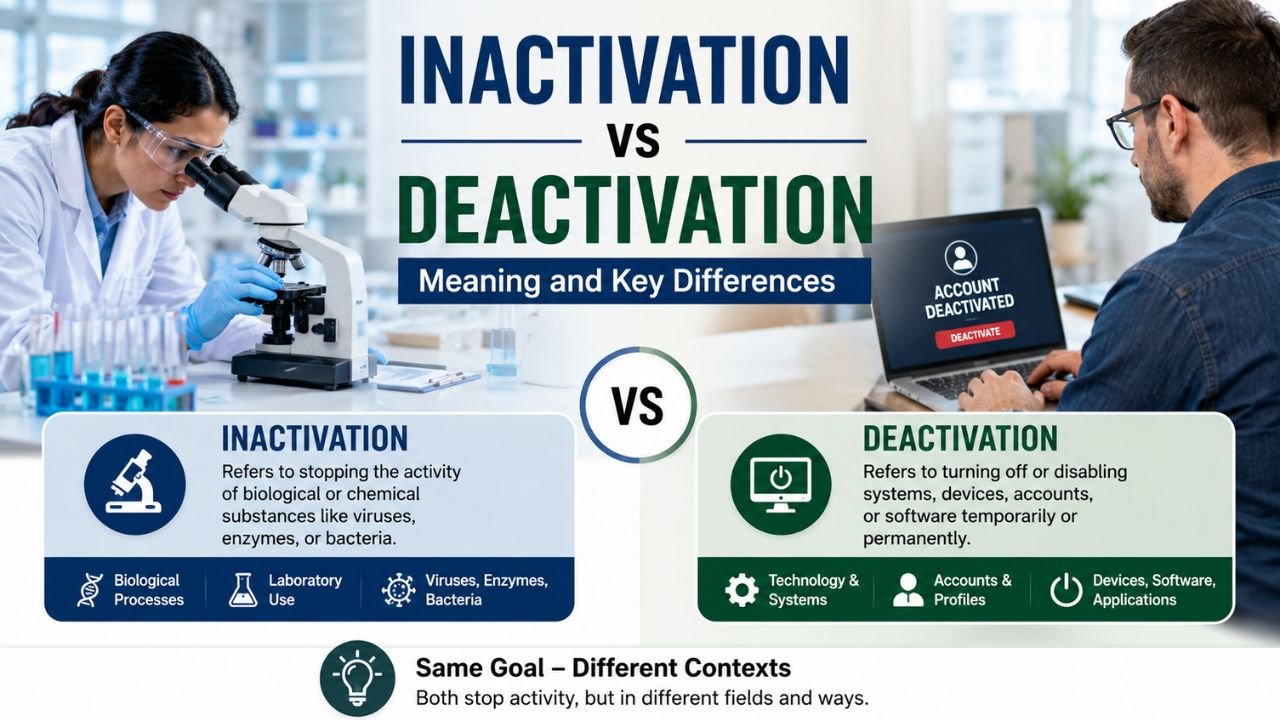
Understanding Inactivation vs. Deactivation can be confusing because the two words seem similar, yet they are used in different ways. The difference between inactivation and deactivation mainly depends on context. In biology, chemistry, and biotechnology, inactivation usually means stopping the activity of a virus, enzyme, protein, or other biological material without necessarily removing it.
Deactivation, however, is more common in technology, where it refers to turning off a device, software, system, or user account. Although the terms sometimes overlap, they are not always interchangeable.
This guide explains the inactivation meaning, deactivation meaning, key differences, real-world examples, and when to use each word correctly. By the end, you’ll clearly understand Inactivation vs. Deactivation and choose the right term with confidence.
Quick Answer
Inactivation and deactivation both describe making something inactive, but they are used in different contexts. Inactivation is most common in biology, medicine, chemistry, and biotechnology, where it stops the activity of a virus, enzyme, or protein. Deactivation is mainly used for devices, software, systems, and user accounts, meaning they are turned off or temporarily disabled.
What Does Inactivation Mean?
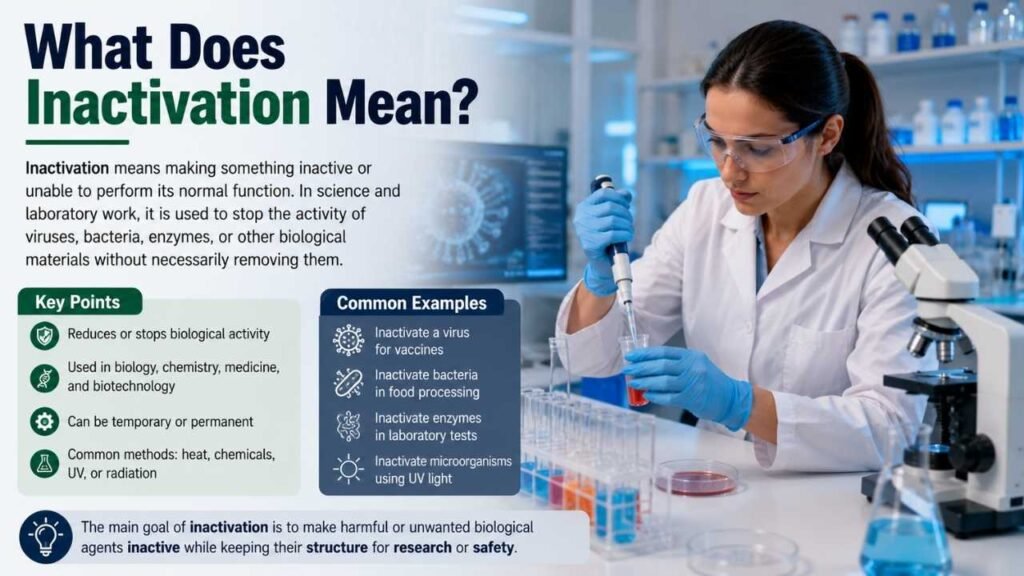
Inactivation means making something inactive so it can no longer perform its normal function. In biology, medicine, chemistry, and biotechnology, this term is often used when a virus, enzyme, protein, or microorganism loses its activity without necessarily being removed.
For example, scientists may inactivate a virus during vaccine production so it cannot cause disease but can still help the body build immunity. Heat inactivation, chemical inactivation, and UV inactivation are common laboratory methods.
The inactivation meaning usually refers to reducing or stopping biological activity, whether the change is temporary or permanent. Like understanding Objective vs Subjective, knowing the context helps you choose the correct word because scientific terms often have very specific meanings.
What Does Deactivation Mean?
Deactivation means turning something off, disabling it, or stopping it from working until it is activated again. Unlike inactivation, this word is most common in technology, electronics, software, and online services.
You can deactivate a user account, deactivate software, deactivate a security system, or deactivate a mobile application without deleting it. In many cases, the item can be restored whenever needed. The deactivation meaning focuses on changing the operational status instead of affecting biological functions.
For example, when you temporarily disable a social media profile, you have deactivated your account, not inactivated it. Understanding these differences helps you communicate more accurately in both everyday conversations and professional writing.
Inactivation vs. Deactivation: Side-by-Side Comparison
Although Inactivation vs. Deactivation may sound similar, they are used in different situations. Inactivation is mainly linked to biology, chemistry, medicine, and laboratory research, where it describes stopping the activity of a virus, enzyme, or protein. Deactivation is usually connected with technology, where it means turning off a device, system, or user account.
Another important difference is that inactivation often involves changing biological activity, while deactivation changes operational status. Some forms of inactivation can be permanent, but deactivation is often temporary and reversible.
Just as expressions like From My Family To Yours depend on context, choosing between these two words also depends on where and how they are being used.
The Key Differences Between Inactivation and Deactivation
The difference between inactivation and deactivation becomes clear when you look at their purpose. Inactivation is used to stop biological or chemical activity, while deactivation is used to stop the operation of technology, devices, or services. Scientists may inactivate bacteria, viruses, or enzymes during research or manufacturing.
On the other hand, people commonly deactivate a device, deactivate software, or deactivate an online account. Another key difference is that inactivation may involve physical or chemical changes, whereas deactivation usually changes only the working status.
Although both words describe making something inactive, they are not always interchangeable, and using the correct term improves both scientific accuracy and everyday communication.
When Should You Use “Inactivation”?
You should use inactivation whenever you are talking about biology, medicine, chemistry, microbiology, or biotechnology. It is the correct word when describing processes that stop the activity of viruses, bacteria, enzymes, proteins, or other biological materials.
For example, researchers may inactivate a virus before creating a vaccine or inactivate enzymes during laboratory experiments. Common methods include heat inactivation, chemical inactivation, and radiation inactivation.
The goal is usually to remove harmful activity while keeping certain structures unchanged for research or medical purposes. If the topic involves biological processes, molecular activity, or laboratory work, inactivation is almost always the more accurate and professional choice.
When Should You Use “Deactivation”?
You should use deactivation when talking about technology, electronics, software, online accounts, or security systems. It means turning something off or stopping it from working without permanently removing it.
For example, you can deactivate a user account, deactivate software, deactivate a mobile app, or deactivate a security alarm. In most cases, the item can be reactivated later with little effort.
This is why deactivation is common in IT, engineering, and everyday technology. Unlike biological inactivation, deactivation usually does not change the object itself—it only changes its operating status. If you are discussing devices, digital services, or computer systems, deactivation is the correct and more natural term.
Can Inactivation and Deactivation Ever Mean the Same Thing?
Inactivation and deactivation can sometimes describe a similar idea because both involve making something inactive. However, they are not true synonyms in most situations. The correct word depends on the field and the object you are describing.
In some scientific discussions, people may use the terms in a broad sense, but professionals usually prefer inactivation for viruses, enzymes, proteins, and other biological materials.
Deactivation is preferred for software, electronic devices, user accounts, and technical systems. If you are unsure, think about whether the subject is a living or biological process or a technology-based system. That simple check will usually help you choose the right word.
Real-Life Examples Across Different Industries
Understanding Inactivation vs. Deactivation becomes easier when you see real examples. In healthcare, scientists inactivate viruses to develop safe vaccines. In pharmaceutical laboratories, researchers inactivate enzymes during testing.
Food manufacturers use heat inactivation to reduce harmful bacteria. In contrast, an IT department may deactivate a user account when an employee leaves a company. A smartphone owner can deactivate an app to stop notifications, while a security team may deactivate an alarm system during maintenance.
These examples show that inactivation is mainly connected with scientific and biological processes, whereas deactivation is used for technology, electronics, and digital services. The surrounding context always determines the correct choice.
Common Mistakes People Make
A common mistake is using deactivation when discussing biology or using inactivation when referring to technology. For example, saying you “inactivated your Facebook account” sounds unnatural because people normally deactivate an account.
Likewise, saying scientists “deactivated a virus” is less accurate than saying they inactivated a virus. Another mistake is thinking the words always mean the same thing. Although both describe making something inactive, they belong to different fields.
Writers also confuse inactive, disabled, and deactivated, even though each has its own meaning. To avoid errors, consider the context first. If the topic is science, choose inactivation. If it involves devices, software, or accounts, choose deactivation.
Similar Words You Shouldn’t Confuse with Inactivation and Deactivation
Several words are related to inactivation and deactivation, but they are not exact replacements. Disable usually means preventing something from working, especially a feature or device.
Suspend often means stopping something temporarily, such as an account or service. Neutralize is common in chemistry and biology, where it means removing the harmful effect of a substance.
Shut down is an everyday phrase for turning off a machine or computer. Dormant describes something that is inactive but may become active again, while terminate usually means ending something permanently. Learning these related terms helps improve your vocabulary and ensures you use the most accurate word in both professional and everyday communication.
FAQs
Is inactivation the same as deactivation?
No. Inactivation is mainly used in biology, medicine, and chemistry, while deactivation is commonly used in technology and electronics.
Can I use the two words interchangeably?
Not usually. The correct choice depends on the context and the subject being discussed.
What is an example of inactivation?
Scientists inactivate a virus during vaccine development so it cannot cause disease.
What is an example of deactivation?
You can deactivate a user account, mobile app, or security system until you need it again.
Is deactivation always temporary?
Often, yes. Most deactivated devices or accounts can be reactivated, although some systems may have permanent deactivation options.
Can inactivation be reversible?
Sometimes. Some biological processes are reversible, while others cause permanent loss of activity.
Which word should I use in everyday writing?
Use deactivation for devices, accounts, and software, and inactivation for scientific or biological topics.
Conclusion
The difference between inactivation and deactivation is easier to understand once you know the context. Inactivation is the preferred term in biology, medicine, chemistry, and biotechnology, where it describes stopping the activity of viruses, enzymes, proteins, or other biological materials.
Deactivation, on the other hand, is commonly used for software, devices, systems, and user accounts that are temporarily turned off or disabled. While both words describe making something inactive, they are not always interchangeable.
Choosing the correct term makes your writing more accurate and professional. Whenever you are unsure, simply think about whether you are discussing a biological process or a technology-based system, and the right choice will become much clearer.