
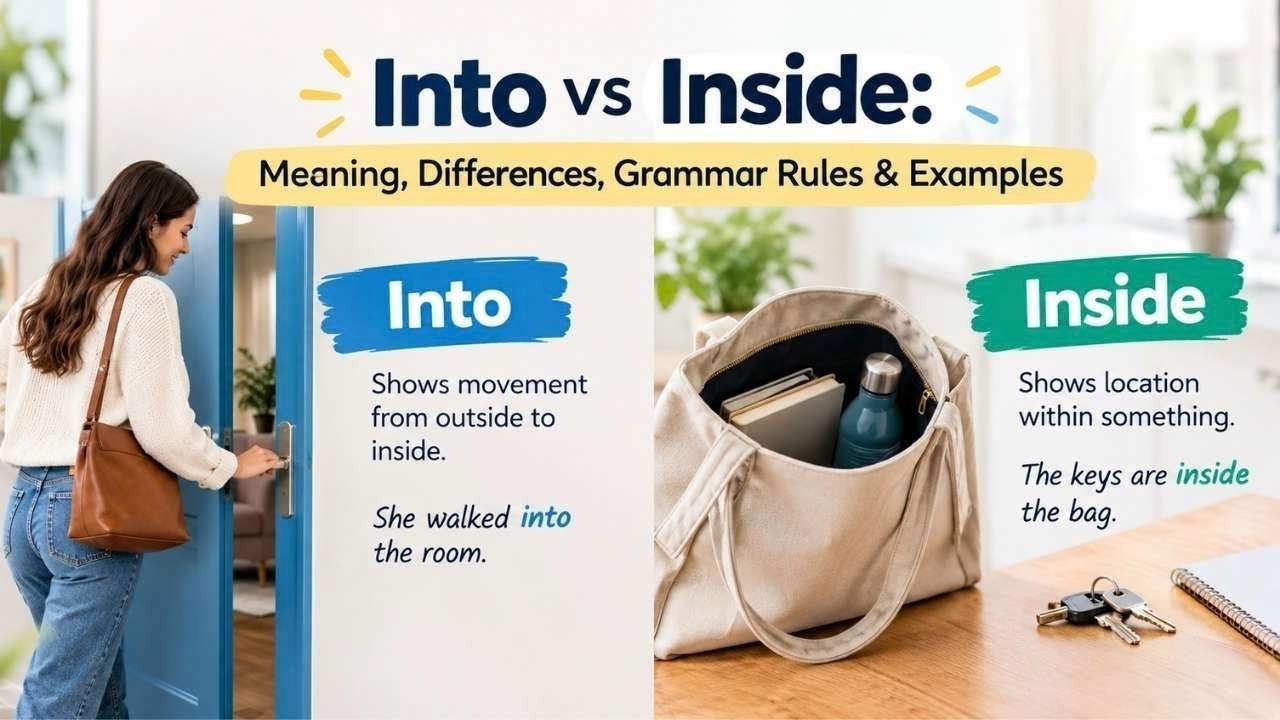
Learning English prepositions can be confusing, especially when two words have similar meanings. Many learners struggle to understand the difference between into vs inside because both relate to being in a place or space.
However, these words are used differently depending on the situation. “Into” shows movement from outside to a place, while “inside” usually describes a position or location within something.
Understanding the difference between into vs inside can help you write clearer sentences and avoid common grammar mistakes. In this guide, we will explain the meaning of into and inside, their grammar rules, practical examples, and how to use these English prepositions correctly in everyday conversations.
Quick Answer
Into and inside are both English prepositions, but they have different uses. Into shows movement from outside to a place or space, while inside describes a person or object already located within something. For example, “She walked into the room” shows movement, while “She is inside the room” shows location.
What Are English Prepositions?
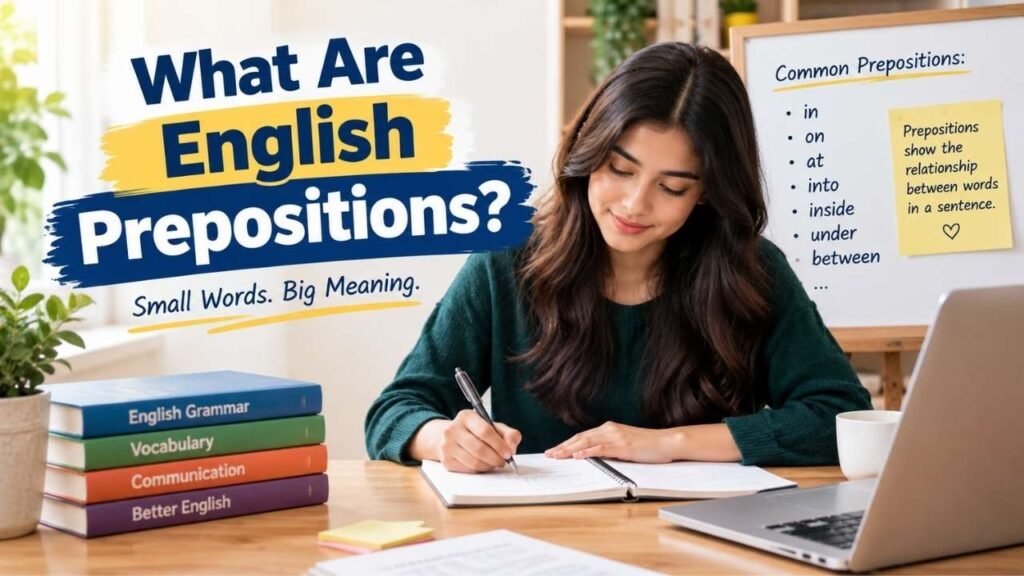
English prepositions are words that show the relationship between different parts of a sentence. They help explain the connection between a person, object, place, time, or direction. Common examples include in, on, at, into, inside, under, and between. Learning prepositions in English is important because these small words can change the meaning of a sentence completely.
Many learners find English grammar rules difficult because some prepositions have similar meanings. For example, into vs inside often creates confusion because both words relate to a place or space. However, they are used in different situations. Understanding prepositions of place and prepositions of movement can help you choose the correct word and create clearer sentences in everyday English.
What Does “Into” Mean in English Grammar?
The word “into” is an English preposition that usually shows movement from one place to another. It explains that someone or something moves from the outside to the inside of a place, object, or area. In simple words, into means entering something.
The meaning of into becomes clearer when we look at examples. For example, “She walked into the room” means she moved from outside the room to inside it. Similarly, “He put the book into the bag” shows movement of the book from one position to another.
The into preposition is often used with action verbs like go, walk, run, jump, and move. It is known as a preposition of movement because it focuses on direction and change.
What Does “Inside” Mean in English Grammar?
The word “inside” describes a position or location within something. Unlike into, it usually does not show movement. Instead, it tells us where a person or object is already located. The meaning of inside is connected with being within an enclosed area, place, or object.
For example, “The keys are inside the drawer” means the keys are already in the drawer. Another example is “The children are playing inside the house,” which shows their location.
The word inside can work as a preposition, adverb, noun, or adjective depending on how it is used. Learning these different uses helps learners understand how to use inside in a sentence correctly. It is one of the important topics when studying English prepositions explained.
Into vs Inside: What Is the Main Difference?
The main difference between into and inside is movement versus location. Into focuses on an action where someone or something enters a place. Inside focuses on the position of someone or something that is already within a place.
| Into | Inside |
| Shows movement | Shows location |
| Focuses on entering | Focuses on being within |
| Used with action | Used to describe position |
For example:
- She went into the classroom. (She moved from outside to inside.)
- She is inside the classroom. (She is already there.)
Understanding this difference makes into vs inside easier for English learners. Similar word comparisons, such as [Words That End In Do], can also help improve vocabulary skills and overall English understanding.
When Should You Use “Into” in a Sentence?
You should use into when you want to describe movement toward the inside of something. It is commonly used when a person, animal, or object changes position and enters a new place. The word into answers the question “Where is something moving?”
Examples:
- The cat jumped into the box.
- She walked into the office.
- He poured water into the glass.
The use of into in English is not limited to physical movement. It can also describe changes or situations. For example, “The caterpillar turned into a butterfly” shows a transformation.
Many learners confuse into and inside, but remembering this simple rule helps: use into for movement and entering, not just location.
When Should You Use “Inside” in a Sentence?
You should use inside when you want to describe the location of someone or something within a place, object, or area. It tells us that something is already contained within boundaries. The use of inside in English is common when talking about homes, rooms, containers, and enclosed spaces.
Examples:
- My phone is inside my bag.
- They are waiting inside the building.
- The toys are inside the box.
Unlike into, inside does not usually show movement. It simply explains where something is located. Learning how to use inside in a sentence can prevent common grammar mistakes. When studying English vocabulary and grammar together, resources like [Verbs Starting With G] can also help learners build stronger sentence skills and improve their communication.
Into vs Inside Examples in Real-Life Sentences
Understanding into and inside examples makes it easier to use these English prepositions correctly in daily conversations. Real-life examples help learners see how these words work in different situations.
Examples with Into:
- She ran into the kitchen to answer the phone.
- The boy jumped into the swimming pool.
- He moved into a new apartment last month.
These sentences show movement from one place to another.
Examples with Inside:
- The documents are inside the folder.
- She is waiting inside the office.
- The children stayed inside during the rain.
These examples describe location rather than movement. By practicing these examples, learners can better understand the difference between into and inside and use them naturally in speaking and writing.
Can “Into” and “Inside” Be Used Interchangeably?
Many learners ask, “Are into and inside interchangeable?” The answer is usually no. Although both words relate to being within a place, they focus on different ideas. Into shows movement, while inside shows position.
For example:
- She walked into the room.
This means she entered the room from outside. - She is inside the room.
This means she is already in the room.
In some casual situations, people may use inside when talking about entering a place, but into is often the better choice when movement is clear. Understanding the difference between into and inside helps you avoid confusion and follow natural English usage.
Common Mistakes With Into and Inside
Many English learners make mistakes when using into and inside because their meanings seem similar. These errors often happen when learners translate directly from their first language. Knowing the correct rules can improve your English grammar rules and sentence accuracy.
Common Mistake 1:
❌ He went inside the car.
✅ He got into the car.
The second sentence sounds more natural because the person is moving from outside the car to the inside.
Common Mistake 2:
❌ The keys are into the drawer.
✅ The keys are inside the drawer.
The keys are already located there, so inside is correct.
Remember this simple tip:
Use into for entering or movement. Use inside for location or position.
Difference Between Into, In, Inside, and Within
The words in, inside, into, and within are closely related, but they are not always used in the same way. Understanding their differences can improve your knowledge of English prepositions.
| Word | Main Use | Example |
| Into | Movement toward the inside | She went into the room. |
| Inside | Location within something | The book is inside the bag. |
| In | General location | He is in the office. |
| Within | Inside a limit, time, or area | Finish the work within two days. |
While in and inside often have similar meanings, into focuses on movement. This comparison helps learners understand different prepositions of place and prepositions of movement more easily.
How to Choose Between Into and Inside Correctly
Choosing between into and inside becomes easier when you focus on the action in the sentence. Ask yourself one simple question:
“Is something moving or is it already there?”
If there is movement from outside to inside, use into.
Examples:
- She stepped into the elevator.
- The dog ran into the garden.
If something is already located in a place, use inside.
Examples:
- The dog is inside the house.
- The money is inside the wallet.
This simple method helps you understand how to use into and inside without memorizing complicated grammar rules. Learning through examples is one of the best ways to improve your English sentence structure and avoid common preposition mistakes.
Practice Exercises: Into vs Inside
Practicing into vs inside examples can help you remember the correct usage. Choose the correct word to complete each sentence.
Fill in the blanks:
- She walked ___ the classroom before the lesson started.
- The shoes are ___ the closet.
- The bird flew ___ the cage.
- They are waiting ___ the restaurant.
Answers:
- She walked into the classroom.
- The shoes are inside the closet.
- The bird flew into the cage.
- They are waiting inside the restaurant.
These exercises show the basic rule: into describes movement, while inside describes location. Regular practice with English preposition examples can make grammar easier and improve confidence in speaking and writing.
FAQs
Is “into” a preposition?
Yes, into is a preposition that shows movement from outside to inside a place or object. It is commonly used with action verbs like go, walk, jump, and move.
Is “inside” a preposition or adverb?
Inside can be a preposition, adverb, noun, or adjective depending on how it is used. For example, “The keys are inside the bag” uses inside as a preposition.
What is the difference between into and inside?
The main difference is movement and location. Into shows entering, while inside shows being within something.
Can inside replace into?
Usually, no. If the sentence shows movement, into is normally the correct choice. If the sentence describes location, inside works better.
When should I use into instead of inside?
Use into when someone or something moves from outside to the inside of a place, object, or area.
When should I use inside instead of into?
Use inside when you want to describe where someone or something is located.
Why are English prepositions confusing?
English prepositions can be confusing because small differences in words can change the meaning of a sentence. Learning through examples makes them easier to understand.
Conclusion
Understanding the difference between into and inside can make your English sentences clearer and more accurate. While both words are related to being within a place or space, they have different purposes.
Into is used to show movement from outside to inside, while inside explains the location of someone or something that is already within a place. By learning these English prepositions with simple rules and examples, you can avoid common grammar mistakes and communicate more naturally.
Remember the easy rule: use into for entering and movement, and use inside for position and location. With regular practice, understanding into vs inside and other prepositions in English will become much easier.