

Have you ever paused while writing and wondered whether month’s or months is the correct choice? You’re not alone. This small punctuation mark can confuse even experienced writers because the difference between month’s, months, and months’ depends on whether you’re showing possession or simply referring to more than one month.
Understanding the correct apostrophe and grammar rules is important for clear and professional English writing. Whether you’re writing one month’s notice, talking about two months’ leave, or simply mentioning several months, knowing the right form helps you avoid common grammar mistakes.
In this guide, you’ll learn the difference between month’s and months, when to use each form, simple apostrophe rules, practical examples, and easy tips to remember the correct usage so you can write with confidence every time.
Quick Answer
Month’s is the singular possessive form of month, meaning something belongs to one month, such as one month’s notice or a month’s salary. Months is simply the plural form, referring to more than one month. Months’ is the plural possessive form, showing that something belongs to multiple months, as in two months’ rent or three months’ experience.
Why People Confuse “Month’s” and “Months”
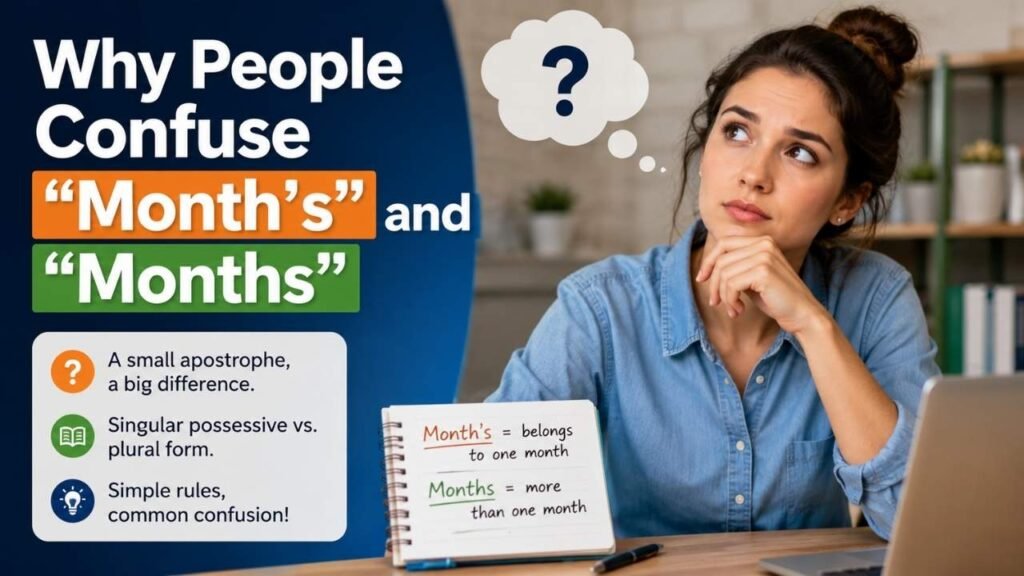
Many writers get confused between month’s and months because the only visible difference is an apostrophe. However, that small punctuation mark completely changes the meaning.
Months is the plural form of month, while month’s is the singular possessive form that shows ownership. Things become even more confusing when you add months’, which is the plural possessive form. This is why many people search for month’s or months which is correct or difference between month’s and months.
Learning these simple grammar rules makes your English writing much clearer. If you enjoy exploring interesting language topics, you might also like our article on There Once Was a Girl From Nantucket, which explains another commonly discussed English expression.
What Does “Month’s” Mean?
Month’s is the singular possessive form of month. It means that something belongs to, relates to, or happens within one month. The apostrophe before the s shows possession.
For example, one month’s notice, a month’s salary, and this month’s report are all correct because they refer to something connected with a single month. If you are wondering when to use month’s, remember that it always shows ownership or association.
This simple grammar rule helps you avoid common grammar mistakes in both formal and everyday writing. Understanding the month possessive grammar also makes your emails, assignments, and professional documents sound more accurate and polished.
Examples:
- We gave one month’s notice before moving.
- I received this month’s salary yesterday.
- The company released this month’s report.
What Does “Months” Mean?
Months is simply the plural form of month. It refers to more than one month and does not show ownership. Because it is only a plural noun, it does not need an apostrophe. For example, you would write three months, many months, or six months ago.
These phrases only talk about a period of time, so no possession is involved. If you ask yourself when to use months, the answer is easy: use it whenever you are referring to two or more months.
If you enjoy learning everyday English expressions, you may also find our guide on How Is Your Day Going helpful, as it explains another phrase people often use incorrectly.
Examples:
- She traveled for three months.
- We waited several months for the results.
- The project lasted six months.
What Does “Months'” Mean?
Months’ is the plural possessive form of months. It shows that something belongs to more than one month. Since the word is already plural, the apostrophe is placed after the s. T
his form appears less often than month’s or months, but it is still important in English grammar. You will commonly see it in phrases like two months’ notice, three months’ rent, or six months’ experience.
If you are learning apostrophe rules, remember that months’ combines both plural and possession. Knowing the difference between months and months’ helps you write clearly and avoid confusing punctuation errors.
Examples:
- She gave two months’ notice before leaving.
- We paid three months’ rent in advance.
- He has six months’ experience in marketing.
Month’s vs. Months vs. Months’ (Comparison Table)
These three forms look very similar, but each has a different purpose. The table below makes it easier to understand the difference between month’s and months while also showing when to use months’. Learning these apostrophe rules will help you write with confidence and avoid common grammar mistakes.
| Word | Meaning | Grammar Function | Example |
| Month’s | Something belongs to one month | Singular possessive | One month’s notice |
| Months | More than one month | Plural noun | Three months passed quickly. |
| Months’ | Something belongs to multiple months | Plural possessive | Two months’ salary |
A simple way to remember this table is to first decide whether you are talking about one month, many months, or ownership.
When Should You Use “Month’s”?
Use month’s whenever you want to show that something belongs to one month. This is the singular possessive form, so the apostrophe comes before the s. It is commonly used in everyday conversation, business writing, and legal documents.
You will often see phrases such as one month’s notice, this month’s expenses, a month’s work, or this month’s schedule. If you are unsure how to use month’s correctly, ask yourself whether the noun belongs to a single month.
If the answer is yes, month’s is the correct choice. Following this simple grammar rule makes your English writing clearer and more professional.
Examples:
- The employee submitted one month’s notice.
- We reviewed this month’s budget.
- She completed a month’s work in two weeks.
When Should You Use “Months”?
Use months whenever you are talking about two or more months without showing ownership. Since it is only the plural form of month, it does not need an apostrophe. This form is common when discussing time, schedules, projects, or events.
You might write four months ago, many months later, or the project lasted eight months. If you are wondering is months plural, the answer is yes. It simply refers to multiple months.
Remember, if there is no possession, you should use months, not month’s or months’. This easy rule will help you avoid one of the most common grammar mistakes in English.
Examples:
- We studied for five months.
- The repairs took two months.
- They traveled for eight months before returning home.
When Should You Use “Months'”?
Use months’ when you need the plural possessive form of month. This means something belongs to or is connected with more than one month. The apostrophe comes after the s because the noun is already plural.
Many writers make mistakes with this form, but the rule is simple. If you are talking about ownership involving multiple months, use months’. You will often see it in business, legal, and formal writing.
Understanding when to use months’ and the difference between months and months’ will improve your English grammar and make your writing more accurate.
Examples:
- The company required two months’ notice.
- We paid three months’ rent in advance.
- She has six months’ experience in customer service.
Common Expressions Explained
Some phrases with month’s, months, and months’ appear so often that they can easily confuse writers. The key is to decide whether you are talking about one month, many months, or ownership.
For example, one month’s notice is correct because the notice belongs to one month. Two months’ notice uses the plural possessive because it refers to two months. Meanwhile, six months pregnant and twelve months old simply describe time, so they use months without an apostrophe.
Learning these common expressions helps you apply the correct apostrophe rules in everyday writing and avoid repeated grammar mistakes.
Common Examples
- One month’s notice ✔️
- Two months’ notice ✔️
- A month’s salary ✔️
- Three months’ rent ✔️
- Six months pregnant ✔️
- Twelve months old ✔️
Most Common Grammar Mistakes
Many people know the difference between month’s and months, yet they still make small mistakes while writing. One common error is adding an apostrophe to a plural word that does not show possession. Another mistake is forgetting to use months’ when something belongs to more than one month.
These errors can make your writing look less professional. A simple way to avoid them is to ask yourself, “Am I showing ownership or simply talking about more than one month?” Once you answer that question, choosing the correct form becomes much easier.
| Incorrect | Correct |
| Two month’s notice | Two months’ notice |
| Three month ago | Three months ago |
| One months notice | One month’s notice |
| Six month’s old | Six months old |
| Two months salary | Two months’ salary |
Simple Trick to Remember the Difference
A simple memory trick can help you remember these grammar rules every time you write. Think of it this way:
- No apostrophe = More than one month → Months
- Apostrophe before “s” = One month owns something → Month’s
- Apostrophe after “s” = Multiple months own something → Months’
This quick rule works for almost every situation. Before writing, pause for a moment and ask yourself these questions:
- Am I talking about one month?
- Am I talking about many months?
- Am I showing ownership?
Your answers will immediately tell you whether to use month’s, months, or months’. This easy trick makes proofreading faster and reduces common punctuation errors.
Practice Sentences
Test your understanding by choosing the correct word before checking the answers. These examples cover the most common situations you will see in English writing.
Choose the correct form:
- We gave one ______ notice before leaving.
- She worked here for six ______.
- The tenant paid three ______ rent in advance.
- They traveled for two ______ across Europe.
- This ______ report includes the latest sales figures.
Answers:
- month’s
- months
- months’
- months
- month’s
If you answered all five correctly, you now understand the basic apostrophe rules and can confidently use month’s, months, and months’ in your writing.
FAQs
Is it month’s or months?
It depends on the meaning. Month’s is the singular possessive form, while months is the plural form.
What does month’s mean?
Month’s means something belongs to or is related to one month, such as a month’s salary.
What does months mean?
Months simply refers to more than one month and does not show ownership.
What does months’ mean?
Months’ is the plural possessive form. It shows that something belongs to multiple months, such as two months’ notice.
Does months always need an apostrophe?
No. Months only needs an apostrophe when it becomes the plural possessive form (months’). Otherwise, write it without an apostrophe.
How do I remember the difference?
Remember this simple rule: No apostrophe = plural, apostrophe before s = singular possessive, and apostrophe after s = plural possessive.
Conclusion
Understanding the difference between month’s, months, and months’ is easier than it first appears. Month’s shows that something belongs to one month, months refers to more than one month, and months’ shows possession by multiple months.
Once you understand these basic grammar rules, choosing the correct form becomes natural. Whenever you are unsure, ask yourself whether you are talking about one month, many months, or ownership.
This simple habit will help you avoid common grammar mistakes, improve your English writing, and use apostrophes correctly in school assignments, workplace documents, emails, and everyday conversations. With regular practice, these rules will soon become second nature.