
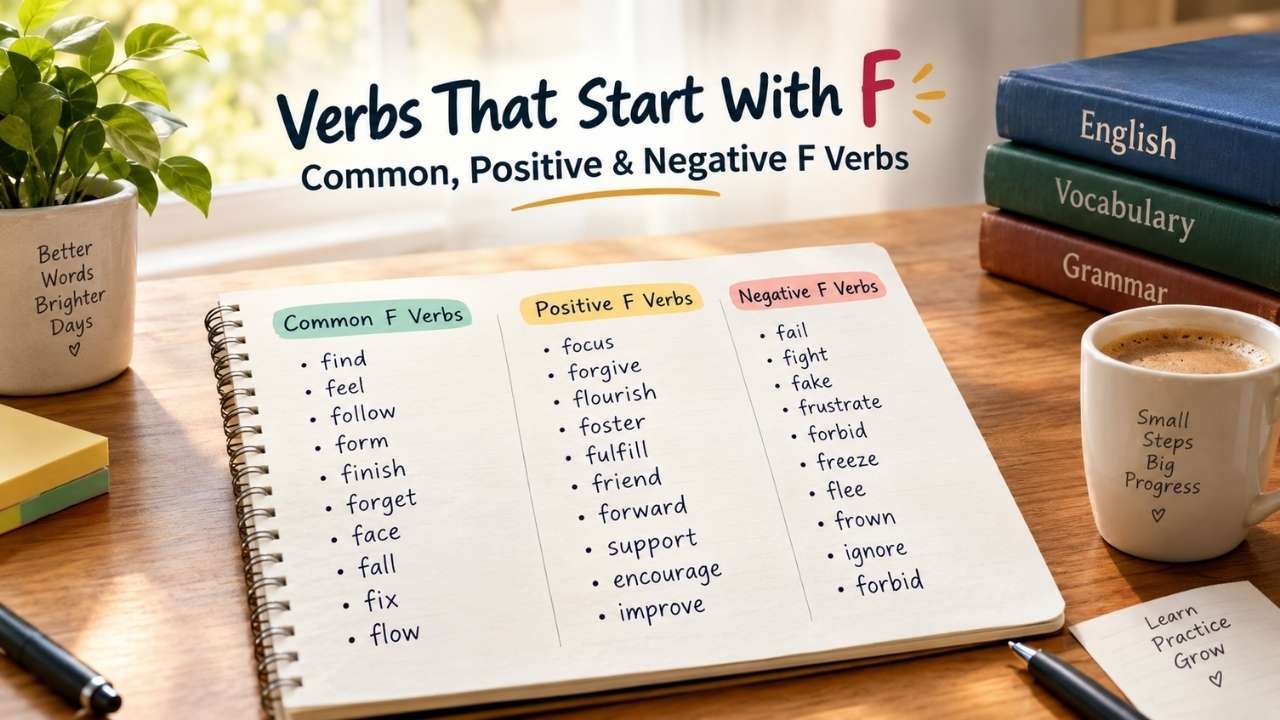
If you’re looking for verbs that start with F, you’ve come to the right place. Whether you’re building your English vocabulary, improving your writing skills, or searching for the perfect action verbs, this guide has everything you need. You’ll find a complete list of F verbs, along with their meanings, example sentences, and practical tips for using them correctly.
We’ve also grouped common verbs that start with F, positive verbs that start with F, powerful verbs that start with F, and easy verbs starting with F into helpful categories, making it simple to find exactly what you need.
Whether you’re a student, teacher, job seeker, writer, or English learner, this guide will help you discover useful English verbs beginning with F and use them naturally in everyday conversations, schoolwork, and professional writing.
Quick Answer
Verbs that start with F are action words beginning with the letter F that describe actions, events, or states of being. Common examples include find, follow, finish, fix, fight, fold, and forgive. This guide provides a complete list of F verbs with meanings, example sentences, and categorized sections featuring positive, powerful, and common verbs that start with F to expand your English vocabulary and improve your writing.
What Are Verbs That Start With F?
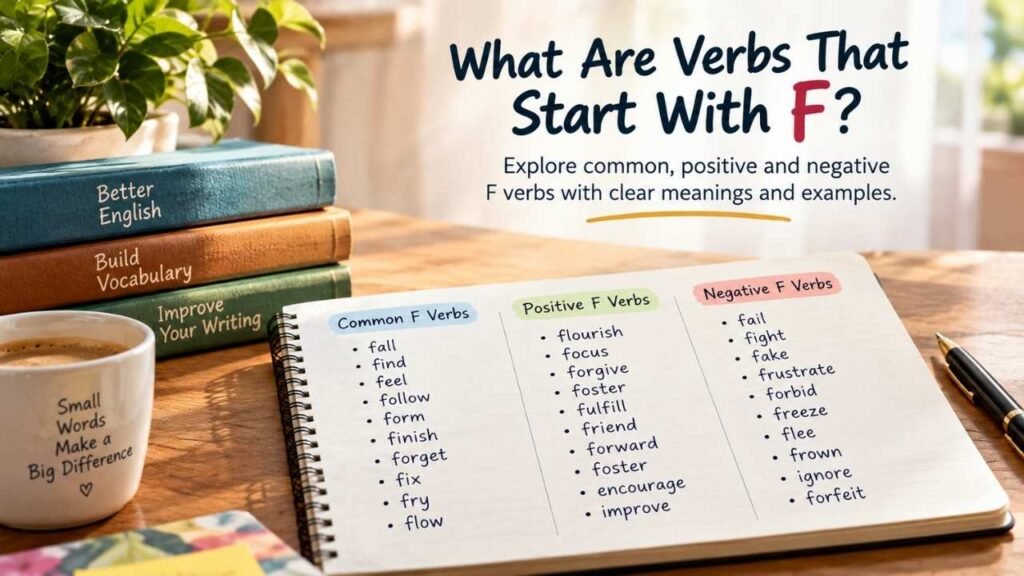
Verbs that start with F are action words that begin with the letter F and describe what someone or something does, feels, or experiences. They play an important role in English grammar because they help form clear and meaningful sentences.
Common English verbs beginning with F include find, follow, fix, finish, fold, and forgive. These common verbs that start with F appear in everyday conversations, school assignments, and workplace communication.
Learning these F verbs can improve your English vocabulary, make your writing more interesting, and help you speak with confidence. If you enjoy expanding your vocabulary, you may also like our guide on Vagrant vs Hobo, which explains another commonly confused pair of English words in a simple way.
Complete List of Verbs That Start With F
A complete list of verbs that start with F makes it easier to discover new vocabulary and quickly find the right word for speaking or writing. Some of the most useful verbs beginning with F include face, fade, fail, fall, fasten, favor, fear, feed, feel, fetch, fight, fill, filter, finance, find, finish, fish, fit, fix, flash, flee, float, flourish, flow, fold, follow, fool, force, forgive, form, found, frame, free, freeze, frighten, fry, and function.
These English verbs cover everyday actions, emotions, work, education, and creative writing. As you continue reading, you’ll also discover positive verbs that start with F, action verbs that start with F, and powerful verbs that start with F with meanings and examples.
Common Verbs That Start With F Used in Everyday English
Many common verbs that start with F are used every day in conversations, emails, and schoolwork. Words like find, follow, finish, fix, feel, and forget help describe daily actions and experiences clearly.
For example, you can say, “I found my keys,” or “Please follow the instructions carefully.” These F verbs are simple but useful because they fit many situations. Learning them improves your English vocabulary and makes your writing sound more natural.
If you enjoy learning the meanings behind everyday expressions, don’t miss our article on Counting Your Days Meaning, where we explain the phrase with examples and modern usage. Building vocabulary through both verbs and idioms helps you become a more confident English speaker and writer.
Positive Verbs That Start With F
Positive verbs that start with F help express encouragement, kindness, success, and personal growth. These words are useful in conversations, professional writing, motivational content, and everyday communication.
Examples include forgive, flourish, focus, free, favor, foster, friend, and fulfill. You might say, “We should forgive others,” or “Good habits help people flourish.” Using these powerful verbs that start with F creates a more uplifting and engaging message. They are also valuable for speeches, personal statements, and social media posts.
By adding these English verbs beginning with F to your vocabulary, you can express positive ideas more naturally while improving your communication and writing skills.
Action Verbs That Start With F
Action verbs that start with F describe physical or mental activities that people perform. They make sentences more lively and help readers picture what is happening. Popular F verbs include fight, fetch, flip, fly, fold, fire, float, follow, fix, and face. For example, “The birds fly south every winter,” and “She folded the clothes neatly.”
These action verbs are useful in stories, essays, emails, and everyday conversations because they add movement and clarity. Learning common verbs starting with F also strengthens your English vocabulary and helps you choose more precise words instead of repeating the same verbs in your writing.
Powerful Verbs That Start With F for Strong Writing
Using powerful verbs that start with F can make your writing more interesting and engaging. Instead of choosing simple words repeatedly, you can use stronger English verbs beginning with F to express ideas clearly. Great examples include forge, flourish, fuel, formulate, fortify, fulfill, frame, and foster.
For instance, instead of saying, “The team made a plan,” you can write, “The team formulated a plan.” These strong verbs are excellent for essays, blogs, business writing, and creative stories because they add meaning without making sentences difficult to read.
Learning these verbs that start with F with meanings helps you improve both your vocabulary and overall writing style while making your message more memorable.
Verbs That Start With F for Kids and Students
Learning verbs that start with F for kids is a fun way to build a strong vocabulary from an early age. Many easy verbs that start with F are simple to understand and use in daily life. Examples include find, feed, fold, fix, fall, fasten, fill, fetch, and follow. Children can practice these common F verbs by reading short stories, writing sentences, or playing vocabulary games.
Students can also improve their English vocabulary by learning the meaning of each word and using it in class activities. These verbs beginning with F for students make reading, writing, and speaking easier while helping learners communicate with greater confidence every day.
Business and Resume Verbs That Start With F
Strong business and resume verbs that start with F help describe your achievements in a professional way. Instead of using basic words, choose action-focused F verbs that highlight your skills and experience.
Useful examples include facilitated, finalized, founded, formulated, fostered, forecasted, financed, fulfilled, and focused. You could write, “Facilitated team meetings” or “Formulated new marketing strategies” on your resume to show leadership and responsibility.
These action verbs that start with F make job applications sound more confident and professional. They also improve business reports, emails, and presentations by making your writing clear, direct, and results-oriented while expanding your professional vocabulary.
Verb Forms of Common F Verbs
Understanding verb forms helps you use verbs that start with F correctly in different tenses. Most verbs have four common forms: the base form, past tense, past participle, and present participle.
For example, find becomes found, found, and finding. Follow changes to followed, followed, and following, while fix becomes fixed, fixed, and fixing. Learning these forms improves your grammar and helps you write complete, accurate sentences.
Whether you are writing emails, school assignments, or stories, knowing the correct form of English verbs beginning with F makes your communication smoother and more natural.
Tips for Learning and Remembering F Verbs Faster
The best way to remember verbs that start with F is to practice them regularly in different situations. Start by learning a few common verbs starting with F each day instead of trying to memorize a long list at once.
Write short sentences, read English articles, and use the verbs in conversations whenever possible. Grouping positive verbs that start with F, action verbs, and powerful verbs into separate categories also makes them easier to remember. Flashcards, vocabulary notebooks, and word games are excellent learning tools.
Reviewing the words every few days will strengthen your memory and help you use these English verbs naturally in speaking and writing.
Common Mistakes When Using F Verbs
Even simple F verbs can be used incorrectly if you do not understand their meaning or grammar. One common mistake is confusing similar verbs like find and found. Remember that find is the present form, while found is the past tense and past participle.
Another mistake is using the wrong verb form after helping verbs, such as writing “has find” instead of “has found.” Some learners also confuse flee with fly, even though they have different meanings.
Reading example sentences and practicing regularly will help you avoid these errors. Using verbs that start with F with examples is one of the easiest ways to improve both grammar and vocabulary.
FAQs
What are verbs that start with F?
These are action words that begin with the letter F, such as find, follow, fix, finish, and forgive. They describe actions, events, or states of being.
What are some common verbs that start with F?
Some of the most common F verbs include face, fail, fall, fasten, feed, feel, fetch, fight, fill, find, finish, fix, fold, follow, and forget.
What are positive verbs that start with F?
Positive examples include forgive, flourish, foster, fulfill, favor, free, and focus. These verbs express growth, kindness, success, and encouragement.
Why should I learn verbs that start with F?
Learning English verbs beginning with F expands your vocabulary, improves writing, strengthens speaking skills, and helps you communicate more clearly.
Are these verbs useful for resumes?
Yes. Professional verbs like facilitated, formulated, founded, fulfilled, and fostered help describe achievements and responsibilities effectively.
How can I remember F verbs easily?
Practice a few verbs every day, write example sentences, use flashcards, read regularly, and group verbs into categories like action, positive, and common verbs.
Where can I use F verbs in daily life?
You can use them in conversations, emails, school assignments, creative writing, business communication, presentations, and social media posts.
Conclusion
Learning verbs that start with F is a simple way to strengthen your English vocabulary and improve your writing and speaking skills. From common verbs that start with F like find and follow to positive, action, and powerful verbs, each word helps you communicate more clearly and confidently.
By understanding their meanings, practicing their verb forms, and using them in everyday sentences, you will remember them more easily. Whether you are a student, teacher, writer, job seeker, or English learner, this complete list of F verbs provides valuable vocabulary for every situation.
Keep practicing these English verbs beginning with F, and you’ll notice steady improvement in both your grammar and communication.