
If you’ve ever wondered whether Targeted vs Targetted is the correct spelling, you’re not alone. Many writers, students, and professionals search for the answer because the two words look very similar. The confusion often comes from English spelling rules, especially when adding “-ed” to a verb.
So, which is correct: targetted or targeted? The simple answer is that targeted is the correct spelling, while targetted is considered an incorrect spelling in both British English and American English.
In this guide, you’ll learn the meaning of targeted, why people commonly misspell it, the grammar rule behind its spelling, and how to use it correctly with clear sentence examples. By the end, you’ll know how to spell targeted correctly and avoid this common spelling mistake in your writing.
Quick Answer
Targeted is the correct spelling, while targetted is a common misspelling and is not accepted in standard British or American English. If you’re wondering which is correct: targetted or targeted, always use targeted. It means aimed at a specific person, group, or goal and is the only spelling recognized by major English dictionaries and style guides.
What Does “Targeted” Mean?
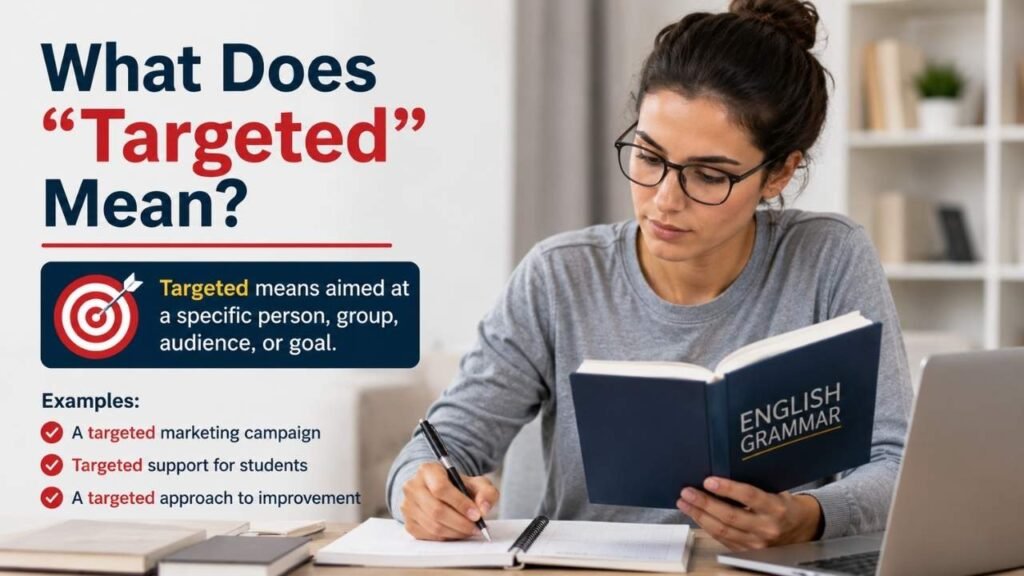
The word targeted means aimed at a specific person, group, place, or goal. It is the correct spelling and is commonly used in business, education, healthcare, technology, and everyday English.
For example, a company may run a targeted marketing campaign to reach a particular audience, while a teacher may provide targeted support to students who need extra help. The word can also describe something that is carefully planned for a specific purpose.
If you are wondering about the targeted meaning, it simply refers to something directed toward a clear objective. Learning the correct spelling of targeted helps you communicate more clearly and avoid common grammar mistakes in your writing.
Is “Targetted” Ever Correct?
Many people ask, “Is targetted correct?” or “Is targetted a real word?” The answer is no. Targetted is a common misspelling and is not accepted in standard British English or American English. Major dictionaries and writing style guides recognize only targeted as the correct form.
The confusion usually happens because some English words double the final consonant before adding “-ed.” However, target does not follow that pattern. If you want to write correctly, always choose targeted instead of targetted. This simple rule will improve your English spelling and make your writing look more professional and trustworthy.
Targetted vs Targeted: Side-by-Side Comparison
Although targetted and targeted look similar, only one is correct. The table below makes the difference easy to understand.
| Feature | Targeted | Targetted |
| Correct spelling | Yes | No |
| Dictionary accepted | Yes | No |
| Used in British English | Yes | No |
| Used in American English | Yes | No |
| Recommended for writing | Always | Never |
If you are searching for targetted vs targeted or which is correct: targetted or targeted, remember that targeted is the only accepted spelling. Using the correct form improves readability and helps you avoid a common spelling mistake.
Why Is “Targeted” Spelled with One “T”?
The spelling of targeted follows a simple English spelling rule. When adding “-ed” to a verb, you only double the final consonant if certain grammar conditions are met. Since target does not meet those conditions, it becomes targeted, not targetted. This is why targeted spelling is accepted in both British English and American English.
Understanding this rule also explains why targeting is correct instead of targetting. Learning these basic grammar rules helps you spell words correctly and avoid repeating the same mistake. If you enjoy learning about confusing word pairs, you may also like our guide on Performed vs Preformed, which explains another commonly mixed-up pair.
Common Reasons People Misspell “Targeted”
Many writers accidentally type targetted because English spelling can sometimes seem confusing. Some people assume that every verb ending with “-ed” needs an extra letter, while others simply write the word the way it sounds.
Similar-looking words also make the mistake more common. In addition, typing quickly or relying on memory instead of checking a dictionary can lead to errors. The good news is that this common spelling mistake is easy to avoid once you know the rule.
Reading more and proofreading your work will improve your English grammar over time. If you enjoy exploring similar language topics, you may also find our article on Emersion vs. Immersion helpful for understanding another frequently confused word pair.
Examples of “Targeted” in Sentences
The best way to remember the correct spelling of targeted is to see it used in real sentences. Here are a few examples:
- The company launched a targeted advertising campaign.
- Doctors provided targeted treatment for the patient.
- The teacher created targeted lessons for struggling students.
- Police carried out a targeted investigation.
- The charity offered targeted support to local families.
- Our marketing team developed a targeted strategy for young customers.
These examples show that targeted is used whenever something is aimed at a specific goal or audience. Practicing with targeted sentence examples will help you remember the correct spelling and use it naturally in your everyday writing.
Targeting vs Targetting: Another Common Confusion
Many people who confuse targetted and targeted also wonder whether targeting or targetting is correct. The correct spelling is targeting, with only one “t.” Just like targeted, the verb target does not double its final consonant when adding “-ing” or “-ed.”
Therefore, targetting is an incorrect spelling in both British English and American English. You should always write targeting when referring to aiming at a specific audience, goal, or object.
For example, “The company is targeting young professionals with its new campaign.” Learning this simple spelling rule helps you avoid common grammar mistakes and write with greater confidence.
Similar Words That Cause the Same Confusion
The confusion between targetted and targeted is not unique. English has many words that make people question whether a letter should be doubled. For example, writers often compare focused vs focussed, benefited vs benefitted, traveled vs travelled, and modeled vs modelled.
Some of these spellings change depending on British English or American English, while others follow a fixed rule. Unlike those examples, targeted remains the standard spelling in both varieties of English. When you are unsure about a word, checking a trusted dictionary is the safest choice. Understanding these patterns improves your English spelling, strengthens your grammar skills, and reduces common spelling mistakes in everyday writing.
How to Remember the Correct Spelling
A simple memory trick can help you remember the correct spelling every time. Think of the base word target. When you add “-ed,” you simply write target + ed = targeted. There is no extra “t.” If you see targetted, remember that it is a misspelling and should be corrected. Another useful tip is to read the word aloud.
You will notice that targeted sounds natural and matches the spelling found in major dictionaries. The more you use the correct form in emails, school assignments, and professional writing, the easier it becomes to remember. Small habits like proofreading can help you avoid this and many other common spelling mistakes.
Common Mistakes to Avoid (120–130 words)
One of the biggest mistakes is believing that targetted is an accepted spelling because it appears online. In reality, it is considered an incorrect spelling in standard English. Another mistake is assuming that every verb ending in “-ed” requires doubling the final consonant.
English spelling rules do not work that way. Writers also confuse targeting with targetting, which follows the same misunderstanding. To avoid these errors, always proofread your work and rely on trusted dictionaries or grammar tools.
Whether you are writing an email, report, essay, or blog post, using targeted correctly makes your writing look more professional and easier for readers to understand.
FAQs
Is targetted a real word?
No. Targetted is a common misspelling and is not the standard form in modern English.
Which is correct: targetted or targeted?
Targeted is the only correct spelling recognized by major dictionaries and style guides.
Why is targeted spelled with one “t”?
The word follows standard English spelling rules, so the final consonant is not doubled before adding “-ed.”
Is targetted used in British English?
No. Both British English and American English use targeted.
Can targeted be used as both a verb and an adjective?
Yes. It can describe an action or something aimed at a specific person, group, or purpose.
Conclusion
The answer is simple: targeted is the correct spelling, while targetted is an incorrect spelling that should be avoided. Whether you are writing for school, work, or online, choosing the correct form helps your writing appear clear, accurate, and professional.
Remember that targeted follows standard English grammar and is accepted in both British English and American English. Understanding the grammar rule, reviewing sentence examples, and using simple memory tricks can help you avoid this common mistake in the future.
Whenever you wonder how to spell targeted correctly, remember this guide and always choose targeted with one “t” before “-ed.”