
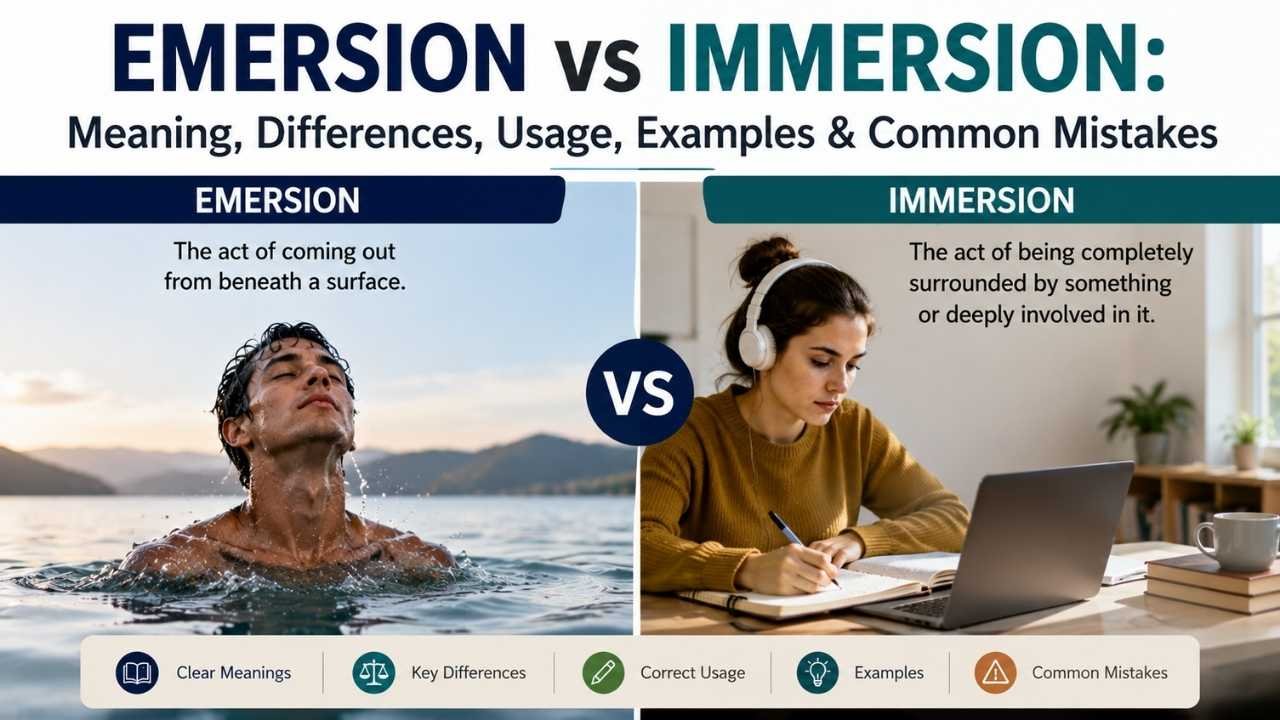
Emersion vs. Immersion is a pair of words that often confuses English learners, writers, and even native speakers because they look and sound similar. However, they have different meanings and are used in different contexts.
While immersion usually refers to being completely involved in an activity, experience, or liquid, emersion means coming out from beneath a surface, especially in science and astronomy. Understanding the difference between emersion and immersion helps you choose the correct word in both everyday and technical writing.
In this guide, you’ll learn the emersion meaning, immersion meaning, key differences, correct usage, pronunciation, and real-world examples. By the end, you’ll know when to use emersion, when to use immersion, and how to avoid one of the most common confusing English words with confidence.
Quick Answer
Emersion and immersion are not interchangeable. Emersion means emerging from or coming out of a surface, especially in science and astronomy. Immersion means being completely surrounded by or deeply involved in something, such as language learning, education, or water.
Although they look alike, understanding the difference between emersion and immersion ensures you use the correct word in every context.
Emersion vs. Immersion at a Glance
Although emersion and immersion look similar, they have opposite meanings and are used in different situations. Understanding the difference between emersion and immersion is the first step toward using them correctly. Emersion means coming out from beneath a surface, while immersion means going into something or becoming completely involved in it.
Immersion is common in language learning, education, travel, and virtual reality, whereas emersion is mainly used in science and astronomy. If you enjoy learning about commonly confused words, you may also find our guide on Performed vs Preformed helpful. The quick comparison below makes it easy to understand emersion vs immersion at a glance.
| Feature | Emersion | Immersion |
| Meaning | Coming out from beneath a surface | Going into or being completely surrounded |
| Direction | Outward movement | Inward movement |
| Common Contexts | Astronomy, marine biology, science | Language learning, education, gaming, travel |
| Everyday Use | Rare | Very common |
| Opposite Idea | Emerging | Deep involvement or submersion |
What Does “Emersion” Mean?
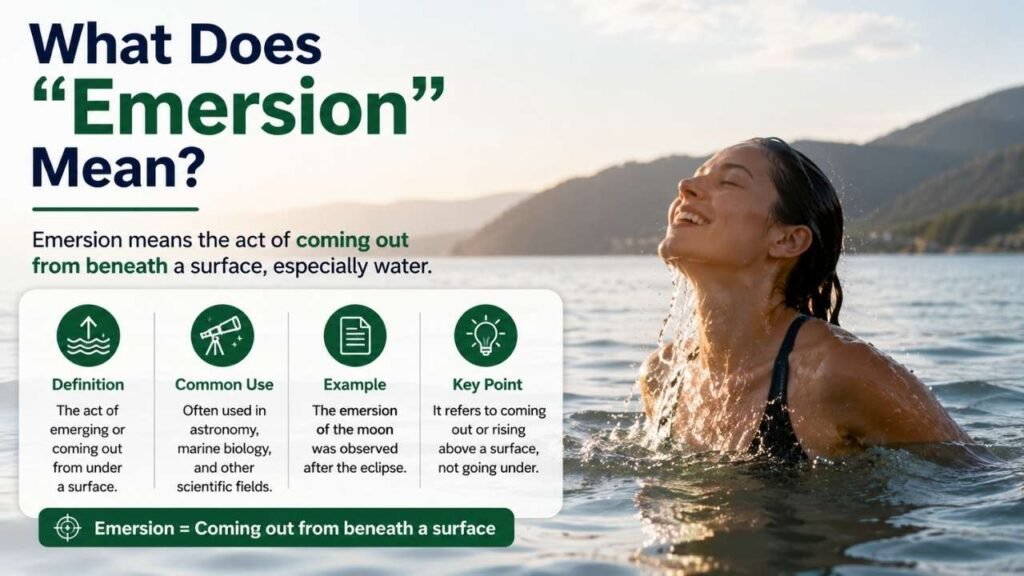
The emersion meaning is the act of coming out from beneath a surface, especially water or another covering. The word is most often found in scientific and technical writing, particularly in astronomy and marine biology.
For example, astronomers use emersion when describing a planet or moon reappearing after being hidden during an eclipse. In biology, it can describe aquatic plants or animals becoming exposed above the water.
Because of its specialized use, emersion is not a word most people hear every day. If you’re wondering when should you use emersion, choose it only when something emerges or rises above a surface. Knowing the correct emersion definition helps you avoid confusing it with immersion.
Definition
Emersion means coming out from beneath a surface, especially water or another object.
Pronunciation
Emersion is pronounced ih-MER-zhən (/ɪˈmɜːrʒən/).
Origin and Etymology
The word comes from the Latin emergere, meaning “to rise out” or “come forth.”
When Is “Emersion” Used?
It is mainly used in astronomy, marine biology, and other scientific fields.
What Does “Immersion” Mean?
The immersion meaning is the state of being completely surrounded by or deeply involved in something. It can describe being underwater, but it is more commonly used for experiences such as language immersion, cultural immersion, education, gaming, and virtual reality. For example, students often learn faster through language immersion because they practice the language every day.
Travelers also experience cultural immersion when they live among local communities and follow local traditions. If you’re unsure which of the following words fits a sentence, think about whether it describes complete involvement or entering something. In those situations, immersion is the correct choice. Understanding the immersion definition makes it much easier to distinguish it from emersion.
Definition
Immersion means being fully covered by something or deeply involved in an activity or experience.
Pronunciation
Immersion is pronounced ih-MER-shən (/ɪˈmɜːrʃən/).
Origin and Etymology
It comes from the Latin immergere, meaning “to dip into” or “plunge into.”
Common Uses of “Immersion”
It is widely used in education, language learning, travel, technology, gaming, and everyday English.
When Should You Use “Immersion”?
Use immersion when talking about being completely surrounded by or deeply involved in something. Unlike emersion, which means coming out of a surface, immersion describes going into or becoming fully engaged in an activity, place, or experience. It is the correct word in contexts such as language learning, education, virtual reality, gaming, travel, and even being underwater.
For example, students improve faster through language immersion because they practice the language every day. Travelers also experience cultural immersion when they live like local people. If you are wondering when should you use immersion, choose it whenever you want to describe complete involvement, deep focus, or being fully covered by a liquid.
Real-Life Examples of Emersion and Immersion
Seeing these words in context makes it much easier to understand the difference between emersion and immersion. Here are a few examples:
- The diver’s emersion from the lake marked the end of the rescue exercise.
- Scientists observed the moon’s emersion after the eclipse.
- The students improved their speaking skills through language immersion.
- Her immersion in the novel made her forget about the time.
- Virtual reality creates a strong sense of immersion for players.
- During the biology lesson, the teacher explained how aquatic plants survive after emersion from water.
These examples show that emersion usually appears in scientific contexts, while immersion is much more common in everyday English, education, travel, and entertainment.
Common Mistakes People Make
Many writers make mistakes because emersion and immersion look and sound alike. The most common error is using emersion when talking about learning a language or becoming deeply involved in an activity. In these situations, immersion is always the correct choice. Another mistake is assuming that emersion is simply a misspelling of immersion.
In reality, emersion is a real English word, but it is mostly used in science and astronomy. To avoid confusion, remember the meaning before choosing the word. If the idea is coming out, use emersion. If it is going into or becoming fully involved, use immersion.
Memory Trick to Remember the Difference
A simple memory trick can help you remember emersion vs. immersion forever. Think of the letter “E” in Emersion as “Exit.” When something exits the water or comes out from beneath a surface, it is an emersion. Now think of the letter “I” in Immersion as “Inside.” When someone goes inside an experience, a language, or even water, they experience immersion.
This easy connection works in most situations and helps prevent common writing mistakes. The next time you need to choose between the two words, simply ask yourself whether something is coming out or going inside. The answer will guide you to the correct word.
Why Is “Immersion” Much More Common Than “Emersion”?
You will see immersion much more often than emersion because it is used in many parts of everyday life. People commonly talk about language immersion, cultural immersion, virtual reality immersion, gaming, education, and even cooking or diving. In contrast, emersion is a specialized term that mainly appears in astronomy, marine biology, and other scientific fields.
Since most people rarely write or speak about these subjects, emersion is used far less often. This difference in modern English usage explains why many learners recognize immersion immediately but have never heard of emersion. Knowing this can help you choose the correct word with greater confidence.
Words Commonly Confused with Emersion and Immersion
Besides emersion and immersion, several other words can cause confusion because they have similar spellings or meanings. Emergence refers to the process of appearing or becoming visible, while submersion means being completely covered by water. The verb emerge means to come out, and immerse means to place something into a liquid or become deeply involved.
Although these words are related, they are not interchangeable. Understanding their meanings will improve your vocabulary and help you write more accurately. Learning these commonly confused words also makes it easier to recognize the correct term in different situations, whether you are reading, writing, or speaking English.
FAQs
Is emersion a real English word?
Yes. Emersion is a real English word, but it is mainly used in science, astronomy, and marine biology to describe something coming out from beneath a surface.
What is the difference between emersion and immersion?
Emersion means coming out, while immersion means going into or becoming completely involved in something.
Can emersion and immersion be used interchangeably?
No. Although they look similar, they have different meanings and are used in different contexts.
Which word is more common in everyday English?
Immersion is far more common because it is widely used in education, travel, technology, and daily conversations.
How can I remember the difference?
Remember E = Exit for Emersion and I = Inside for Immersion.
Conclusion
Understanding emersion vs. immersion is easier once you know their basic meanings. Emersion describes coming out from beneath a surface and is mostly used in scientific contexts, while immersion refers to being completely surrounded by or deeply involved in something and is common in everyday English.
By learning their definitions, pronunciation, examples, and correct usage, you can avoid common mistakes and communicate more clearly.
Whenever you are unsure, remember the simple rule: Emersion = Exit, Immersion = Inside. Keeping this difference in mind will help you choose the right word confidently in both academic and everyday writing.