
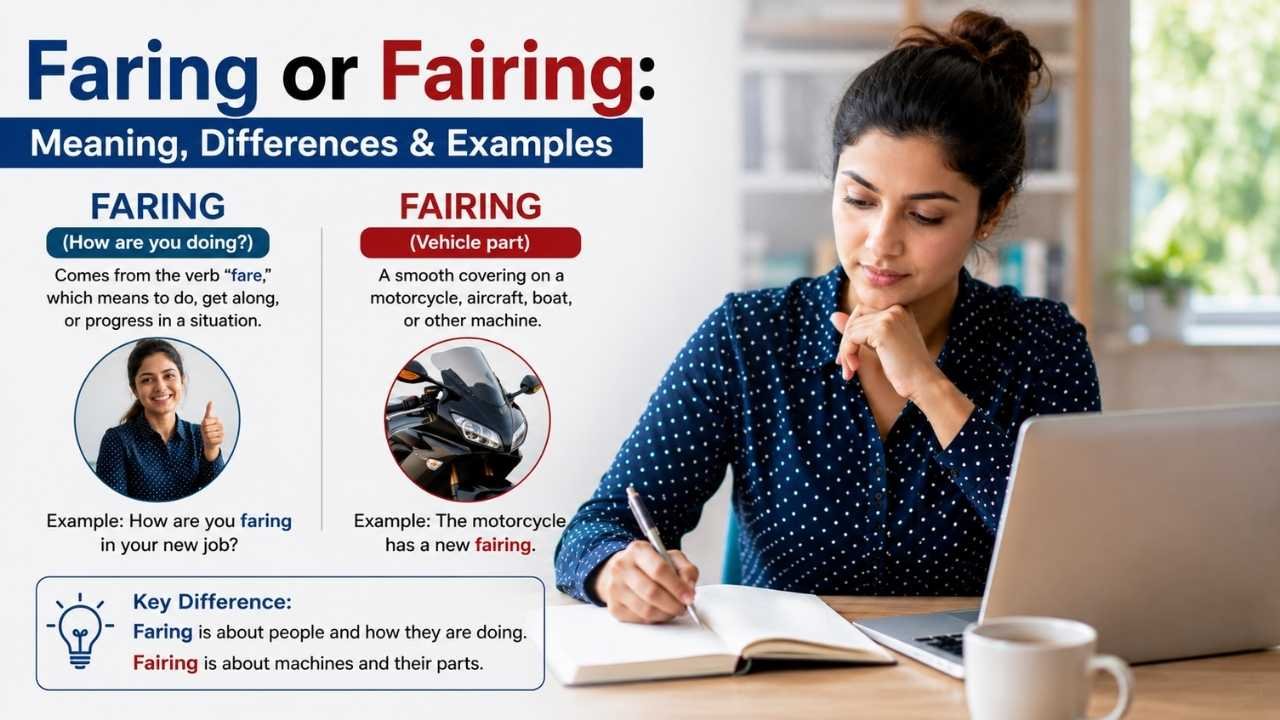
Have you ever typed “How are you fairing?” and wondered if it was actually correct? You’re not alone. Many English learners and native speakers confuse faring and fairing because they sound alike, but they have very different meanings.
Knowing the difference between faring and fairing can help you avoid a common grammar mistake and communicate more clearly. In most everyday conversations, the correct phrase is “How are you faring?” because faring means how someone is doing or getting along. On the other hand, fairing is a technical term often used for motorcycles, aircraft, and boats.
In this guide, you’ll learn faring meaning, fairing meaning, fairing vs. faring, when to use each word, practical example sentences, and simple memory tips to help you choose the correct spelling with confidence.
Quick Answer
“You faring” is usually the correct phrase when asking how someone is doing. The word faring comes from the verb fare, which means to get along, perform, or manage in a situation. For example, “How are you faring?” is grammatically correct. Fairing, however, is a noun that refers to a structure on a motorcycle, aircraft, or boat. In everyday conversation, faring is almost always the right choice.
What Does “Faring” Mean?

Faring comes from the verb fare, which means to do, get along, or progress in a particular situation. When someone asks, “How are you faring?”, they are asking how you are doing or how things are going in your life. This is the correct and natural expression in everyday English. The faring meaning is connected to a person’s condition, success, or well-being rather than a physical object.
You may hear it in conversations about work, school, health, or travel. Understanding what does faring mean helps you avoid a common grammar mistake and choose the correct spelling. If you want to write clear and correct English, remember that faring is the right word when talking about someone’s progress or situation.
What Does “Fairing” Mean?
Unlike faring, fairing has a completely different meaning. A fairing is a smooth covering or structure attached to a motorcycle, aircraft, boat, bicycle, or other machine. Its purpose is to reduce air or water resistance, improve performance, and sometimes protect important parts. This is the fairing meaning used in engineering and transportation.
For example, motorcycle riders often install a motorcycle fairing to improve aerodynamics and shield themselves from the wind. Similarly, an aircraft fairing helps airplanes move through the air more efficiently. Since fairing is a technical noun, it should never replace faring when asking someone how they are doing. Learning this difference makes your English vocabulary stronger and helps you use the correct word in every context.
You Faring or Fairing: What’s the Difference?
The biggest difference between fairing and faring is their meaning and usage. Faring is related to people and their progress, while fairing refers to a mechanical or structural covering. If you are asking about someone’s well-being, the correct question is “How are you faring?” Writing “How are you fairing?” is a common spelling mistake because both words sound alike.
This makes them commonly confused words in English. A simple way to remember this is that faring is connected to the verb fare, while fairing belongs to the world of engineering and vehicles. Knowing fairing vs. faring helps you communicate more confidently and avoid confusing readers with the wrong word.
Side-by-Side Comparison Table: Faring vs. Fairing
Understanding fairing vs. faring becomes much easier when you compare them directly. Both words share the same pronunciation, but they have different meanings, grammar, and uses. Faring is a verb form that describes how someone is doing, while fairing is a noun that names a protective part of a vehicle or machine.
For example, “She is faring well in her new job” is correct because it talks about her progress. In contrast, “The motorcycle has a new fairing” is correct because it refers to a physical component. Looking at examples side by side helps you remember the correct usage, improve your English grammar, and avoid one of the most common confusing word pairs.
| Feature | Faring | Fairing |
| Meaning | Doing or getting along | Protective covering on a machine |
| Part of Speech | Verb | Noun |
| Used For | People or situations | Motorcycles, aircraft, boats, bicycles |
| Example | How are you faring? | The motorcycle needs a new fairing. |
Why “How Are You Faring?” Is Correct
The phrase “How are you faring?” is correct because faring means how someone is doing or managing. It comes from the verb fare, which has been used in English for centuries. When you ask this question, you are showing concern about another person’s well-being, progress, or situation. Although many people mistakenly write “How are you fairing?”, that version is incorrect because fairing refers only to a mechanical part.
If you have ever wondered which is correct, faring or fairing, the answer is simple—use faring whenever you are talking about a person. If you enjoy learning about confusing grammar pairs, you may also like our guide on Performed vs Preformed, which explains another commonly mixed-up word pair.
When Is “Fairing” the Right Word to Use?
You should use fairing only when talking about a protective covering or streamlined structure on a vehicle or machine. It is commonly used in engineering, aviation, cycling, and motorcycling. For example, a motorcycle fairing helps reduce wind resistance, while an aircraft fairing improves the airplane’s aerodynamics.
Since fairing is a technical term, it has nothing to do with asking how someone feels or how they are progressing. If you are unsure which of the following words is correct in a sentence, think about the context.
Is the sentence about a person or about a machine? This simple question will help you choose the correct word every time. For more grammar tips, see our article on Which of the Following to understand another commonly misunderstood English expression.
Example Sentences Using Faring and Fairing
Looking at example sentences is one of the easiest ways to understand the difference between fairing and faring. Here are a few examples. Faring: How are you faring after your new job? The students are faring well in their exams. Our team is faring much better this season. In each sentence, faring means doing or getting along. Now look at fairing: The motorcycle has a new fairing.
The aircraft fairing reduces air resistance. The damaged fairing was replaced before the race. Here, fairing refers to a physical part of a machine. These examples show that the correct usage depends entirely on the meaning of your sentence, not just the pronunciation of the word.
Why People Commonly Confuse Faring and Fairing
Many people confuse faring and fairing because they are homophones, meaning they sound the same but have different meanings and spellings. When speaking, you cannot hear the difference, so many writers choose the wrong word without realizing it. Another reason is that fair is a familiar English word, making fairing seem like the correct spelling.
However, when you ask about someone’s well-being, faring is always the right choice. Learning the faring meaning and fairing meaning separately makes the difference much easier to remember. Reading more, paying attention to context, and checking your writing can help you avoid this common grammar mistake and improve your English vocabulary over time.
How to Remember the Difference (Memory Tricks)
A simple memory trick can help you remember fairing vs. faring forever. Think of faring as being connected to the verb fare, which means to do or get along. Whenever you ask about a person’s progress, health, or success, choose faring.
For fairing, remember the word fairing contains air, which can remind you of aircraft and other vehicles that use a fairing for better aerodynamics. This connection makes it easier to pick the correct word without stopping to think. You can also ask yourself one quick question: Am I talking about a person or a machine? If it’s a person, use faring. If it’s a machine, use fairing.
Common Grammar Mistakes to Avoid
One of the most common grammar mistakes is writing “How are you fairing?” instead of “How are you faring?” This happens because both words sound alike, but they have different meanings. Another mistake is using fairing in emails, messages, or professional writing when asking about someone’s condition.
Before you finish writing, read the sentence again and check the context. If the sentence is about how someone is doing, the correct spelling is faring. If it describes a motorcycle, aircraft, boat, or bicycle part, then fairing is correct. Paying attention to these small details will improve your English grammar, make your writing more professional, and help you avoid confusing your readers.
Pronunciation Guide: Faring vs. Fairing
The pronunciation of faring and fairing is exactly the same, which is why they are often confused. Both words are commonly pronounced as /ˈfer.ɪŋ/ in standard English. Since you cannot tell them apart by sound, the context of the sentence becomes very important. When someone says, “How are you faring?”, they are asking about your well-being, not talking about a motorcycle or airplane.
Likewise, if a mechanic mentions a fairing, they are referring to a part of a vehicle. Understanding the pronunciation along with the meaning helps you choose the correct spelling every time. Always focus on what the sentence is describing instead of how the word sounds.
FAQs
Is it “How are you faring?” or “How are you fairing?”
The correct phrase is “How are you faring?” because faring means doing, getting along, or progressing. Fairing is a technical term used for a protective covering on vehicles or machines.
What does “faring” mean?
Faring comes from the verb fare, which means to do, manage, or get along. It is commonly used when talking about someone’s well-being, progress, or current situation.
What does “fairing” mean?
A fairing is a smooth covering found on a motorcycle, aircraft, boat, bicycle, or other machine. It helps improve aerodynamics or protects certain mechanical parts.
Why do people confuse “faring” and “fairing”?
People often confuse these words because they are homophones. They sound exactly the same but have different spellings and meanings, making them a common source of grammar and spelling mistakes.
Can I use “fairing” when asking someone how they are doing?
No. If you are asking about someone’s condition or progress, you should always use faring. Writing “How are you fairing?” is incorrect in standard English.
How can I remember the difference between faring and fairing?
A simple trick is to remember that faring is about people and progress, while fairing is about machines and vehicles. If you’re talking about a person’s well-being, choose faring.
Is “faring” a verb or a noun?
Faring is the present participle of the verb fare. It describes how someone or something is doing, such as “She is faring well.”
Is “fairing” a verb or a noun?
Fairing is usually used as a noun. It refers to a structural covering that improves the performance or appearance of vehicles, especially motorcycles and aircraft.
Can “faring” and “fairing” be used interchangeably?
No. These words have completely different meanings. Faring relates to a person’s progress or well-being, while fairing refers to a mechanical component. They should never be used interchangeably.
What is the easiest way to choose the correct word?
Ask yourself what the sentence is about. If it is about how someone is doing, use faring. If it is about a motorcycle, aircraft, boat, or another machine, use fairing.
Quick Practice Quiz: Can You Choose the Correct Word?
Let’s test your understanding. 1. “How are you ______ after moving to a new city?” The correct answer is faring because it asks about someone’s progress. 2. “The mechanic replaced the damaged ______ on the motorcycle.” The correct answer is fairing because it refers to a machine part. 3. “Our business is ______ much better this year.” The answer is faring because it describes progress. 4. “The airplane’s ______ improves its aerodynamics.” The answer is fairing because it is a structural covering. If you answered all four correctly, you now understand the correct usage of these commonly confused words and can avoid this spelling mistake with confidence.
Conclusion
If you are still wondering which is correct, faring or fairing, remember one simple rule. Use faring whenever you are talking about how someone is doing, progressing, or getting along. Use fairing only when referring to a protective covering on a motorcycle, aircraft, boat, or similar machine.
Although the words sound the same, their meanings are completely different. Keeping this rule in mind will help you avoid common spelling mistakes, improve your English grammar, and write with greater confidence.
Whenever you pause to choose between these words, think about the context first. That one habit will help you select the correct word every time.