
Have you ever wondered whether you should say “what kind of” or “what kinds of”? Although these two expressions look very similar, they are not always used in the same way. Knowing the difference between “what kind of vs what kinds of” can help you write and speak more naturally in English grammar.
The choice usually depends on whether you are talking about one category or multiple categories, as well as whether the noun is singular or plural. Many English learners make mistakes with these phrases because the grammar rule seems confusing at first. In this guide, you’ll learn when to use “what kind of”, when to use “what kinds of”, and how to avoid common grammar mistakes.
You’ll also find easy explanations, comparison tables, and practical sentence examples to help you use both expressions with confidence in everyday English.
Quick Answer
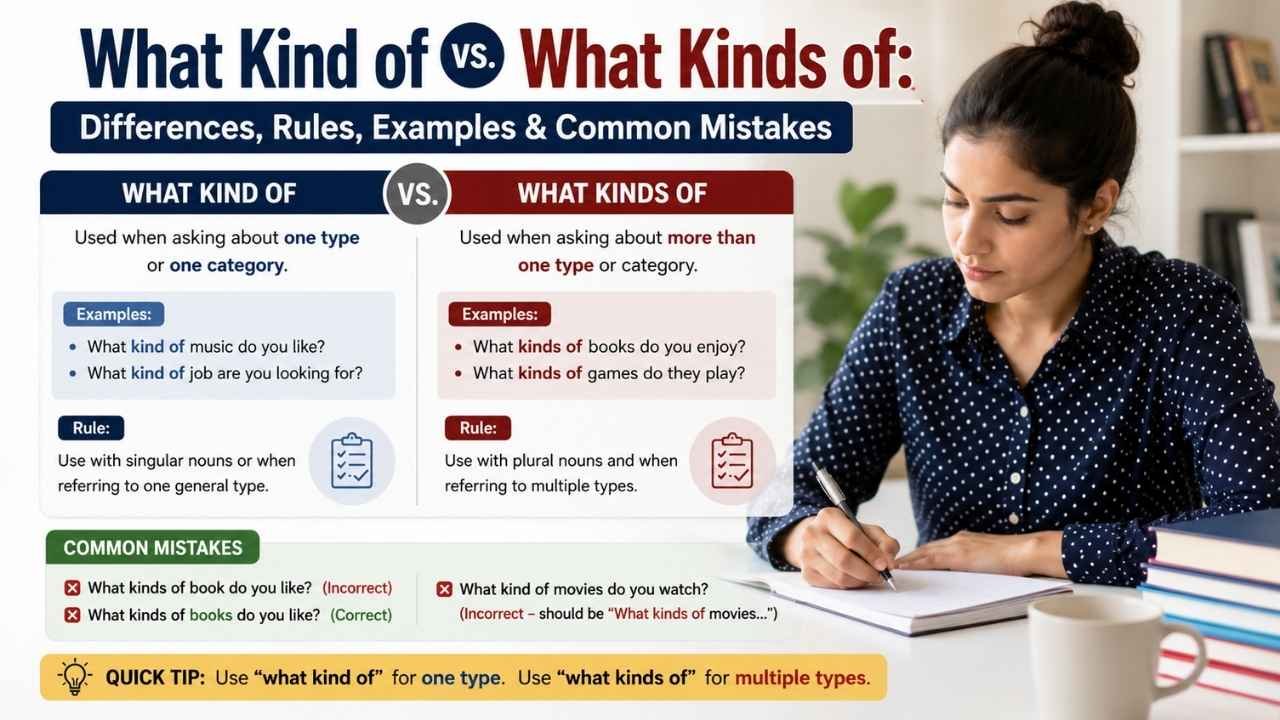
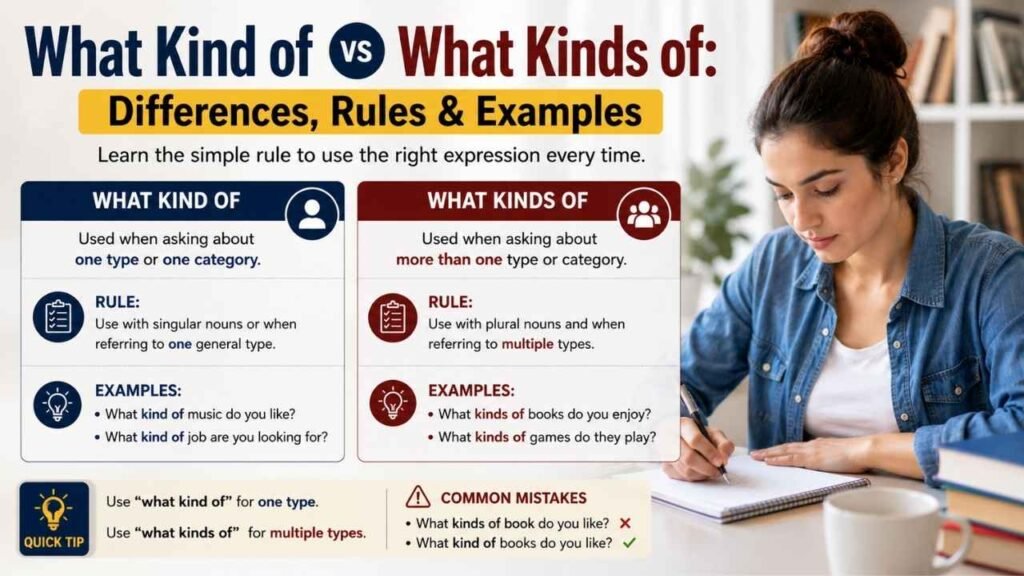
The main difference between “what kind of” and “what kinds of” is whether you are asking about one category or more than one category. Use “what kind of” when you want to know about a single type or category. Use “what kinds of” when you are asking about several types or groups. This simple English grammar rule helps you choose the correct expression in different situations.
For example, you can ask, “What kind of music do you like?” because you are talking about one category. If you want to ask about different categories, you can say, “What kinds of books do you enjoy?” Learning this rule will help you avoid common grammar mistakes and make your English sound more natural.
Understanding the Meaning of “Kind” and “Kinds”
To understand these expressions, you first need to know the meaning of “kind” and “kinds.” A kind means one type, group, or category of something. Kinds is simply the plural form, which means more than one type or category. This is why the noun that follows often helps you decide which expression to use.
For example, “What kind of fruit do you eat?” asks about one category of food. On the other hand, “What kinds of fruits are available?” asks about several categories. In fact, native English speakers use these phrases every day without thinking much about the rule. Once you understand this idea, choosing the correct expression becomes much easier.
When to Use “What Kind of”
Use “what kind of” when you are asking about one type, one category, or one group of something. It is commonly followed by a singular noun, although it can sometimes appear before a plural noun when the focus is still on one general category.
For example, you can ask, “What kind of movie do you want to watch?” or “What kind of job are you looking for?” These questions ask someone to describe one general type rather than list several different ones.
When to Use “What Kinds of”
Use “what kinds of” when you are asking about multiple types, different categories, or several groups of something. This expression usually comes before a plural noun because the speaker wants more than one possible answer.
For example, you can ask, “What kinds of games do children enjoy?” or “What kinds of animals live in this forest?” These questions invite people to mention several examples instead of just one.
Using the plural form makes your meaning clear and helps you follow the correct English grammar rule. When you remember that “kinds” refers to more than one category, it becomes much easier to choose the right expression in everyday conversations and writing.
Singular vs. Plural Nouns: The Rule Explained
The easiest way to choose between “what kind of” and “what kinds of” is to look at the noun and your meaning. If you are asking about one category, use “what kind of.” If you are asking about several categories, use “what kinds of.” This rule is based on the difference between singular and plural nouns.
For example, “What kind of phone do you use?” asks about one type of phone. However, “What kinds of phones are popular today?” asks about different types. Paying attention to the noun and the number of categories will help you avoid mistakes and improve both your speaking and writing in everyday English.
“What Kind of” vs. “What Kinds of”: Side-by-Side Comparison
Although these expressions look almost the same, they are used in different situations. “What kind of” is best when you want one general answer or one category. “What kinds of” is the better choice when you expect several answers or different categories.
For example, “What kind of tea do you prefer?” asks about one type, while “What kinds of tea do you drink?” invites several answers, such as green tea, black tea, or herbal tea.
Remember that the choice depends on your meaning, not only on the noun. Thinking about whether you expect one type or many types is the easiest way to select the correct expression and sound more natural in English.
Common Mistakes Learners Make
Many English learners make small mistakes when using “what kind of” and “what kinds of.” One common mistake is using “what kinds of” when only one category is needed. Another mistake is using “what kind of” when asking about several different categories.
For example, “What kinds of book do you like?” is incorrect because “kinds” should be followed by a plural noun. The correct sentence is “What kinds of books do you like?” Likewise, if you ask about one category, “What kind of sport do you play?” is the better choice.
Before speaking or writing, think about whether you expect one type or many types. This simple habit can help you avoid common grammar mistakes.
Real-Life Examples in Everyday English
These expressions are common in daily conversations, school, work, and even online discussions. You might ask, “What kind of coffee do you drink?” when talking to a friend. A teacher may ask, “What kinds of books do you enjoy reading?” to learn about students’ interests.
At work, someone may ask, “What kind of experience do you have?” during a job interview. If you are shopping, you could ask, “What kinds of shoes do you sell?”
These examples show that both expressions are useful in different situations. The key is to think about whether you are asking about one category or several categories before choosing the correct phrase.
“What Kind of” vs. “What Type of” vs. “What Sort of”
The expressions “what kind of,” “what type of,” and “what sort of” have very similar meanings. In most situations, they can be used in the same way. “What kind of” is the most common choice in everyday English and sounds natural in both speaking and writing.
“What type of” is often used in formal, academic, or technical situations because it sounds more specific. “What sort of” is also correct but is more common in British English and casual conversations. No matter which expression you choose, remember to match it with the correct singular or plural form based on the number of categories you are asking about.
How Native English Speakers Naturally Use These Expressions
Native English speakers usually choose these expressions without thinking about grammar rules. They naturally say “What kind of music do you like?” when asking about one general category. If they want several answers, they say “What kinds of movies do you watch?” In everyday conversations, people focus on the meaning rather than the rule itself.
Listening to English podcasts, watching videos, or reading books can help you notice these natural patterns. The more examples you hear, the easier it becomes to use the correct expression. Instead of memorizing many rules, pay attention to how native speakers ask questions in real-life situations and try to copy those patterns.
Corpus-Based Usage Examples
Looking at real English usage shows that both expressions appear very often, but they are used for different purposes. “What kind of” is commonly followed by words like person, music, food, car, and job because people often ask about one general category. “What kinds of” is frequently used with books, animals, games, plants, and questions because these words usually involve several categories.
These common word combinations make English sound more natural. Instead of creating unusual sentences, try using expressions that people already use every day. Reading articles, newspapers, and books can help you become familiar with these natural patterns and improve your English over time.
Easy Decision Tree: Which One Should You Use?
Choosing the correct expression is simple if you follow a few easy steps. First, ask yourself if you are talking about one category or more than one category. If the answer is one category, use “what kind of.” If you want to know about different categories, use “what kinds of.” Next, check the noun that follows.
A singular noun usually goes with “what kind of,” while a plural noun often goes with “what kinds of.” Finally, read the sentence again to see if it sounds natural. With a little practice, this quick method will help you choose the right expression with confidence every time.
FAQs
What is the difference between “what kind of” and “what kinds of”?
The main difference is the number of categories you are asking about. Use “what kind of” when referring to one type or category. Use “what kinds of” when asking about multiple types or categories. The choice depends on the meaning of your sentence.
When should I use “what kind of”?
Use “what kind of” when you want to ask about a single type or general category. For example, “What kind of music do you enjoy?” asks about one broad category rather than several different ones.
When should I use “what kinds of”?
Use “what kinds of” when you expect more than one answer or want to know about different categories. For example, “What kinds of books do you read?” invites someone to mention several types of books.
Is “what kind of books” grammatically correct?
Yes, it can be correct if you are asking about one general category of books. However, if you want to know about several categories, “what kinds of books” is usually the better and more natural choice.
Is “what kinds of book” correct?
No. Since “kinds” is plural, it should be followed by a plural noun. The correct sentence is “What kinds of books do you like?” This follows the standard rule of singular and plural noun agreement.
Can “what kind of” be used before a plural noun?
Yes, sometimes it can. For example, “What kind of books do you enjoy?” is acceptable when you are asking about one general category of books instead of several different categories. The meaning of the sentence determines the correct choice.
What is the difference between “what kind of” and “what type of”?
Both expressions have similar meanings and are often interchangeable. However, “what type of” is more common in formal or technical writing, while “what kind of” is the preferred choice in everyday English conversations.
Is “what sort of” the same as “what kind of”?
Yes, “what sort of” has nearly the same meaning as “what kind of.” The difference is mainly in style. “What sort of” is slightly more common in British English, while “what kind of” is widely used in both American and British English.
How can I remember the rule easily?
A simple trick is to count the categories. If you are asking about one category, choose “what kind of.” If you are asking about many categories, choose “what kinds of.” This quick method works in most everyday situations.
Why do English learners confuse these expressions?
Many learners focus only on whether the noun is singular or plural. In reality, you should also think about how many categories you are asking about. Understanding both the grammar rule and the meaning makes it much easier to use these expressions correctly.
Conclusion
The difference between “what kind of” and “what kinds of” is simple once you understand the basic rule. Use “what kind of” when asking about one type or one category. Use “what kinds of” when asking about multiple types or different categories. Always think about your meaning before choosing the expression.
Reading, listening, and practicing with real examples will help you use both phrases naturally. Do not worry if you make mistakes at first because every learner improves with practice. By following these easy grammar rules and paying attention to singular and plural nouns, you can speak and write more confidently and communicate clearly in everyday English.