

Choosing between Copys or Copies may seem like a small spelling issue, but using the correct form can make your writing look more professional and accurate. If you’ve ever wondered is copys a word, what is the plural of copy, or why “copies” is correct, you’re not alone.
Many English learners and native speakers search for the right grammar rule because words ending in -y can be confusing. In this guide, you’ll discover the correct spelling, learn the simple English grammar behind the plural of copy, and see plenty of copies examples in everyday sentences.
We’ll also explain copy as a noun and copy as a verb, highlight common grammar mistakes, and share an easy trick to remember the rule so you can write with confidence every time.
Quick Answer
“Copies” is the correct plural of copy, while “copys” is incorrect. According to the English grammar rule for words ending in -y, when a consonant comes before -y, you change y to ies to form the plural. So, copy → copies. Whether you’re writing about document copies, books, or digital files, always use “copies.”
Why “Copies” Is Correct and “Copys” Is Incorrect
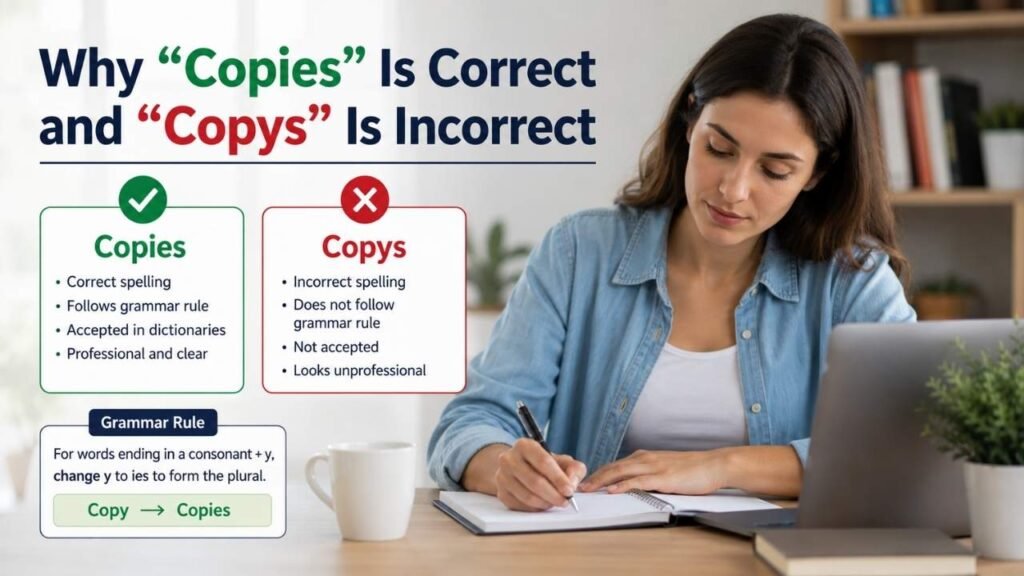
Many people search for Copys or Copies because both spellings may look correct at first glance. However, only copies is the correct spelling. The word copys is not accepted in English grammar or standard dictionaries.
The reason is simple. Copy ends with a consonant (p) followed by the letter y. According to the grammar rule for forming plural nouns, you replace y with ies, making the correct plural of copy copies. Whether you are talking about document copies, books, school papers, or digital files, copies is always the right choice.
If you’ve ever wondered is copys a word, the answer is no. Learning this correct spelling will help you avoid common grammar mistakes and write with greater confidence in everyday and professional communication.
The Grammar Rule for Words Ending in -Y
The grammar rule for words ending in -y is easy to remember once you understand how it works. If a word ends with a consonant + y, change the y to ies to make it plural. This is why copy → copies is correct.
On the other hand, if a word ends with a vowel + y, simply add s, such as toy → toys or key → keys. This simple English spelling rule helps you form the correct plural nouns and avoid mistakes.
Understanding this rule answers questions like how to spell copies, why is copies correct, and copy plural grammar. If you enjoy improving your writing, you may also like our guide on Forever Grateful vs. I’ll Forever Be Grateful, which explains another common English usage question in simple terms.
When to Use “Copy” and When to Use “Copies”
Knowing when to use copy and when to use copies makes your writing much clearer. Use copy when referring to one document, book, file, or printed page. For example, “Please send me one copy of the report.”
Use copies when talking about two or more items. For example, “The teacher handed out twenty copies of the worksheet.” This rule applies in schools, offices, businesses, and daily conversations. Using the correct plural form of copy improves your English grammar and makes your writing more professional.
Whether you need printed copies, digital copies, or document copies, always choose the correct form based on the number you are describing. Following this rule helps you avoid unnecessary spelling errors.
“Copy” as a Noun vs. “Copy” as a Verb
The word copy can be both a noun and a verb, so understanding the difference is important. As a noun, copy means a duplicate of something, such as a report, book, or file. The correct plural is copies.
For example, “Please print three copies of this document.” As a verb, copy means to duplicate or reproduce something. For example, “Please copy this file before editing it.” Knowing whether copy is used as a noun or a verb helps you choose the correct spelling and avoid common grammar mistakes.
If you’re interested in learning about other confusing English words, check out our article on Momma or Mama, where we explain their meanings, usage, and differences with simple examples.
Copys vs. Copies: Side-by-Side Comparison Table
| Feature | Copys | Copies |
| Correct spelling | Incorrect | Correct |
| Accepted in English dictionaries | No | Yes |
| Correct plural of copy | No | Yes |
| Follows the grammar rule | No | Yes |
| Used in formal writing | Never | Always |
| Used in academic writing | Incorrect | Correct |
| Used in business documents | Incorrect | Correct |
| Example | I printed two copys. ❌ | I printed two copies. ✅ |
The comparison above makes the answer clear. Copies is always the correct plural of copy, while copys is a spelling mistake. Remember the simple grammar rule: if a word ends with a consonant + y, change y to ies.
Following this pattern will help you write correctly in school assignments, business documents, emails, and everyday communication.
Real-Life Examples of “Copies” in Sentences
Seeing copies in real sentences is one of the best ways to remember the correct spelling. Here are some everyday examples. School: “The teacher handed out thirty copies of the worksheet.” Office:
“Please print two copies of the contract.” Business: “The manager requested extra copies for the meeting.” Publishing: “The novel sold thousands of copies in its first week.” Digital files: “Keep backup copies of your important documents.” In each sentence, copies refers to more than one item, making it the correct plural of copy.
These copies examples show how the word is used in real life. Practicing with sentences like these helps improve your English grammar and writing confidence.
Common Mistakes People Make with “Copies”
Many writers make simple mistakes when using the plural form of copy. The most common error is writing copys instead of copies. This happens because people add -s without following the grammar rule for words ending in a consonant and -y.
Another mistake is using copy when talking about more than one document, file, or book. Some people also confuse copy as a noun with copy as a verb. To avoid these common grammar mistakes, always think about the number you are describing.
If it is more than one, use copies. A quick grammar check before sending an email, report, or assignment can help you catch these spelling errors.
Exceptions to the “-Y” Plural Rule
Although copy → copies follows the standard rule, not every word ending in -y changes to -ies. The rule depends on the letter before y. If there is a consonant before y, change y to ies, such as baby → babies, city → cities, and story → stories. However, if there is a vowel before y, simply add -s.
Examples include toy → toys, day → days, key → keys, and boy → boys. Understanding these exceptions makes English spelling much easier. Instead of memorizing every word, remember the pattern. This simple trick will help you form correct plural nouns and avoid confusion when writing.
Easy Memory Trick to Remember “Copies”
A simple memory trick can help you remember the correct spelling every time. Think of this rule: “Consonant before Y? Change Y to IES.” Since copy ends with the consonant p before y, it becomes copies. You can also remember this phrase: “Copy changes, toy stays.” This reminds you that copy → copies, but toy → toys because toy has a vowel before y.
Using small memory tricks makes grammar easier and helps you avoid spelling mistakes without looking up the rule each time. With regular practice, choosing copies instead of copys will become natural, whether you’re writing emails, reports, school assignments, or everyday messages.
Similar Grammar Mistakes You Should Avoid
The rule used for copy → copies also applies to many other English words. For example, city → cities, party → parties, lady → ladies, family → families, and country → countries all follow the same pattern because they end with a consonant + y.
On the other hand, words like key → keys, boy → boys, and monkey → monkeys only add -s because they have a vowel before y. Learning these examples strengthens your understanding of English grammar and helps you avoid similar spelling mistakes. Once you understand the rule, you’ll find it much easier to form correct plurals and write with confidence in every situation.
FAQs
Is “copys” a real word?
No. Copys is not a correct English word. The correct plural of copy is copies.
Why is “copies” correct?
Because copy ends with a consonant + y, the grammar rule says to change y to ies.
What is the plural of copy?
The correct plural is copies.
Can “copy” be both a noun and a verb?
Yes. Copy can be a noun (a duplicate) or a verb (to duplicate something).
How can I remember the rule?
Remember this simple tip: Consonant + Y = IES. This makes copy → copies.
Do all words ending in -y change to -ies?
No. Words with a vowel + y, such as toy and key, simply add -s.
Is “copies” used in formal writing?
Yes. Copies is the correct spelling for academic, professional, and everyday writing.
Conclusion
The answer to Copys or Copies is clear: copies is always the correct spelling, while copys is incorrect. By following the simple English grammar rule for words ending in -y, you can avoid common spelling mistakes and write with confidence.
Remember that copy becomes copies because the y follows a consonant. This rule applies in school, business, and everyday writing.
Whether you are printing document copies, sharing digital files, or writing professional emails, using the correct plural form of copy improves your communication. Keep practicing the rule, use the examples in this guide, and you’ll never have to wonder copy vs. copies again.