
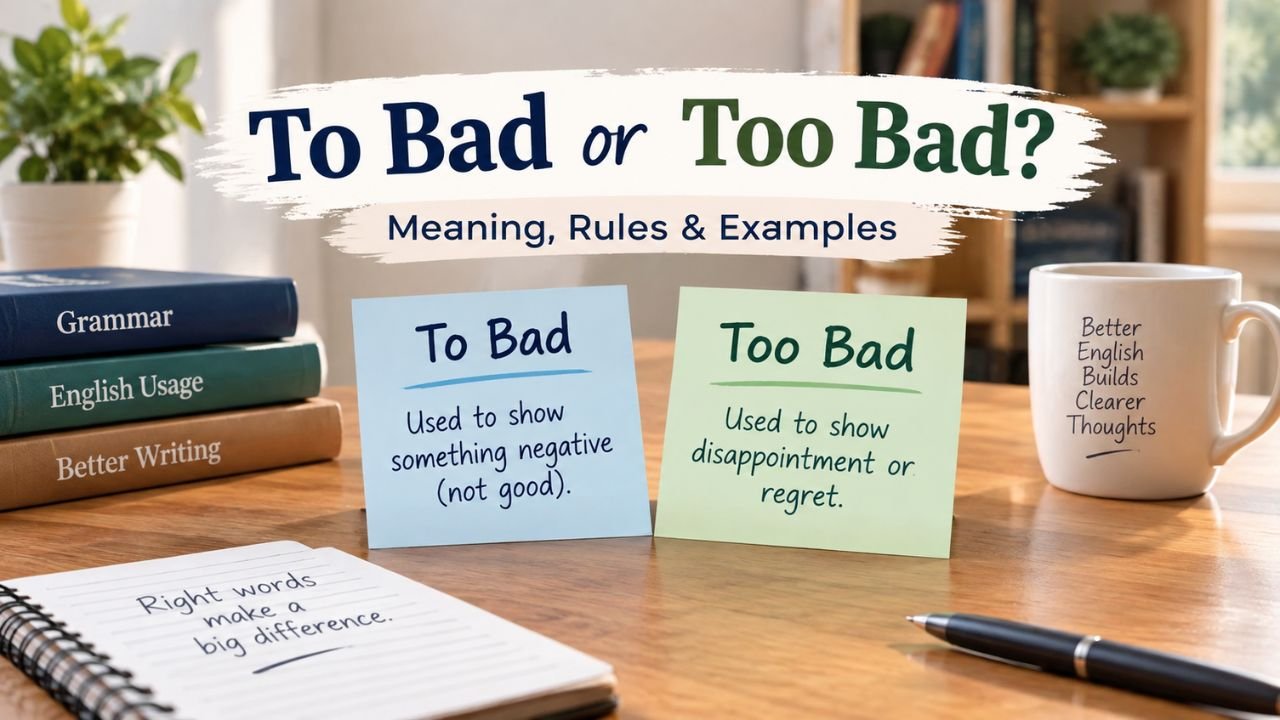
If you’ve ever typed “to bad” instead of “too bad,” you’re not alone. Many English learners and even native speakers confuse these two words because To Bad or Too Bad sound the same.
However, only “too bad” is the correct spelling when you want to express disappointment or say that something is unfortunate. Understanding the difference between to vs too is an important English grammar skill that can improve both your writing and everyday conversations.
In this guide, you’ll learn is it to bad or too bad, why “to bad” is incorrect, the meaning of “too bad,” simple grammar rules, and plenty of real-life examples. You’ll also discover common grammar mistakes, easy memory tricks, and practical tips to help you use “too bad” confidently in any situation.
Quick Answer
“Too bad” is the correct phrase, while “to bad” is a grammar mistake. “Too bad” means unfortunate, sad, or a shame and is commonly used to express disappointment or sympathy. If you’re wondering is it to bad or too bad, always choose “too bad.” Remember, “too” means also or excessively, making “too bad” the correct English expression.
Why “Too Bad” Is Correct and “To Bad” Is Incorrect
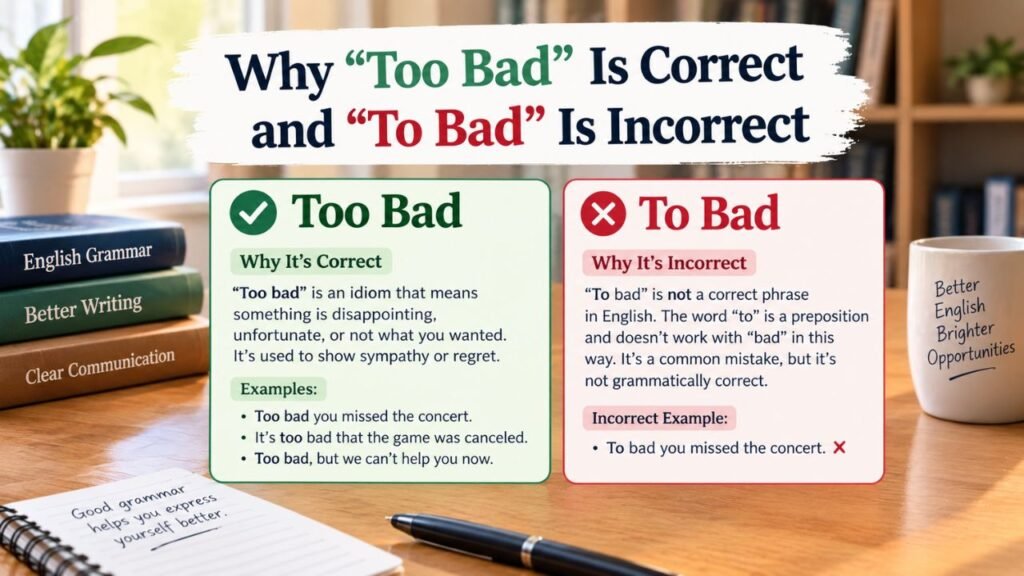
Many people wonder, “Is it to bad or too bad?” The correct phrase is always “too bad.” The phrase “to bad” is not grammatically correct because “to” is a preposition, while “too” is an adverb that can mean “also” or “more than enough.”
In the expression “too bad,” the word “too” helps express that something is unfortunate, disappointing, or a shame. That is why native English speakers use “too bad” in both speaking and writing.
If you accidentally write “to bad,” it is simply a common grammar mistake. Learning this small rule will improve your English grammar and help you avoid one of the most common spelling mistakes in everyday writing.
What Does “Too Bad” Mean?
The phrase “too bad” means something unfortunate, disappointing, or unlucky has happened. People use it to show sympathy, disappointment, or mild regret. For example, if your friend misses a concert, you might say, “That’s too bad.”
Here, you are showing that you feel sorry for the situation. The meaning of “too bad” can change slightly depending on the conversation. Sometimes it sounds caring, while other times it may sound casual or even a little sarcastic.
If you are asking what does “too bad” mean or looking for the too bad meaning in English, remember that it is an everyday English expression used in both spoken and written communication.
The Difference Between “To” and “Too”
Understanding the difference between “to” and “too” makes it much easier to avoid mistakes like “to bad.” The word “to” is mainly used before a noun or a verb, such as “go to school” or “talk to her.”
On the other hand, “too” means also or more than enough, as in “I want to come too” or “The coffee is too hot.” In the phrase “too bad,” the word “too” is always correct because it forms a fixed expression.
If you often confuse to vs too, try reading the sentence aloud and checking its meaning. This simple habit can help you avoid common grammar mistakes in daily writing.
| To | Too |
| Shows direction or purpose | Means also or excessively |
| Preposition | Adverb |
| “Go to work” | “It’s too bad” |
When Should You Use “Too Bad”?
You should use “too bad” whenever you want to express that something is unfortunate, sad, or disappointing. It is common in everyday conversations, text messages, emails, and even social media posts.
For example, if someone says they lost their wallet, you can reply, “That’s too bad.” If a game is canceled because of rain, someone may simply say, “Too bad!” The phrase is natural, friendly, and easy to understand.
However, in formal writing, you may choose alternatives like “unfortunately” or “that is unfortunate.” If you enjoy learning common English expressions, you may also like our guide on My Work Here Is Done, which explains another popular phrase and how people use it naturally.
Examples of “Too Bad” in Sentences
Learning through examples is one of the best ways to remember how to use “too bad” correctly. Here are a few simple sentences:
- It’s too bad you couldn’t join us for dinner.
- That’s too bad. I hope you feel better soon.
- It’s too bad the weather changed so quickly.
- Too bad we missed the last train.
- It’s too bad the tickets were sold out.
Each sentence shows the phrase expressing regret or disappointment. Notice that “too bad” stays the same in every example. If you write “to bad,” the sentence becomes incorrect.
For another common spelling question, read our guide on In Front or Infront, where we explain which form is correct and why.
Easy Memory Trick to Remember “Too Bad”
A simple way to remember “too bad” is to think of the extra “o” in “too.” That extra letter reminds you that “too” often means “also” or “more than enough.” Since “too bad” is a fixed English expression, it always uses “too,” never “to.”
If you ever stop and ask yourself, “Is it to bad or too bad?” just remember the extra “o” means the correct phrase is “too bad.” You can also practice by reading and writing the phrase in different sentences.
The more you use it, the easier it becomes to avoid this common grammar mistake and improve your English writing.
Is “Too Bad” Formal or Informal?
The phrase “too bad” is mostly informal, which makes it perfect for everyday conversations with friends, family, and coworkers. It is often used to express sympathy, disappointment, or regret in a friendly way.
However, in business emails, academic writing, or professional messages, you may want to choose a more formal expression. Instead of saying “too bad,” you can write “unfortunately,” “that is unfortunate,” or “it is regrettable.”
These alternatives sound more professional while keeping the same meaning. Knowing when to use “too bad” helps you communicate naturally and choose the right words for different situations.
Better Alternatives to “Too Bad”
Although “too bad” is common, using different expressions can make your writing and speech more interesting. Here are some useful alternatives:
- Unfortunately
- That’s unfortunate
- What a shame
- That’s disappointing
- I’m sorry to hear that
- That’s regrettable
- How unfortunate
Each phrase expresses disappointment in a slightly different way. For example, “I’m sorry to hear that” sounds caring, while “Unfortunately” works well in formal writing. Choosing the right expression depends on the situation and your audience.
Learning these alternatives also improves your English vocabulary and helps you communicate more naturally in conversations, emails, and professional settings.
Similar Grammar Mistakes Like “To Bad”
The mistake “to bad” is only one of many common English grammar mistakes. Many writers also confuse words that sound alike but have different meanings. Some examples include:
- Your vs. You’re
- Its vs. It’s
- Then vs. Than
- Their vs. There vs. They’re
- Affect vs. Effect
- To vs. Too vs. Two
These errors happen because the words have similar pronunciation. The best way to avoid them is to understand what each word means and practice using it in sentences. Proofreading your work before sending or publishing it can also help you catch these mistakes and improve your grammar and writing skills.
Quick Comparison Table: “To Bad” vs. “Too Bad”
The table below makes it easy to see the difference between the two phrases.
| Feature | To Bad | Too Bad |
| Correct Spelling | ❌ No | ✅ Yes |
| Grammar | Incorrect | Correct |
| Meaning | No meaning | Unfortunate, disappointing, or a shame |
| Used in English? | No | Yes |
| Example | ❌ To bad you missed it. | ✅ Too bad you missed it. |
If you ever wonder which is correct: to bad or too bad, this comparison gives you the answer at a glance. Always choose “too bad” in both speaking and writing.
FAQs
Is it “to bad” or “too bad”?
Too bad is the correct phrase. To bad is a spelling and grammar mistake.
What does “too bad” mean?
It means unfortunate, disappointing, or a shame.
Why is “to bad” incorrect?
Because “to” is a preposition, while “too” is the correct word used in this expression.
Can I use “too bad” in formal writing?
You can, but in formal situations, words like “unfortunately” or “that is unfortunate” are usually better choices.
How can I remember the correct spelling?
Remember the extra “o” in “too.” It reminds you that “too bad” is the correct English expression.
Is “too bad” always negative?
Yes. It is used to express disappointment, sympathy, regret, or that something unfortunate happened.
Can “too bad” sound rude?
Sometimes. Your tone and the situation matter. It can sound caring or sarcastic depending on how you say it.
Conclusion
If you’ve been asking “is it to bad or too bad,” the answer is simple: “too bad” is always the correct phrase. It is a common English expression used to show disappointment, sympathy, or regret, while “to bad” is a grammar mistake with no correct use.
By understanding the difference between to vs. too, practicing with real examples, and using the memory trick in this guide, you’ll avoid this error with confidence.
Whether you’re writing an email, chatting with friends, or improving your English grammar, choosing “too bad” will help your writing sound clear, natural, and correct every time.