

Understanding the difference between Suggest Vs Recommend can improve both your speaking and writing. Although these verbs are often used in similar situations, they do not always have the same meaning or level of strength.
Knowing the difference between suggest and recommend helps you choose the right word in conversations, emails, school assignments, and professional communication. In simple terms, suggest offers an idea or option, while recommend expresses a stronger opinion or endorsement based on experience or judgment.
This grammar guide explains the suggest meaning, recommend meaning, correct verb usage, and common grammar rules with clear examples. You’ll also learn when to use suggest, when to use recommend, common mistakes to avoid, and practical suggest vs recommend examples so you can use both words naturally and confidently in everyday English.
Quick Answer
The main difference between suggest and recommend is the level of confidence behind the advice. Suggest means offering an idea or possible option, while recommend means giving stronger advice based on knowledge, experience, or belief. Understanding Suggest Vs Recommend helps you choose the right word in different situations, improve your English grammar, and communicate more clearly and naturally.
Suggest Vs Recommend: Comparison Table
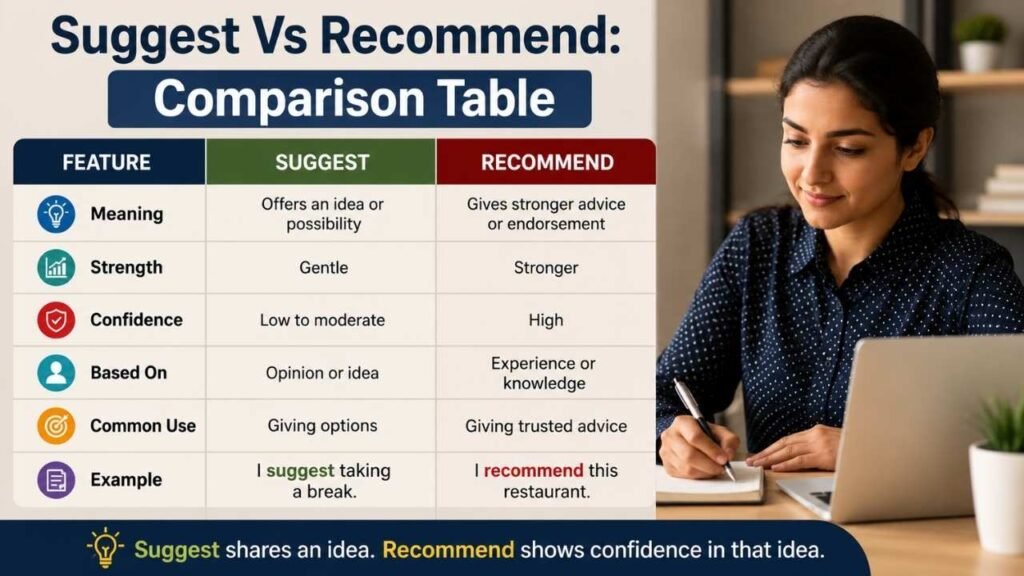
Understanding Suggest Vs Recommend becomes much easier when you compare them side by side. Although both verbs involve giving advice or ideas, they are used in different situations. Suggest usually means offering an idea or possible option without expecting someone to follow it.
Recommend, on the other hand, shows stronger confidence because it is often based on personal experience, knowledge, or trust. This difference between suggest and recommend is important in English grammar, professional writing, and daily conversations.
The table below helps you see the recommend vs suggest comparison clearly, making it easier to choose the right word. Learning these grammar rules and verb usage will improve your communication and help you avoid common mistakes.
| Feature | Suggest | Recommend |
| Meaning | Offers an idea or possibility | Gives stronger advice or endorsement |
| Strength | Gentle | Stronger |
| Confidence | Low to moderate | High |
| Based On | Opinion or idea | Experience or knowledge |
| Common Use | Giving options | Giving trusted advice |
| Example | I suggest taking a break. | I recommend this restaurant. |
What Does “Suggest” Mean?
The suggest meaning is to offer an idea, plan, or possible solution for someone to think about. It does not force anyone to accept the idea, making it a softer way to give advice. You can use suggest when sharing opinions, making plans, or offering helpful ideas in everyday conversations, school, or work.
For example, you can say, “I suggest leaving early to avoid traffic.” This sentence simply gives an option. Understanding when to use suggest helps you communicate politely and naturally.
If you’re expanding your vocabulary, exploring Verbs That Start With T can also help you discover more useful action words. Learning suggest meaning with examples improves both your speaking and writing skills.
What Does “Recommend” Mean?
The recommend meaning is to give strong advice because you believe something is good, useful, or suitable. Unlike suggest, recommend usually shows confidence based on experience, knowledge, or trust.
People often recommend books, restaurants, movies, products, or services they personally like. For example, “I recommend reading this grammar guide before your exam.” This tells the listener that you strongly believe it is a good choice. Knowing when to use recommend helps you sound more confident in both personal and professional communication.
If you’re building your vocabulary, reading lists like Verbs That Start With N is another excellent way to improve your English. These recommend meaning with examples make the difference easier to understand.
Key Differences Between Suggest and Recommend
The key difference between suggest and recommend is the level of confidence behind the advice. Suggest simply presents an idea or option, while recommend expresses a stronger opinion that something is the best choice.
For example, a friend might suggest visiting a new café, but a doctor may recommend a specific treatment based on medical knowledge. This means recommend often carries more authority and trust.
Another difference is that suggest is commonly used when brainstorming ideas, whereas recommend is used when giving reliable guidance. Learning these suggest vs recommend examples helps you understand their real meaning. Once you know the recommend vs suggest difference, choosing the correct word becomes much easier.
Grammar Rules for Suggest and Recommend
Learning the grammar rules for suggest and recommend helps you avoid common writing mistakes. Both verbs can be followed by different sentence patterns, but they are not always used in the same way.
You can say “I suggest taking a taxi,” where suggest is followed by a gerund (-ing form). You can also say “I suggest that you leave early.” Similarly, recommend works with a noun, a gerund, or a that-clause, such as “I recommend this book,” “I recommend studying every day,” or “I recommend that she apply.”
Understanding these verb patterns, sentence structures, and suggest vs recommend grammar rules helps you write accurate, natural, and confident English.
Can Suggest and Recommend Be Used Interchangeably?
Many learners ask whether suggest and recommend can be used interchangeably. The simple answer is sometimes, but not always. Both words involve giving advice, yet the meaning and strength can change depending on the situation.
For example, saying “I suggest trying this café” sounds like a friendly idea, while “I recommend this café” shows that you truly believe it is an excellent choice. In casual conversations, either word may work, but in business, healthcare, or professional settings, choosing the correct verb is important.
Understanding recommend or suggest correctly allows you to express your ideas more naturally. By learning the context, you’ll know which word is stronger: suggest or recommend, and when each one fits best.
Which Word Is Stronger: Suggest or Recommend?
When comparing Suggest Vs Recommend, recommend is generally the stronger word. It shows a higher level of confidence because the advice is often based on experience, knowledge, or trust. In contrast, suggest simply offers an idea without expecting the other person to follow it.
For example, a friend might suggest watching a movie, but a teacher may recommend a grammar book that has helped many students. This difference is why recommend is common in professional, medical, and academic settings.
Understanding which word is stronger: suggest or recommend helps you choose the right expression for every situation. These suggest vs recommend examples make the distinction clear and improve your everyday communication.
What Is the Difference Between Formal and Informal Usage?
Both suggest and recommend can be used in formal and informal situations, but recommend is more common in professional communication. In business emails, reports, or academic writing, people often recommend a product, service, or solution because it sounds more confident and authoritative.
Suggest, however, is widely used in friendly conversations when offering ideas politely. For example, you might say, “I suggest meeting on Friday,” to a friend, while writing “I recommend reviewing the report before submission,” in a workplace email.
Knowing when to use suggest and when to use recommend helps you match the right tone. This understanding improves your English writing, word choice, and overall communication skills.
Common Mistakes and How to Avoid Them
Many English learners make mistakes because they think suggest and recommend always follow the same grammar rules. One common error is writing “I recommend you to study.” A better sentence is “I recommend that you study” or “I recommend studying.”
Another mistake is using recommend when a simple idea is enough. In that case, suggest is usually the better choice. Some learners also use these verbs interchangeably without considering the level of confidence behind the advice.
Learning the correct grammar rules for suggest and recommend, along with proper sentence structure, helps you avoid these errors. Regular practice with recommend sentence examples and suggest sentence examples will make your writing more natural.
Real-Life Examples of Suggest vs Recommend
Looking at real-life examples is one of the easiest ways to understand Suggest Vs Recommend. Imagine you are planning a vacation with friends. You might say, “I suggest visiting the beach this weekend,” because you are offering an idea.
If you have already stayed at a great hotel, you could say, “I recommend this hotel because the service is excellent.” In school, a teacher may recommend a reference book, while classmates suggest study methods.
At work, a manager may recommend a strategy after reviewing the results, but team members may suggest new ideas during a meeting. These everyday suggest vs recommend examples show how each word fits different situations naturally.
Similar Words and Alternatives
Besides suggest and recommend, English has several other words that express advice or opinions. Advise is often used when giving professional or serious guidance, while encourage means motivating someone to do something.
Propose is useful when presenting a plan, and endorse means publicly supporting a person, product, or idea. Other alternatives include urge, counsel, and advocate, depending on the situation.
Although these words have similar meanings, each carries a slightly different tone and purpose. Expanding your vocabulary with these alternatives improves your English vocabulary, word choice, and writing style. Knowing these expressions also helps you avoid repeating the same verbs in every sentence.
How to Choose the Right Word (Decision Guide)
If you are unsure whether to use suggest or recommend, ask yourself one simple question: Am I offering an idea or giving strong advice? If you are simply sharing an option, choose suggest.
If you truly believe something is the best choice because of your experience or knowledge, choose recommend. This simple rule works well in most conversations, emails, and professional writing. Remember that suggest sounds softer, while recommend sounds more confident and persuasive.
By understanding the difference between suggest and recommend, practicing when to use suggest and when to use recommend, and reviewing examples, you will quickly learn to use both verbs correctly and naturally.
FAQs
What is the main difference between suggest and recommend?
Suggest offers an idea or option, while recommend gives stronger advice based on experience, knowledge, or confidence.
Can suggest and recommend be used interchangeably?
Sometimes, yes. However, recommend usually sounds stronger and more confident than suggest, so the choice depends on the context.
Which word is more formal?
Recommend is generally considered more formal and is commonly used in business, academic, and professional communication.
When should I use suggest?
Use suggest when you want to politely offer an idea, option, or possible solution without putting pressure on someone.
When should I use recommend?
Use recommend when you strongly believe something is the best choice because of your experience, knowledge, or expertise.
Is “I recommend you to study” correct?
No. A better sentence is “I recommend that you study” or “I recommend studying.”
Is “I suggest you study” grammatically correct?
Yes. “I suggest you study” and “I suggest that you study” are both correct and commonly used.
Conclusion
Understanding Suggest Vs Recommend helps you communicate more clearly and confidently in both speaking and writing. Although these verbs have similar meanings, they are not always interchangeable.
Suggest is best for offering ideas or possible options, while recommend expresses stronger advice supported by experience or knowledge. By learning the difference between suggest and recommend, following the correct grammar rules, and practicing with real examples, you can choose the right word for every situation.
Whether you are writing an email, giving advice, or having a casual conversation, using these verbs correctly will improve your English grammar, word choice, and overall communication skills.