
If you’ve ever wondered whether you should say “Have Fun” or “Enjoy,” you’re not alone. These two common English expressions often seem similar, but they are not always used in the same way.
Understanding the difference between Have Fun and Enjoy can help you sound more natural in conversations, emails, and everyday situations. While “Have Fun” is often used to wish someone a good time during an activity, “Enjoy” is a more flexible verb that usually refers to taking pleasure in something specific.
In this guide, you’ll learn Have Fun vs Enjoy, their meanings, grammar rules, correct usage, and plenty of examples. We’ll also explain when to use Have Fun, when to use Enjoy, common mistakes, and which expression sounds most natural to native English speakers.
Quick Answer
“Have Fun” and “Enjoy” are both correct, but they are used in different situations. Have Fun is a friendly way to wish someone a good time during an activity, while Enjoy means taking pleasure in something and usually needs an object, such as “Enjoy your meal” or “Enjoy the movie.” Choosing the right phrase depends on the context and what you want to express.
Have Fun vs Enjoy: Side-by-Side Comparison Table
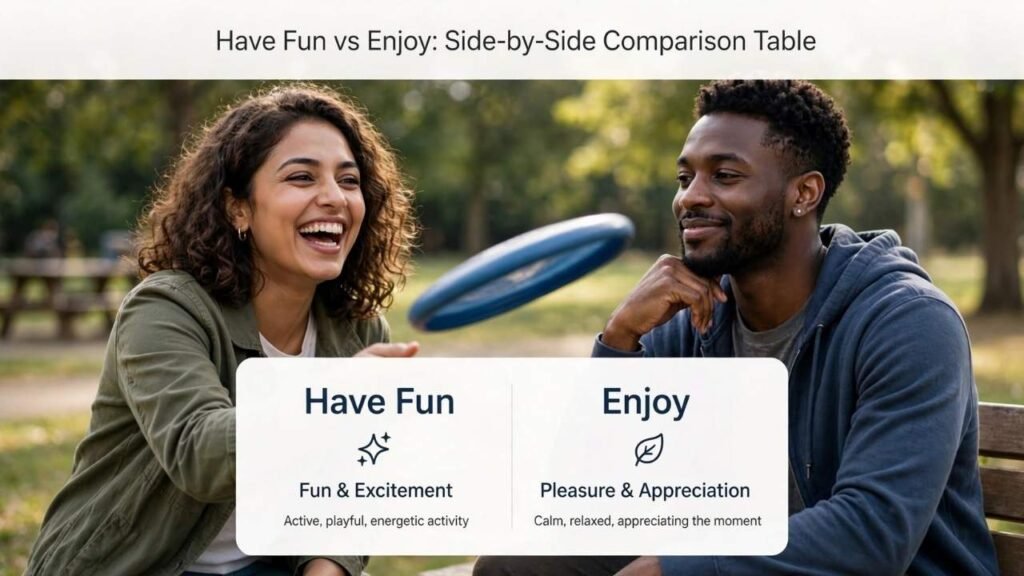
Although “Have Fun” and “Enjoy” both express positive feelings, they are not used in exactly the same way. Knowing the difference between Have Fun and Enjoy helps you choose the right expression in everyday English.
Have Fun is commonly used to wish someone a good time before they start an activity. Enjoy means taking pleasure in something and usually needs an object, such as “Enjoy your meal” or “Enjoy the concert.”
Both expressions are correct, but the context changes which one sounds more natural. The table below gives a quick overview to help you understand Have Fun vs Enjoy, improve your English grammar, and use each phrase with confidence.
| Feature | Have Fun | Enjoy |
| Meaning | Wish someone a good time | Take pleasure in something |
| Grammar | Can stand alone | Usually needs an object |
| Common Use | Activities, trips, parties | Meals, movies, books, vacations |
| Tone | Friendly and casual | Neutral and flexible |
| Example | Have fun at the party! | Enjoy your meal! |
What Does “Have Fun” Mean?
“Have Fun” is a common English expression used to wish someone a pleasant and enjoyable experience. You usually say it before a person begins an activity, such as going to a party, taking a trip, playing sports, or spending time with friends.
It does not describe the activity itself; instead, it expresses a kind wish. This makes it one of the most natural phrases in spoken English. If you are wondering when to use Have Fun, the answer is simple: use it whenever you hope someone enjoys an event or activity.
Native speakers say it every day because it sounds warm and friendly. For more grammar tips, you may also enjoy reading Totaled vs. Totalled to understand another common English usage question.
What Does “Enjoy” Mean?
The word “Enjoy” is a verb that means to take pleasure in or get happiness from something. Unlike “Have Fun,” Enjoy usually needs an object to complete the sentence. For example, people say “Enjoy your dinner,” “Enjoy the movie,” or “I enjoy reading books.”
This is one of the most important grammar rules to remember. If you simply say “Enjoy” without an object, it only sounds natural in certain situations where the object is already understood.
Learning Enjoy meaning and correct usage will help you speak more naturally. If you’re expanding your vocabulary, our guide on Verbs That Start With P is another helpful resource for improving your English.
The Key Differences Between Have Fun and Enjoy
The biggest difference between Have Fun and Enjoy is how each expression is used. Have Fun is mainly a friendly wish that encourages someone to enjoy an activity. In contrast, Enjoy describes taking pleasure in something specific and usually requires an object.
For example, you would say “Have fun at the beach,” but “Enjoy the beach” if you want someone to appreciate the place itself. Another difference is tone. Have Fun sounds more casual and personal, while Enjoy works well in both casual and formal situations.
Understanding these differences makes it easier to choose the right phrase and avoid common English grammar mistakes while speaking or writing.
Grammar Rules You Should Know
Understanding a few simple grammar rules makes using Have Fun and Enjoy much easier. Have Fun works as a fixed expression and does not need a direct object. You can say “Have fun!” or “Have fun at the concert!” without changing its structure.
Enjoy, however, is a transitive verb, which means it usually needs an object, such as “Enjoy your holiday” or “Enjoy the music.” Saying only “Enjoy” is acceptable when the object is obvious from the conversation.
If you have ever asked “Is Have Fun grammatically correct?” or “Can Enjoy be used alone?”, the answer depends on the sentence structure and the context in which the phrase is used.
Similar Expressions You Can Use Instead
If you want to avoid repeating “Have Fun” or “Enjoy,” there are many natural alternatives. You can say “Have a great time,” “Enjoy yourself,” “Have a blast,” “Have an amazing trip,” or “Make the most of it.”
These expressions carry a similar meaning but fit different situations. For example, “Have a great time” works well for parties, vacations, and family events, while “Enjoy yourself” sounds polite in both casual and formal conversations.
“Have a blast” is more informal and is often used among friends. Learning these similar expressions improves your spoken English, helps you sound like a native speaker, and gives you more confidence in everyday conversations.
FAQs
Is “Have Fun” grammatically correct?
Yes. “Have Fun” is a correct and natural English expression used to wish someone a good time before an activity.
Can I say “Enjoy” instead of “Have Fun”?
Sometimes, but not always. Enjoy usually needs an object, while Have Fun is used to wish someone well before an activity.
Which is more formal: “Have Fun” or “Enjoy”?
Enjoy is generally more flexible and can be used in both formal and informal situations. Have Fun is more casual.
Can “Enjoy” be used alone?
Yes, but only when the object is already understood from the conversation. Otherwise, it usually needs an object.
Should I say “Enjoy your trip” or “Have fun on your trip”?
Both are correct. “Enjoy your trip” focuses on appreciating the trip itself, while “Have fun on your trip” wishes someone an enjoyable experience.
What do native English speakers use more?
Native speakers use both expressions regularly. The choice depends on the context, the activity, and what they want to emphasize.
Is “Enjoy yourself” the same as “Have Fun”?
They are very similar. “Enjoy yourself” sounds slightly more polite, while “Have Fun” is more casual and commonly used among friends.
Conclusion
Choosing between “Have Fun” and “Enjoy” is easy once you understand their purpose. Use Have Fun when you want to wish someone a good time before an activity, such as a party, vacation, or sporting event. Use Enjoy when talking about taking pleasure in something specific, like a meal, movie, book, or holiday.
Understanding the difference between Have Fun and Enjoy, along with their grammar rules and common examples, will make your English sound more natural and confident.
Both expressions are correct, and neither is better than the other. The key is choosing the one that best matches the situation. With regular practice, using these phrases correctly will soon become second nature.