
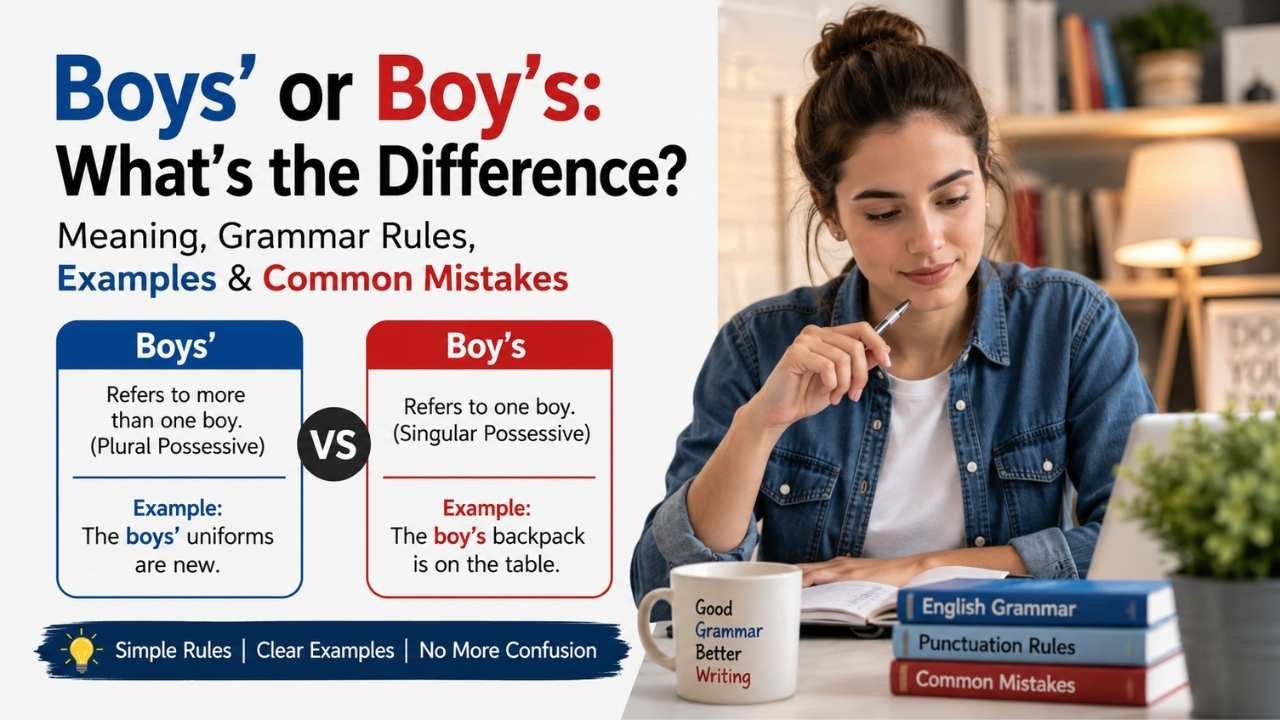
Understanding the difference between Boys’ and Boy’s can be confusing, especially if you’re learning English grammar or trying to improve your writing. Both forms are correct, but they have different meanings because they follow different apostrophe rules.
Knowing when to use Boy’s and when to use Boys’ helps you show ownership correctly and avoid common grammar mistakes. In this guide, you’ll learn the difference between Boys’ and Boy’s, how possessive nouns work, and why the apostrophe placement changes for singular possessive and plural possessive nouns.
We’ll explain each rule in simple language, provide clear grammar examples, and share helpful tips so you can confidently use the correct form in everyday English writing. By the end, you’ll know exactly which is correct: Boys’ or Boy’s in any sentence.
Quick Answer
Boy’s is the singular possessive form, meaning something belongs to one boy. Boys’ is the plural possessive form, meaning something belongs to more than one boy. The apostrophe changes position depending on whether the noun is singular or plural. Example: the boy’s backpack vs. the boys’ backpacks.
What Does Boy’s Mean?
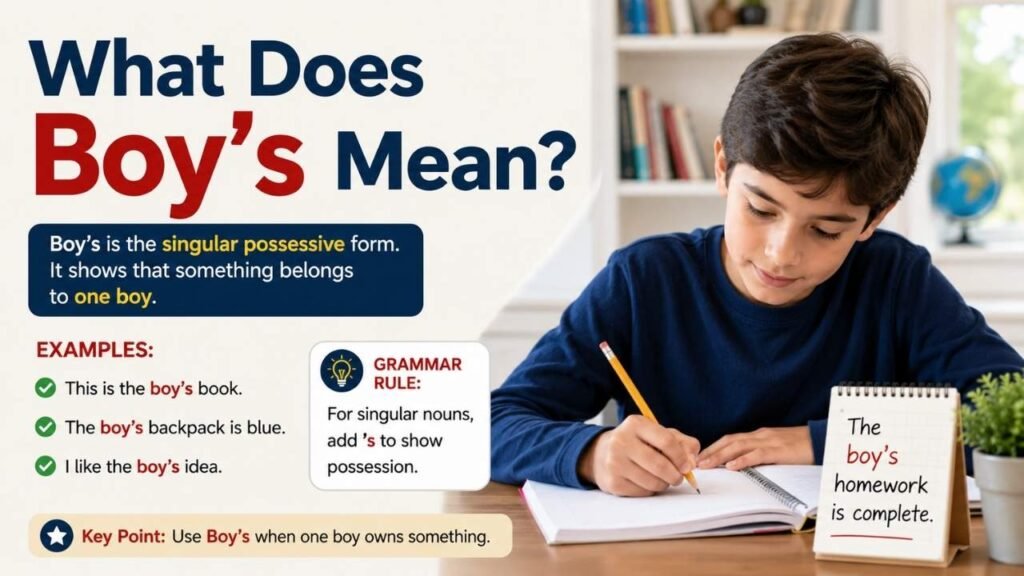
Boy’s is the singular possessive form of boy. It tells readers that one boy owns or is connected to something. To make a singular noun possessive, you usually add ‘s at the end. This is one of the most common apostrophe usage rules in English punctuation. Examples include the boy’s backpack, the boy’s jacket, and the boy’s homework.
In each sentence, the item belongs to only one boy. Learning when to use Boy’s helps you write correctly and avoid confusion. This simple grammar rule is useful for students, teachers, and anyone who wants to improve their writing skills. Always check whether you are talking about one boy before choosing Boy’s.
What Does Boys’ Mean?
Boys’ is the plural possessive form of boys. It shows that more than one boy owns or shares something. Since boys is already plural, you simply place the apostrophe after the letter s.
For example, the boys’ classroom, the boys’ football team, and the boys’ bicycles all describe something belonging to several boys. Knowing when to use Boys’ makes your English grammar stronger and helps you avoid common grammar mistakes.
If you’re interested in other common spelling questions, you can also read our guide on Grateful or Greateful, where we explain another frequently confused pair with easy examples. Understanding plural possessive nouns becomes much easier once you practice with everyday examples.
Boys’ vs. Boy’s: Key Differences at a Glance (Comparison Table)
| Feature | Boy’s | Boys’ |
| Meaning | Belongs to one boy | Belongs to more than one boy |
| Grammar Type | Singular possessive | Plural possessive |
| Apostrophe Placement | Before the s | After the s |
| Example | The boy’s backpack is new. | The boys’ lockers are full. |
| Ownership | One owner | Multiple owners |
The difference between Boy’s and Boys’ becomes simple when you focus on the number of owners. If there is one boy, use Boy’s. If there are many boys, use Boys’. This comparison makes apostrophe placement and possessive nouns much easier to remember.
The Apostrophe Rule Explained: Singular vs. Plural Possessive Nouns
To understand possessive apostrophe rules, first decide whether the noun is singular or plural. A singular possessive noun takes ‘s, so boy becomes boy’s. A plural possessive noun that already ends in s only needs an apostrophe, so boys becomes boys’. This rule also works with many other words, such as teacher’s and teachers’, or girl’s and girls’.
Correct apostrophe placement makes your writing clear and professional. Many learners struggle with English grammar because they confuse plural nouns with possessive nouns. The easiest way to avoid mistakes is to ask yourself one question: Who owns it? Your answer will quickly tell you whether to write Boy’s or Boys’.
When Should You Use Boy’s? (With Everyday Examples)
Use Boy’s when something belongs to one boy. This is called the singular possessive form. Simply add ‘s to the singular noun boy to show ownership. This grammar rule is common in English writing and helps readers understand who owns something.
Here are a few examples: The boy’s hat was left on the bench. The boy’s notebook is on the desk. The boy’s bicycle needs a repair. In every example, only one boy owns the item. If you are unsure when to use Boy’s, ask yourself, “Does this belong to one boy?” If the answer is yes, Boy’s is the correct possessive noun to use.
When Should You Use Boys’? (With Everyday Examples)
Use Boys’ when something belongs to two or more boys. This is known as the plural possessive form. Since boys is already plural, place the apostrophe after the s. This simple apostrophe rule helps show that several boys share or own something. For example: The boys’ classroom was decorated for the event.
The boys’ soccer coach praised the team. The boys’ lunch boxes were placed on the shelf. Each example shows plural ownership. Knowing when to use Boys’ improves your English grammar and reduces common grammar mistakes. Always check whether there is more than one boy before choosing the plural possessive form.
Why the Apostrophe Changes Position (A Visual Step-by-Step Explanation)
Many learners wonder why the apostrophe placement changes between Boy’s and Boys’. The answer is simple. Start with the noun boy. If one boy owns something, add ‘s to make boy’s. If there is more than one boy, first make the noun plural by adding s, creating boys. Then add the apostrophe after the s, giving you boys’.
Think of it like this: Singular → Boy → Boy’s and Plural → Boys → Boys’. This step-by-step method makes possessive apostrophe rules easier to remember. Once you understand this pattern, using singular possessive and plural possessive nouns becomes much more natural.
Common Mistakes People Make with Boy’s and Boys’
One of the most common grammar mistakes is using Boy’s when talking about several boys or using Boys’ when talking about only one boy. Another mistake is forgetting the apostrophe completely and writing boys when the sentence needs a possessive noun. For example, The boys playground is incorrect because it should be The boys’ playground.
Likewise, The boys backpack should be The boy’s backpack if only one boy owns it. To avoid these mistakes, always identify the owner first. Ask yourself whether there is one boy or more than one boy. This simple habit will improve your English writing and make your grammar much more accurate.
Memory Tricks to Always Remember the Difference
A quick memory trick can help you remember Boy’s and Boys’ without confusion. Think of the extra s in Boy’s as standing for single. Since there is only one boy, you add ‘s to show ownership. Now think of Boys’ as already ending in s, which tells you there are several boys.
Because the plural form already has an s, the apostrophe simply moves to the end. Another easy reminder is to ask, “How many boys own it?” If the answer is one, write Boy’s. If the answer is more than one, write Boys’. This simple trick makes apostrophe usage much easier to remember.
Related Possessive Forms: Girl’s, Girls’, Child’s, Children’s, Teacher’s & Teachers’
The same possessive rules used for Boy’s and Boys’ also apply to many other nouns. For example, Girl’s means something belongs to one girl, while Girls’ means it belongs to several girls. Teacher’s refers to one teacher, and Teachers’ refers to many teachers.
Some nouns are different because their plural form does not end in s. For instance, children becomes children’s, not childrens’. Learning these related possessive nouns helps you understand English grammar more deeply. Once you master the pattern of singular possessive and plural possessive forms, writing correctly becomes much easier in everyday situations.
Practice Exercise: Can You Choose the Correct Form?
Test your understanding by choosing the correct word in each sentence.
- The (boy’s / boys’) backpack is blue. (Answer: boy’s)
- The (boy’s / boys’) lockers were cleaned yesterday. (Answer: boys’)
- The (boy’s / boys’) science project won first prize. (Answer: boy’s)
- The (boy’s / boys’) football uniforms were ready before the match. (Answer: boys’)
- The (boy’s / boys’) drawing was displayed in the classroom. (Answer: boy’s)
These examples help you practice apostrophe rules, understand possessive nouns, and recognize the difference between Boy’s and Boys’ in real sentences.
FAQs
Is it Boy’s or Boys’?
Both are correct. Boy’s is the singular possessive form, while Boys’ is the plural possessive form.
When should I use Boy’s?
Use Boy’s when something belongs to one boy.
When should I use Boys’?
Use Boys’ when something belongs to more than one boy.
Why is the apostrophe after the s in Boys’?
Because boys is already plural. You only add an apostrophe to show plural ownership.
Can both forms be correct?
Yes. The correct choice depends on the number of owners in the sentence.
How can I remember the difference?
Ask yourself, “How many boys own it?” One owner uses Boy’s; multiple owners use Boys’.
Is Boys without an apostrophe ever correct?
Yes. Boys is simply the plural noun and does not show ownership.
Conclusion
Understanding the difference between Boy’s and Boys’ is easier than it first appears. The key is to remember that Boy’s shows ownership by one boy, while Boys’ shows ownership by more than one boy.
Once you know the apostrophe rules for singular possessive and plural possessive nouns, you’ll make fewer grammar mistakes and write with greater confidence.
Keep practicing with everyday examples and always ask yourself who owns the object before placing the apostrophe. With this simple approach, using Boy’s and Boys’ correctly will soon become a natural part of your English writing.