
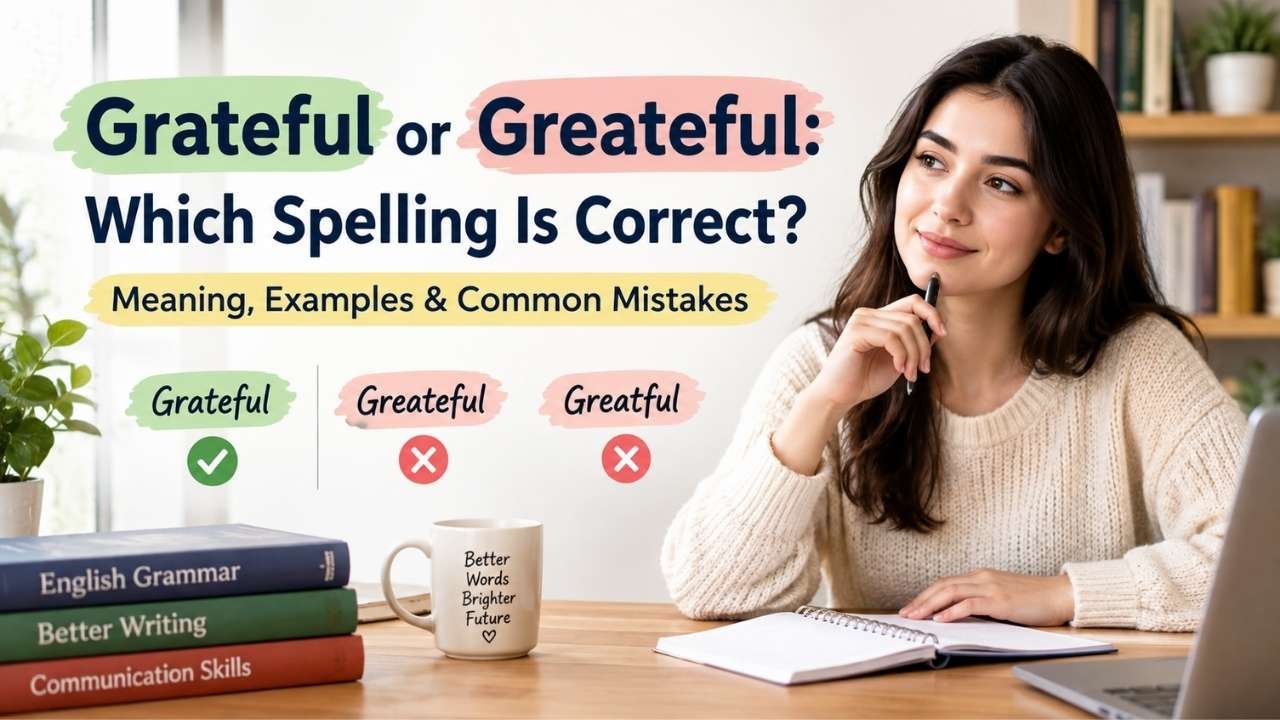
Have you ever paused while typing and wondered whether the correct spelling is grateful, greateful, or greatful? You’re not alone. This is one of the most common spelling mistakes in English because many people assume the word should be linked to “great.”
However, the correct spelling is grateful, while greateful and greatful are incorrect and do not appear in standard dictionaries. In this guide, you’ll learn the correct spelling, grateful meaning, pronunciation, and why this mistake happens.
We’ll also explain grateful vs greateful, share simple memory tricks, provide real-life sentence examples, and show you how to use grateful correctly in everyday writing. By the end, you’ll know exactly how to spell grateful with confidence and avoid this common error in the future.
Quick Answer
The correct spelling is grateful. Greateful and greatful are incorrect spellings and are not recognized as standard English words. Grateful means feeling thankful or appreciative for someone’s kindness or something good that has happened. If you’re wondering, “Is it grateful or greateful?” or “How do you spell grateful?”, the answer is always grateful.
Why Grateful Is the Correct Spelling
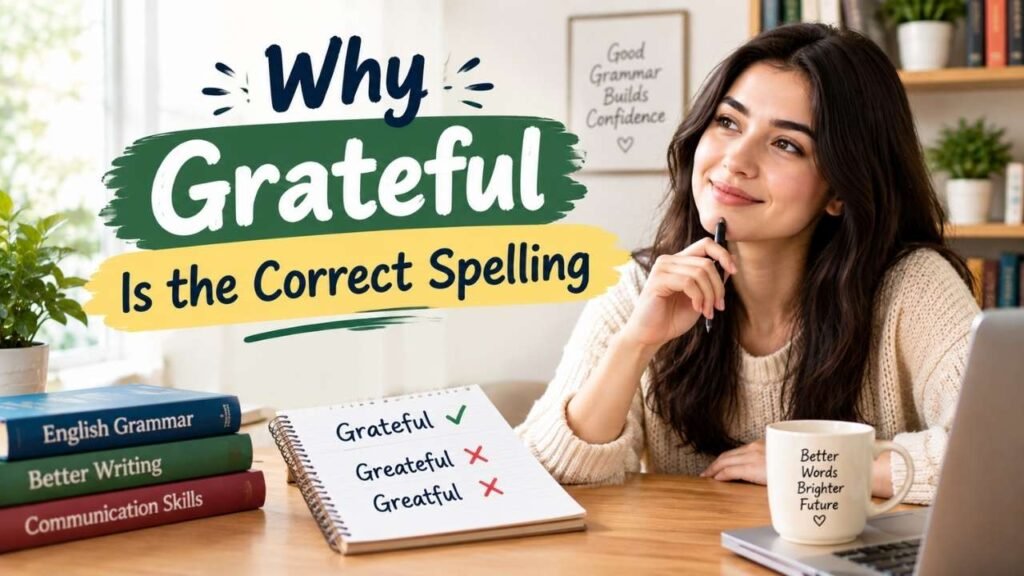
The correct spelling is grateful. If you are wondering, “Is it grateful or greateful?” or “Is greatful a word?”, the answer is simple. Grateful is the only accepted spelling in English dictionaries, while greateful and greatful are common misspellings.
The word grateful means feeling thankful or appreciative for someone’s kindness, help, or a good experience. It comes from the noun gratitude, not the adjective great, which is why it is spelled with “grat-“ instead of “great-“.
Learning the correct spelling of grateful helps you write more clearly and avoid common errors. If you enjoy learning grammar, you may also like our guide on Objective Language, which explains how to write in a clear and unbiased way.
Why People Mistakenly Write Greateful or Greatful
Many people write greateful or greatful because they think the word is connected to great. Since grateful describes a strong feeling of thanks, it seems logical to spell it with “great.” However, this is not how English forms the word.
Grateful comes from gratitude, which means thankfulness, so it keeps the “grat-“ spelling. This mistake is common among students, writers, and even native English speakers. If you ask, “Why is greateful incorrect?”, the answer is that it is not a recognized English word.
Reading carefully and checking your spelling can help you avoid this mistake. You can also explore Suggest Vs Recommend to learn another pair of commonly confused English words.
What Does Grateful Mean?
Grateful means feeling thankful or appreciative for something kind, helpful, or positive. You can feel grateful for a gift, a friend’s support, good health, or an opportunity. It is an adjective that describes a person’s feelings.
For example, “I am grateful for your help” and “She felt grateful after receiving everyone’s support.” Many people also search for grateful meaning, grateful definition, or how to use grateful correctly because they want to use the word with confidence.
Being grateful is about appreciating what you have or what others have done for you. It is a positive word that is widely used in everyday conversations, professional writing, and academic English.
Grateful vs Greateful vs Greatful (Comparison Table)
Many people compare grateful, greateful, and greatful, but only one spelling is correct. The table below makes the difference easy to understand.
| Word | Correct? | Meaning |
| Grateful | ✅ Yes | Feeling thankful or appreciative. |
| Greateful | ❌ No | Incorrect spelling; not a standard English word. |
| Greatful | ❌ No | Common misspelling of grateful. |
If you ever wonder, “Which spelling is correct: grateful or greateful?”, always choose grateful. It is the spelling found in dictionaries and used in formal and informal writing. Remember that grateful comes from gratitude, making it easier to remember the correct form.
How to Pronounce Grateful (IPA + Audio-Friendly Guide)
The pronunciation of grateful is simple once you know the correct sounds. In the International Phonetic Alphabet (IPA), it is written as /ˈɡreɪt.fəl/. You can say it as GRAYT-fuhl, with the stress on the first syllable.
Although the word sounds similar to great, its spelling is different because it comes from gratitude. This difference often causes confusion between grateful, greatful, and greateful.
Listening to native speakers and repeating the word aloud can improve your pronunciation. Practicing it in short sentences, such as “I am grateful for your kindness,” will also help you remember both the correct pronunciation and the correct spelling.
Where Does the Word Grateful Come From? (Origin & Etymology)
The word grateful has an interesting history. It comes from the noun gratitude, which is based on the Latin word gratus, meaning pleasing, thankful, or welcome. Over time, English adopted this root to create the adjective grateful, which describes someone who feels appreciation for kindness or good fortune.
This explains why the word begins with “grat-“ instead of “great-“. Understanding its word origin makes the spelling easier to remember and answers the common question, “Why is grateful spelled this way?” Knowing the history behind words is a useful learning method because it helps you understand both their meaning and their correct spelling instead of relying only on memory.
How to Use Grateful Correctly in Sentences
Using grateful correctly is easy when you remember that it describes feeling thankful or appreciative. It is an adjective, so it usually comes after a linking verb such as am, is, are, was, or feel.
Here are a few examples: “I am grateful for your support.” “She was grateful to her teacher for the extra help.” “We are grateful for this opportunity.” In professional writing, you can say, “I am grateful for your quick response.” In everyday conversations, you might say, “I’m grateful you were there for me.”
These grateful examples show how naturally the word fits into daily English. Avoid using greateful or greatful, as they are incorrect spellings.
Grateful To vs Grateful For: What’s the Difference?
Many English learners wonder whether they should say grateful to or grateful for. The answer depends on what you are talking about. Use grateful to when you mention the person you appreciate, such as “I am grateful to my parents for their support.”
Use grateful for when talking about the thing, opportunity, or experience you appreciate, for example, “I am grateful for good health.” You can even use both together in one sentence: “She is grateful to her friends for their kindness.”
Learning this simple grammar rule helps you use grateful correctly in both speaking and writing while making your sentences sound more natural.
ynonyms, Antonyms, and Related Words
Knowing words related to grateful can improve your vocabulary and make your writing more interesting. Common grateful synonyms include thankful, appreciative, obliged, indebted, and recognizant.
Among these, thankful and appreciative are the most common in everyday English. The opposite of grateful is ungrateful, which describes someone who does not appreciate kindness or help.
Other related words include gratitude, gratefully, and appreciation. Although these words are connected, they are used in different ways. Learning these related terms helps you express your thoughts more clearly and avoid repeating the same word too often in conversations, emails, essays, and other types of writing.
Easy Memory Tricks to Remember the Correct Spelling
A simple memory trick can help you remember the correct spelling of grateful forever. Think of the word gratitude. Since grateful comes from gratitude, both words begin with “grat-“ instead of “great-“.
Another easy tip is to remember that grateful is about thanks, not about being great. Whenever you are unsure, ask yourself, “Does this word come from gratitude?” If the answer is yes, the spelling is grateful.
Reading and writing the word several times also strengthens your memory. These easy techniques can prevent common spelling mistakes and help you feel confident whenever you write grateful in school, work, or everyday communication.
Common Grammar and Spelling Mistakes Related to Grateful
One of the biggest mistakes is writing greateful or greatful instead of grateful. Another common error is confusing grateful with gratitude. Remember that grateful is an adjective, while gratitude is a noun.
Some people also misuse grateful to and grateful for, even though each has a different purpose. Another mistake is assuming that greatful is acceptable because it looks similar to great, but it is not a real English word.
Paying attention to these small grammar and spelling rules will make your writing more accurate. A quick proofread before submitting your work can help you catch these common errors and improve your overall writing quality.
Proofreading Tips to Avoid This Mistake in Writing
Proofreading is one of the easiest ways to avoid spelling mistakes like greateful or greatful. After finishing your writing, read it slowly and look for commonly confused words. You can also use a trusted dictionary, grammar checker, or spelling checker to confirm the correct spelling of grateful.
Reading your sentences aloud is another helpful technique because it encourages you to pay closer attention to each word. If you often make this mistake, create a personal list of commonly misspelled words and review it regularly.
With regular practice and careful proofreading, using grateful correctly will become a natural habit, helping you write clearly and confidently in every situation.
FAQs
Is it grateful or greateful?
The correct spelling is grateful. Greateful is an incorrect spelling and is not recognized in standard English.
Is greatful a real word?
No. Greatful is a common misspelling. The correct word is grateful.
What does grateful mean?
Grateful means feeling thankful or appreciative for someone’s kindness, help, or a positive experience.
How do you spell grateful correctly?
Spell it as G-R-A-T-E-F-U-L. Remember that it comes from gratitude, not great.
Why do people spell grateful incorrectly?
Many people mistakenly connect the word with great, even though its origin is gratitude.
Is grateful an adjective?
Yes. Grateful is an adjective used to describe a feeling of thankfulness or appreciation.
What is the opposite of grateful?
The opposite of grateful is ungrateful, which describes someone who does not appreciate kindness or help.
Conclusion
The answer is clear: grateful is the correct spelling, while greateful and greatful are incorrect. Understanding that grateful comes from gratitude makes it much easier to remember the right form.
Whether you are writing an email, completing schoolwork, or creating professional content, using the correct spelling shows attention to detail and strong language skills.By learning its meaning, pronunciation, grammar rules, and proper usage, you can avoid this common mistake with confidence.
Keep practicing with real-life examples, use proofreading tools when needed, and remember the simple connection between gratitude and grateful. With these tips, you will never have to wonder again whether it is grateful, greatful, or greateful.