

The phrase “Would It Be possible” is common in English, but many learners feel confused about its meaning and correct usage. You may see it in polite requests, questions, and everyday conversations, but understanding why we use “would” instead of “will” can be challenging.
In this guide, we will explain what “would it be” means, how its grammar structure works, and when you should use it correctly. You will also learn the difference between “would it be,” “will it be,” and “could it be” with simple examples.
Whether you are improving your English grammar or trying to sound more natural in conversations, this article will help you understand and use “would it be” with confidence.
Quick Answer
“Would it be” is a phrase used to ask about a possible, imagined, or polite situation. It often makes questions sound softer and more respectful than direct questions. The structure is would + subject + be. For example, “Would it be possible to help me?” is a polite way to ask for assistance.
What Does “Would It Be” Mean in English?
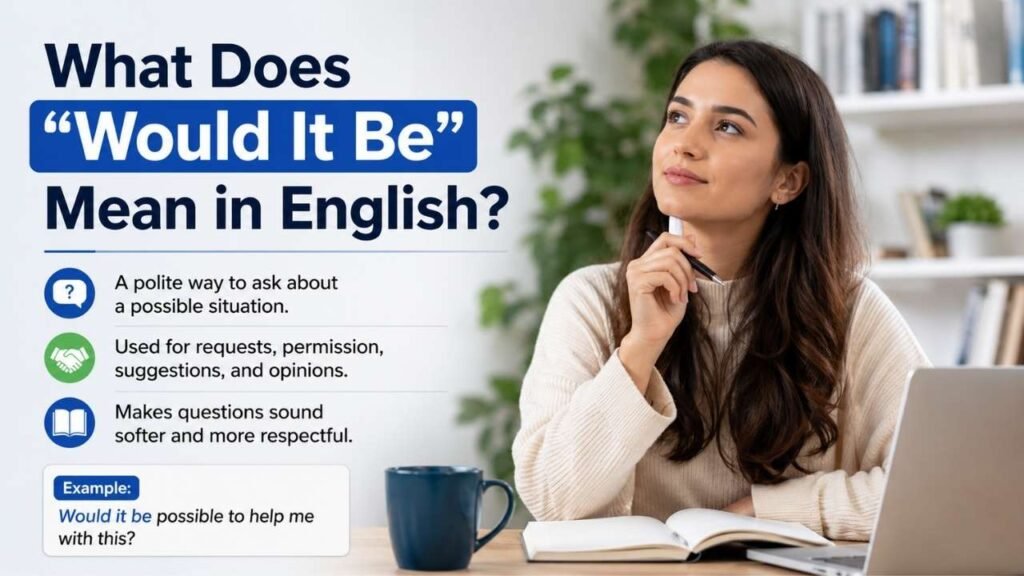
The phrase “would it be” is used when we talk about a possible, imagined, or polite situation. It is a common English expression that helps speakers make questions sound softer and more respectful.
When someone asks “Would it be possible?” or “Would it be okay?”, they are usually making a polite request instead of asking in a direct way. The meaning of “would it be” depends on the situation and the words that come after it.
For example, “Would it be better to wait?” asks for an opinion, while “Would it be possible to help me?” makes a polite request. Understanding this phrase can improve your English conversations and grammar skills.
Is “Would It Be” Grammatically Correct?
Yes, “would it be” is grammatically correct and commonly used in both spoken and written English. The phrase follows normal English grammar rules because “would” works as a modal verb, and “be” stays in its base form after it.
Many learners confuse this structure because they are unsure why we use “would” instead of “will.” However, would it be grammar is simple when you understand that “would” often shows politeness, possibility, or an imagined situation.
For example, “Would it be okay if I joined the meeting?” sounds more polite than a direct question. Learning modal verbs like “would” helps you create more natural English sentences and communicate more effectively.
How Is “Would It Be” Formed? Grammar Structure Explained
The basic structure of “would it be” follows a simple pattern:
Would + subject + be + complement?
In this structure, “would” is the modal verb, “it” is the subject, and “be” is the main verb. The final part gives more information about the situation. For example, “Would it be possible to change the date?” follows this exact pattern. Another example is “Would it be helpful if I explained it again?” This sentence structure is used for polite questions, suggestions, and possible situations.
Understanding the would it be sentence structure makes it easier to use the phrase correctly. Similar grammar patterns can also help when learning other word forms, such as exploring different Verbs Starting With H to expand your English vocabulary.
When Do You Use “Would It Be”?
You can use “would it be” in many situations where you want to sound polite, careful, or thoughtful. One common use is making requests. For example, “Would it be possible to send the file today?” sounds respectful and professional. Another use is asking for opinions or suggestions, such as “Would it be better to leave early?”
The phrase is also useful when talking about possible results or imagined situations. Instead of making a direct statement, it allows you to ask in a softer way. In daily conversations, workplace communication, and formal emails, “would it be” helps create a friendly tone. It is especially useful when you want to ask for help without sounding too demanding.
Understanding “Would It Be Possible” and Its Usage
“Would it be possible” is one of the most common forms of this phrase. It is used when someone wants to ask for something politely or check if something can happen. The phrase is often used in professional and formal situations because it sounds respectful.
For example, you might say, “Would it be possible to reschedule our meeting?” instead of saying, “Can you change the meeting?” The meaning of “would it be possible” is similar to asking whether something can be done, but it adds a polite feeling.
Native speakers commonly use this phrase when requesting help, asking for changes, or making suggestions. It is a useful expression for improving both spoken and written English.
“Would It Be Okay If I…” Meaning and Examples
The phrase “Would it be okay if I…” is another polite form of “would it be.” It is mainly used when asking permission in a respectful way. Instead of directly asking “Can I do this?”, speakers often choose “Would it be okay if I did this?” because it sounds softer.
For example, “Would it be okay if I left early today?” or “Would it be okay if I used your computer?” are polite permission requests. This phrase is common in conversations with friends, coworkers, teachers, and customers.
Using polite English expressions like this can make your communication sound more natural. It helps you ask questions without appearing too direct or demanding, even when you are busy or handling many tasks, similar to being As Busy as a One-Armed Paper Hanger.
“Would It Be” vs “Will It Be”: What’s the Difference?
Many English learners confuse “would it be” and “will it be” because both phrases talk about situations that may happen. However, their meanings are different. “Will it be” is used when asking about a future fact, event, or expected result.
For example, “Will it be sunny tomorrow?” asks about a real future condition. On the other hand, “would it be” is used for polite questions, possibilities, or imagined situations.
For example, “Would it be possible to finish this today?” sounds like a polite request. The main difference between would it be vs will it be is that “would” often creates a softer or conditional meaning, while “will” focuses on a direct future answer.
“Would It Be” vs “Could It Be”: Difference Explained
Although “would it be” and “could it be” both discuss possibilities, they are used in different ways. “Would it be” is often used when asking about a possible action, choice, or polite request. For example, “Would it be better to start now?” asks for an opinion.
Meanwhile, “Could it be” is used when asking whether something is possible or true. For example, “Could it be the right answer?” asks about a possibility.
Understanding the difference between would it be vs could it be helps English learners choose the correct phrase. In simple terms, “would” often focuses on a possible situation or decision, while “could” focuses on ability, chance, or uncertainty.
Common Mistakes When Using “Would It Be”
Many learners make small mistakes when using “would it be” because they are unsure about sentence structure. One common mistake is using the wrong verb form after “would.” Remember that would + base verb is the correct rule. For example:
❌ Would it is possible to join?
✅ Would it be possible to join?
Another mistake is mixing “would” and “will” in the same sentence incorrectly.
❌ Would it will be better tomorrow?
✅ Would it be better tomorrow?
It is also important to remember that “would it be” is usually used for polite questions, suggestions, or imagined situations. Learning these rules will help you avoid errors and create more natural English sentences.
Real-Life Examples of “Would It Be” in Sentences
Learning examples is one of the best ways to understand how “would it be” works in real conversations. This phrase appears in many everyday situations, including workplaces, schools, and personal conversations. Here are some examples:
- Would it be possible to send the report by Friday?
- Would it be okay if I called you later?
- Would it be better to wait for another day?
- Would it be helpful if I explained the process again?
- Would it be a good idea to start early?
These examples show that “would it be” can be used for requests, suggestions, and opinions. By practicing these sentences, learners can understand the natural use of this phrase and improve their English speaking skills.
How “Would It Be” Sounds in Formal and Informal English
The phrase “would it be” can be used in both formal and informal situations, but the tone may change depending on the context. In formal communication, it is often used to make requests sound respectful and professional.
For example, “Would it be possible to arrange a meeting next week?” is suitable for workplace emails. In casual conversations, people may use simpler alternatives like “Is it okay if…” or “Can I…”.
However, “would it be” still works when you want to sound polite with friends, family, or coworkers. Understanding these differences helps you choose the right expression for each situation and makes your English communication more natural and effective.
FAQs
What does “would it be” mean?
“Would it be” means asking about a possible, imagined, or polite situation. It is commonly used to make questions softer and more respectful.
Is “would it be” grammatically correct?
Yes, “would it be” is grammatically correct. It follows the structure would + subject + base verb.
What is the difference between “would it be” and “will it be”?
“Would it be” is used for polite requests, possibilities, or imagined situations, while “will it be” asks about a future fact.
Is “would it be possible” polite?
Yes, “would it be possible” is a polite and respectful way to ask if something can happen.
Can I use “would it be” in everyday conversations?
Yes, native speakers use “would it be” in daily conversations, especially when making requests, asking permission, or discussing choices.
Conclusion
Understanding “would it be” can make your English sound more polite, natural, and confident. This phrase is commonly used for requests, permission, suggestions, and possible situations.
By learning its meaning, grammar structure, and correct usage, you can avoid common mistakes and communicate more effectively. Remember that “would it be” is different from “will it be” because it often expresses a softer or imagined situation rather than a direct future fact.
Whether you are writing a professional email or having a daily conversation, using this phrase correctly can improve your English skills. Keep practicing with different examples, and soon “would it be” will become a natural part of your everyday vocabulary.