
Have you ever wondered whether you should use “ensure” vs “make sure” in a sentence? Although these expressions have a similar meaning, they are not always the best choice in the same situation.
Knowing the difference between ensure and make sure can help you communicate more clearly in spoken English, written English, business English, and even academic writing. In general, ensure is more common in formal English, while make sure sounds more natural in everyday conversations.
Understanding their grammar rules, usage, and sentence patterns will help you choose the right phrase with confidence. In this guide, you’ll learn the meaning of ensure and make sure, discover when to use ensure, when to use make sure, explore practical examples, avoid common mistakes, and improve your overall English grammar and word choice.
Quick Answer
Ensure and make sure both mean to confirm or guarantee that something happens, but they differ in tone and usage. Ensure is more common in formal English, business writing, and academic writing, while make sure is preferred in spoken English and everyday conversations. Understanding the difference between ensure and make sure helps you choose the right expression for every situation.
What Does “Ensure” Mean?
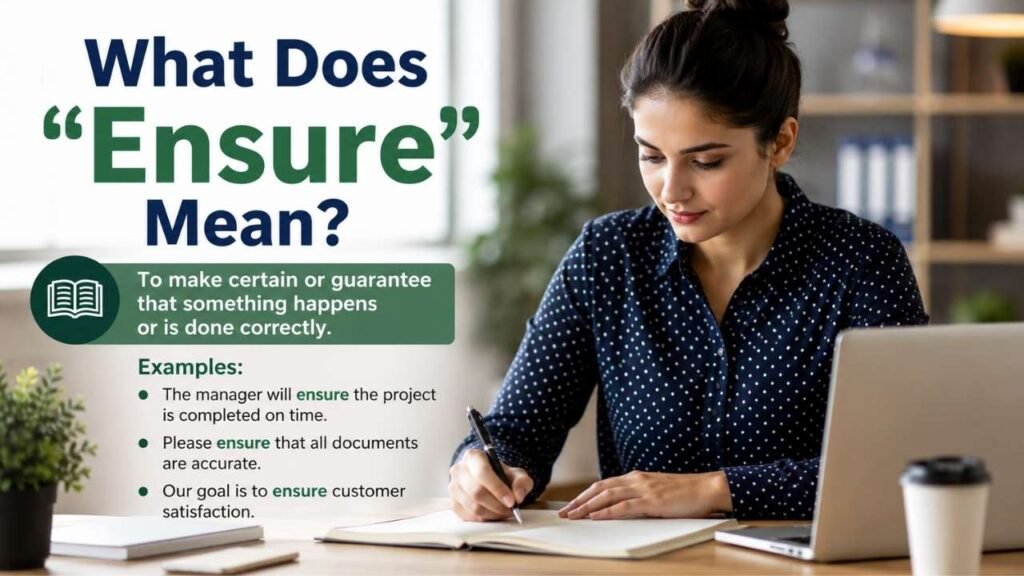
Ensure means to make certain, guarantee, or confirm that something happens or is done correctly. It is commonly used in formal English, business English, academic writing, and official documents.
If you want to express certainty in a professional way, ensure is often the better choice than make sure. It is usually followed by a that clause or an object, making it an important part of English grammar and formal writing.
For example, “Please ensure that all reports are submitted by Friday.” This sentence clearly shows responsibility and certainty. Learning when to use ensure correctly improves your word choice and makes your writing sound more polished. If you’re expanding your vocabulary, exploring Verbs Starting With H can also help strengthen your English skills.
What Does “Make Sure” Mean?
Make sure means to check, confirm, or be certain that something is done correctly. It is widely used in spoken English, everyday English, and casual conversations because it sounds natural and friendly. Although it has a similar meaning to ensure, make sure is less formal and fits daily communication better.
For example, “Make sure you lock the door before leaving.” This expression is also common in emails, instructions, and conversations with family or friends. Understanding the meaning of make sure helps you choose the right phrase based on the situation.
As you improve your English grammar and language usage, you’ll notice how context affects your word choice. You may also enjoy learning about Would It Be Possible to strengthen your understanding of common English expressions.
Ensure vs Make Sure: Key Differences at a Glance
Although ensure and make sure share a similar meaning, they differ in formality, usage, and context. Ensure is preferred in formal English, professional writing, and academic English, while make sure is more common in spoken English and informal situations.
Both expressions can often be used to guarantee or confirm that something happens, but choosing the right one depends on your audience. For example, a business report may use ensure, whereas a friendly reminder usually uses make sure. Understanding the difference between ensure and make sure helps improve your writing style, English usage, and overall communication. The table below highlights their main differences.
| Feature | Ensure | Make Sure |
| Meaning | Guarantee or make certain | Check or confirm something |
| Formality | Formal | Informal |
| Common Use | Business, academic, legal writing | Everyday conversations and casual writing |
| Tone | Professional | Friendly and natural |
| Examples | Ensure customer satisfaction. | Make sure the lights are off. |
When Should You Use “Ensure”?
Use ensure when writing in formal English, especially in business communication, academic writing, reports, contracts, policies, or official instructions. It gives your sentence a professional tone and shows that something must happen or be completed correctly. For example, “The manager must ensure that every employee follows the safety rules.”
Here, ensure expresses responsibility and certainty. It is also common in workplace emails and technical documents where precise language usage matters. If you are unsure whether to choose ensure or make sure, think about your audience.
If the situation is formal, ensure is usually the better option. Knowing how to use ensure correctly helps you write with confidence and avoid common grammar mistakes.
When Should You Use “Make Sure”?
Use make sure when speaking with friends, giving simple instructions, or writing in a relaxed and conversational style. It is the preferred choice in everyday English, spoken English, text messages, and informal emails because it sounds warm and natural. For example, “Make sure you bring your notebook to class tomorrow.”
Native speakers often use this expression in daily conversations instead of ensure. While both phrases can express certainty, make sure feels more personal and easier to understand.
Learning when to use make sure will improve your English vocabulary, sentence structure, and communication skills. Choosing the right expression based on the situation makes your writing and speech sound more fluent and natural.
Grammar Rules for Ensure and Make Sure
Understanding the grammar rules for ensure and make sure helps you use both expressions correctly. Ensure is usually followed by a noun or a that clause. For example, “Please ensure the documents are complete” or “Please ensure that the documents are complete.”
Make sure is commonly followed by a that clause or a statement describing what should happen, such as “Make sure that the windows are closed.” Both phrases express certainty, but their sentence patterns are slightly different.
Using the correct structure improves your English grammar, sentence writing, and language accuracy. Whether you’re writing a report or speaking with friends, choosing the right grammar pattern makes your message clearer and more natural.
Common Mistakes People Make
Many English learners make small mistakes when using ensure and make sure. One common error is using ensure in casual conversations where make sure sounds more natural. Another mistake is confusing ensure with insure, even though they have different meanings.
Ensure means to guarantee that something happens, while insure refers to insurance or financial protection. Some people also forget to use the correct sentence pattern, especially after ensure. Choosing the wrong expression can make your writing sound unnatural or too formal.
Learning these common mistakes helps improve your English usage, word choice, and confidence. With regular practice and examples, you’ll know exactly when to use ensure and when to use make sure
Ensure vs Make Sure vs Insure
Although these words look similar, they have different purposes. Ensure means to guarantee or make certain that something happens. Make sure means to check or confirm that something is done correctly, and it is more common in everyday speech.
Insure, however, is used when talking about insurance or protecting something financially. For example, “Please ensure everyone arrives on time,” “Make sure you save the file,” and “Don’t forget to insure your car.”
Knowing the difference between ensure, make sure, and insure helps you avoid confusion and choose the correct word in every situation. This understanding strengthens your English grammar, improves your writing, and makes your communication more accurate.
| Word | Meaning | Example |
| Ensure | Guarantee something happens | Ensure the project is completed. |
| Make Sure | Check or confirm | Make sure the door is locked. |
| Insure | Protect with insurance | Insure your home against damage. |
Real-Life Examples in Different Situations
Seeing these expressions in real situations makes them easier to understand. In business writing, you might write, “Please ensure that all customer records are updated.” In an academic setting, a teacher may say, “Ensure that you cite your sources correctly.”
During a casual conversation, someone could say, “Make sure you call me when you arrive.” At home, a parent might remind a child, “Make sure your homework is finished before dinner.”
These examples show that ensure is better for formal situations, while make sure fits everyday communication. Practicing with real-life examples helps improve your English vocabulary, writing skills, and confidence when choosing the right expression.
Common Collocations with Ensure and Make Sure
Learning common collocations helps you sound more natural in English. Ensure is often paired with words like safety, quality, accuracy, compliance, success, and security. For example, “Ensure customer satisfaction” or “Ensure workplace safety.”
On the other hand, make sure commonly appears with everyday actions, such as make sure you understand, make sure everyone knows, make sure everything is ready, or make sure the door is locked. These word combinations are frequently used by native speakers in both writing and conversation.
Understanding these collocations improves your language usage, expands your English vocabulary, and helps you use ensure and make sure more naturally in different situations
Native Speaker Tips for Choosing the Right Expression
Native English speakers usually choose ensure or make sure based on the situation rather than the meaning alone. If you’re writing a report, email, policy, or academic paper, ensure sounds more professional and appropriate. I
f you’re speaking with friends, family, or coworkers, make sure feels warmer and more natural. A simple trick is to think about your audience. If the situation is formal, choose ensure. If it’s casual or conversational, choose make sure.
This easy habit can improve your writing style, professional communication, and everyday conversations. The more examples you read and practice, the more confidently you’ll choose the right expression without thinking twice.
FAQs
Is ensure more formal than make sure?
Yes. Ensure is more common in formal English, business documents, and academic writing, while make sure is usually used in everyday conversations.
Can ensure and make sure be used interchangeably?
In many situations, yes. However, ensure sounds more professional, whereas make sure sounds more natural in casual speech.
What is the difference between ensure and insure?
Ensure means to guarantee that something happens, while insure means to provide insurance or financial protection.
Which one should I use in business writing?
Use ensure because it creates a more professional and formal tone.
Is make sure grammatically correct?
Yes. Make sure is completely correct and widely used in spoken and informal written English.
Can I use ensure in everyday conversation?
Yes, but many native speakers naturally prefer make sure in casual conversations.
How can I remember the difference easily?
Remember this simple rule: ensure for formal writing and make sure for everyday speaking.
Concluison
Both ensure and make sure help express certainty, but choosing the right one depends on the context. Ensure is the better option for formal English, business communication, and academic writing, while make sure is ideal for spoken English, friendly conversations, and informal writing.
Understanding the difference between ensure and make sure, along with their grammar rules, common collocations, and real-life examples, will improve your English grammar, word choice, and communication skills.
The more you practice using these expressions in different situations, the more natural they will become. Keep this simple rule in mind: use ensure for formal situations and make sure for everyday conversations, and you’ll choose the right phrase with confidence every time.