
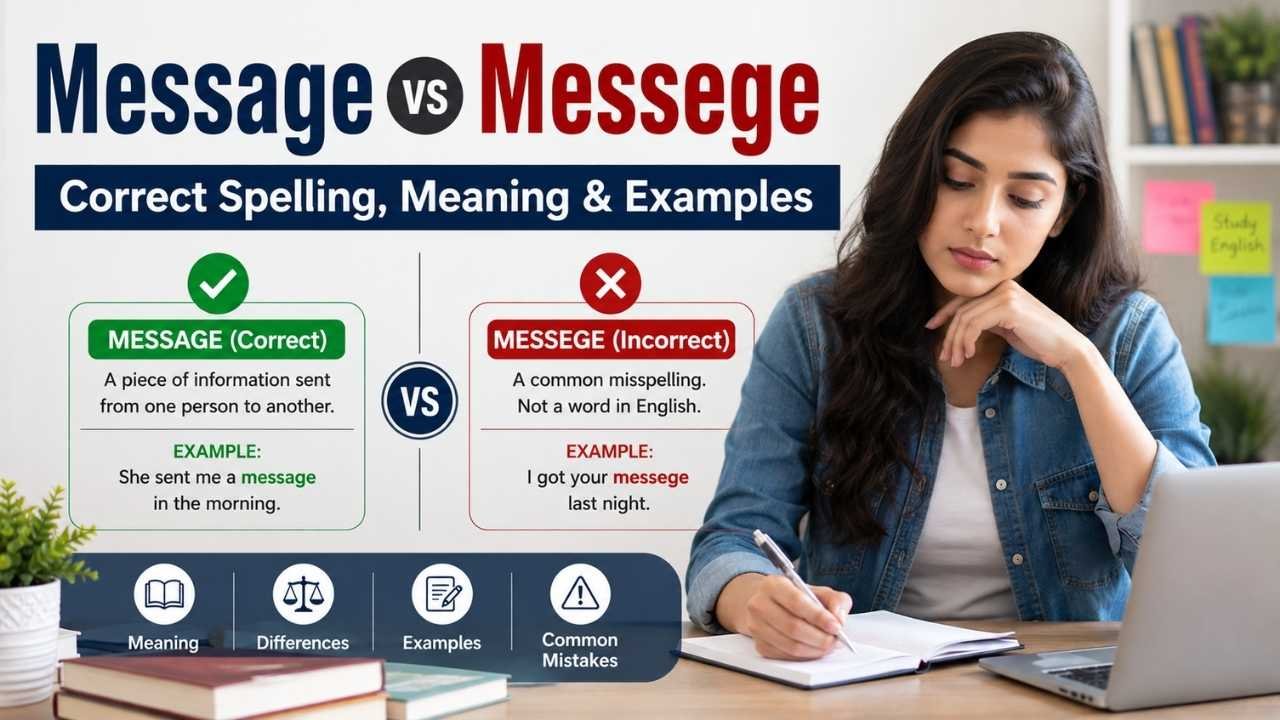
Have you ever typed “messege” and then wondered if it was the correct spelling? You are not alone. Message vs. messege is a common spelling confusion, especially when writing quickly in texts, emails, social media posts, or professional documents.
Although both forms look and sound similar, only one is correct in standard English. Message is the correct spelling, while messege is a common misspelling. The word message can refer to information shared through a text, email, note, phone call, or conversation.
It can also work as both a noun and a verb, such as “I received your message” or “Message me later.” In this guide, we’ll explain the difference between message and messege, their meanings, correct usage, examples, pronunciation, and an easy spelling trick to help you remember the right form.
Quick Answer
Message is the correct spelling, while messege is incorrect. “Messege” is a common spelling mistake and is not a standard English word. Message can mean information sent or shared with someone through a text, email, note, or conversation. It can also be used as a verb, as in “Please message me later.” Remember: the correct spelling is M-E-S-S-A-G-E, not “messege.”
Message vs Messege at a Glance
When comparing message vs messege, the answer is simple: message is the correct spelling, while messege is a misspelling. These two forms can look almost the same, which is why people sometimes use the wrong one when writing quickly.
However, messege is not a standard English word and should not be used in formal or informal writing. The correct spelling is M-E-S-S-A-G-E. The word “message” can refer to information that someone sends or shares with another person.
It can be a text, email, note, voice recording, or spoken communication. It can also be used as a verb, as in “Message me when you arrive.” Remembering the -age ending can help you avoid the common spelling error “messege.”
Which Spelling Is Correct: Message or Messege?
Message is the correct spelling in standard English. Messege is an incorrect spelling that often appears because people are unsure about the letters in the middle of the word. Although “messege” may look reasonable, it does not have a separate meaning or use in standard English.
If you are writing an email, school assignment, work document, text, or social media post, always use message. The word has two common uses. As a noun, it means information communicated to someone, such as “I received your message.”
As a verb, it means to send someone a message, as in “I will message you later.” If you often confuse similar spellings, you may also find it useful to learn about [Led vs Lead], another common English spelling and word-use confusion.
What Does “Message” Mean?
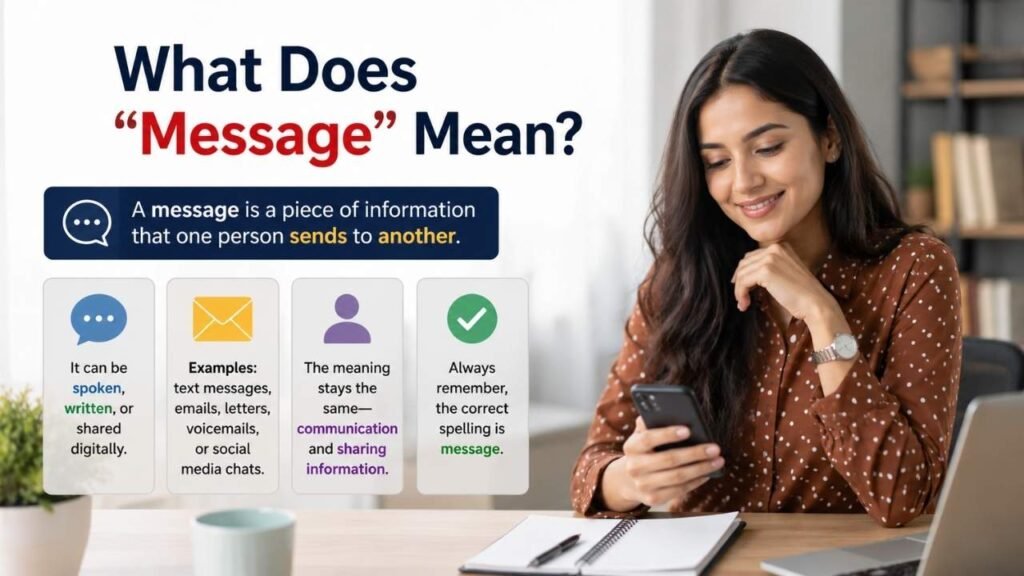
The word message has several related meanings, but its main meaning is information communicated from one person to another. A message can be written, spoken, recorded, or sent digitally.
For example, “She left a message for her brother” means she gave him some information. In modern communication, a message can also mean a text message, email, direct message, or voice message. The word can also describe the main idea or lesson that a person wants to communicate.
For example, a movie may have an important message about friendship or kindness. In grammar, message can be both a noun and a verb. This makes it useful in everyday English. Understanding its meaning makes it easier to use the word correctly in conversations, emails, and other forms of writing.
Is “Messege” a Real Word?
No, “messege” is not a standard English word. It is simply a common misspelling of message. If you search for “messege meaning,” you may find pages explaining the mistake, but you should not treat “messege” as an alternative spelling.
The confusion usually happens because the pronunciation of message does not make every letter obvious. When people spell the word from memory or type quickly, they may replace the a with e, creating “messege.”
The correct form is always message when you mean information sent or communicated to someone. This applies to texts, emails, notes, conversations, and professional communication. If you see “messege” in your writing, simply correct it to message. Learning the correct spelling now can help prevent the same mistake in future writing.
Why Do People Spell Message as “Messege”?
People often write messege because the correct spelling is not always clear from pronunciation. When we say “message,” the word sounds roughly like “mes-ij,” so the middle vowel may be easy to forget when writing.
Fast typing is another common reason for this spelling mistake. People may know the word but type it quickly and accidentally replace the a with an e. This can happen in text messages, emails, notes, and online conversations.
Another reason is simple memory: English contains many words with different vowel patterns, so it is easy to remember the sound but forget the exact spelling. The best way to avoid this mistake is to remember that message contains “ss + age.” Writing the word several times can also make the correct pattern easier to remember.
How to Spell “Message” Correctly
The correct spelling is M-E-S-S-A-G-E: message. A simple way to remember it is to focus on the ending “-age.” The word has two s letters followed by a-g-e. This gives you the pattern mess + age = message.
The incorrect form messege changes the a to an e, which creates the spelling error. When you are unsure, say the word slowly in your mind and check the written form before sending your message. You can also remember the phrase “a message has an A.”
This small spelling trick can be useful for English learners and anyone who frequently types the word. Once you remember the ss + age pattern, it becomes much easier to avoid writing “messege” by mistake. You can also compare this with [Girlie vs Girly], another example of words that can cause spelling and usage confusion.
Message as a Noun
Message is commonly used as a noun when it means information that someone sends, gives, or communicates. The information can be written, spoken, or shared through a digital platform. For example, “I received a message from my friend” uses “message” as a noun because it refers to the information received.
You can also use it for emails, notes, phone messages, and social media communication. The word can describe a simple piece of information or a deeper idea. For example, “The message of the story is to be kind to others.”
Here, it refers to the main idea or lesson. Common phrases include send a message, receive a message, leave a message, and read a message. Understanding these common patterns makes it easier to use “message” naturally in everyday English.
Message as a Verb
The word message can also work as a verb. As a verb, it means to send someone a message, usually through a phone, computer, or another digital service. For example, “Please message me when you get home” means “Please send me a message when you get home.”
This use is especially common in modern, informal English. You may see it in conversations about texting, social media, or online chats. The verb can appear in different forms, including message, messages, messaged, and messaging.
For example, “She messaged me yesterday” uses the past form, while “We are messaging each other now” uses the -ing form. Knowing that “message” can be both a noun and a verb helps you understand sentences more easily and use the word correctly in everyday communication.
Message vs Massage: What’s the Difference?
Message and massage are two different English words, even though they look and sound somewhat similar. A message is information that someone communicates to another person.
For example, “I sent him a message.” A massage, on the other hand, is a physical treatment that involves rubbing or pressing parts of the body. For example, “She booked a massage after a long day.” The difference becomes easier to remember when you connect each word with its meaning. Message relates to communication, while massage relates to physical treatment.
Neither word should be confused with messege, because “messege” is simply an incorrect spelling of “message.” When writing quickly, check the word carefully before using it. Choosing the correct form helps your writing stay clear and avoids unnecessary confusion.
Message in Example Sentences
Seeing message in sentences can make its meaning and usage much easier to understand. Here are some simple examples. “I received your message this morning” uses message as a noun. “Please message me when you arrive” uses it as a verb.
“She left a message for her manager” refers to information given to another person. “The teacher sent a message to the parents” shows how the word can be used in professional or school communication.
“The movie has a powerful message about friendship” uses the word to describe a main idea or lesson. You can also say, “I have several messages to read.” These examples show that message can fit many situations, from casual conversations to formal communication. Always use message, not messege, in each of these sentences.
Message Pronunciation and Spelling
The pronunciation of message can sometimes cause spelling confusion. In standard English, it is commonly pronounced roughly like “MES-ij.” Because the sound does not clearly show the letter a, some people may write “messege” instead. However, pronunciation should not change the correct written form.
The spelling remains M-E-S-S-A-G-E in both British and American English. It is helpful to learn the word as a complete spelling pattern rather than trying to spell it only from sound. Remember “mess + age” when writing it.
If you are learning English, reading the word aloud while looking at its spelling can also help connect the sound with the correct letters. With regular practice, the spelling becomes familiar. Most importantly, remember that messege is not an alternative spelling of message.
Message in British and American English
Unlike some English words that have different British and American spellings, message is spelled the same way in both varieties of English. British English uses message, and American English also uses message.
Therefore, “messege” is not a British spelling or an American spelling. It is simply an incorrect form. This is useful to remember if you write for people from different English-speaking countries. Whether you are writing a British email, an American text, a school assignment, or a business document, use message.
The pronunciation may have small differences depending on the speaker’s accent, but the spelling does not change. So, if you were wondering whether message vs messege is a regional spelling issue, the answer is no. The correct spelling remains message in standard English across both major varieties.
Common Mistakes with Message
The most common mistake is writing messege instead of message. Another mistake is trying to change the spelling because of how the word sounds. Some people may also confuse message with massage, but these words have completely different meanings.
You may also see errors such as leaving out one of the two s letters or changing the a to e. For example, mesage and messege are both incorrect spellings of message. These mistakes can appear in texts, emails, schoolwork, and workplace writing.
To avoid them, remember the simple pattern M-E-S-S-A-G-E. Checking your writing before sending it can also catch small errors. If you use spell-check tools, pay attention to the suggested correction rather than automatically accepting every change. A quick review can keep your writing accurate and professional.
Easy Ways to Remember the Correct Spelling
A simple spelling trick can help you remember message correctly. Think of the word as “mess + age.” The first part gives you mess, and the ending is age. Put them together, and you get message.
Another useful reminder is: “Message has an A.” This helps you avoid replacing the a with the e found in the common misspelling “messege.” You can also write the correct spelling several times, use it in short sentences, or type it whenever you need to communicate with someone.
For example, write “I sent a message” or “Please message me later.” Repeated use helps the correct spelling become familiar. These simple methods are especially helpful for English learners who often rely on pronunciation when spelling unfamiliar words.
FAQs
Is “message” or “messege” correct?
Message is the correct spelling. Messege is a common spelling mistake and is not a standard English word. Always use “message” when referring to information sent or communicated to someone.
Is “messege” a real English word?
No, “messege” is not a standard English word. It is an incorrect spelling of “message.” If you see “messege” in writing, it should normally be corrected to message.
How do you spell “message” correctly?
The correct spelling is M-E-S-S-A-G-E. A useful way to remember it is “mess + age.” This helps you avoid changing the “a” to an “e” and writing the common mistake “messege.”
What does “message” mean?
A message is information communicated from one person to another. It can be a text, email, note, voice recording, or spoken communication. It can also mean the main idea or lesson of a story, speech, or movie.
Can “message” be used as a verb?
Yes. Message can be used as a verb meaning to send someone a message. For example, “Please message me when you arrive.” Its other forms include messages, messaged, and messaging.
Why do people spell “message” as “messege”?
People may write “messege” because the pronunciation of “message” does not clearly show the letter a. Fast typing, pronunciation, and simple memory mistakes can also cause this error.
What is the difference between message and massage?
A message is information communicated to someone, while a massage is a physical treatment involving rubbing or pressing the body. Although the words look similar, they have completely different meanings.
Is “message” spelled differently in British and American English?
No. Message has the same spelling in both British and American English. “Messege” is not a regional spelling. It is simply an incorrect spelling.
What is the plural of “message”?
The plural form of message is messages. For example: “I received three messages this morning.” The spelling keeps the original ss + age pattern.
How can I remember the spelling of “message”?
Remember the simple pattern “mess + age = message.” You can also use the reminder “message has an A.” These tricks can help you avoid writing messege by mistake.
Conclusion
When choosing between message vs messege, always use message. It is the correct spelling, while messege is incorrect and is not a standard English word. The word message can be used as both a noun and a verb.
As a noun, it can mean information, communication, or the main idea of something. As a verb, it means to send someone a message. The correct spelling is M-E-S-S-A-G-E, with two s letters and the -age ending.
If you remember “mess + age”, you can avoid the common mistake of writing “messege.” Whether you are writing a text, email, school assignment, or professional message, choose message. Keeping this simple spelling rule in mind will make your everyday English clearer and more accurate.