
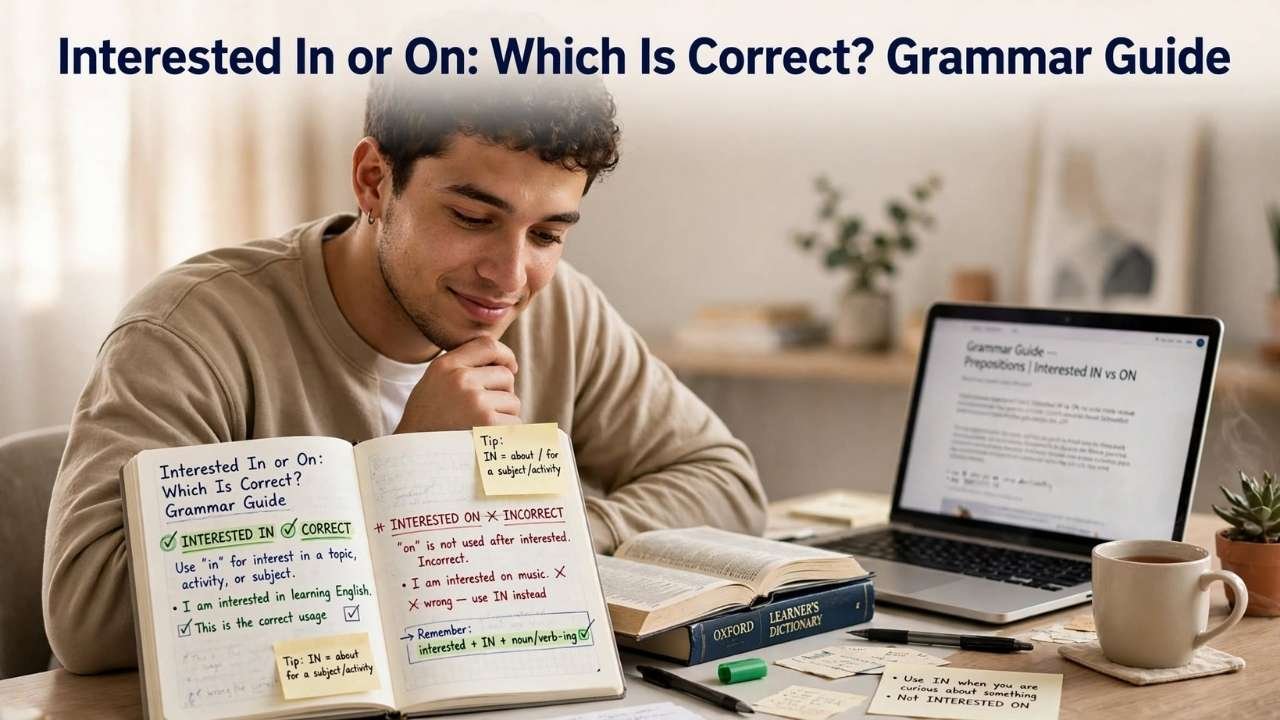
Have you ever wondered whether you should say “interested in or interested on”? This is a common English grammar question, especially for English learners and anyone who wants to write or speak with confidence.
The correct expression is “interested in,” while “interested on” is generally not grammatically correct in standard English. Understanding the correct preposition after interested helps you avoid common grammar mistakes in conversations, emails, academic writing, and professional communication.
In this guide, you’ll learn why we say “interested in,” the grammar rule behind it, clear sentence examples, and the differences between interested in vs interested on. You’ll also discover practical tips, common mistakes to avoid, and simple ways to remember the correct usage so you can write natural, accurate English every time.
Quick Answer
“Interested in” is the correct and standard English expression, while “interested on” is generally incorrect. The adjective interested is naturally followed by the preposition in to show interest in a person, subject, activity, or idea. If you’re wondering “interested in or on—which is correct?” the answer is simple: always use “interested in” in everyday, academic, and professional English.
What Does “Interested In” Mean?

Interested in is the correct expression in English grammar. It means you enjoy, like, or want to learn more about a person, topic, activity, or idea. The adjective interested is always followed by the preposition in in standard English.
For example, you can say, “She is interested in science,” or “They are interested in learning English.” These sentences sound natural because they follow the correct grammar rule.
If you are unsure about interested in or interested on, remember that interested in is the accepted form in everyday, academic, and professional writing. Learning this simple adjective + preposition combination will help you write clearly and avoid common grammar mistakes.
Is “Interested On” Ever Correct?
Many learners ask, “Is interested on grammatically correct?” The simple answer is no. In standard English, interested on is not the correct phrase.
Native speakers almost always use interested in because it is the proper collocation. You might occasionally see on used nearby in a sentence, but it belongs to another part of the sentence, not to interested itself.
For example, “She gave a presentation on climate change, and I was interested in it.” Here, on describes the presentation topic, while interested in remains the correct expression. If you want accurate English writing and natural speech, always choose interested in instead of interested on.
Why Is “Interested In” the Correct Preposition?
The reason we say interested in is that English follows fixed adjective + preposition patterns called collocations. These combinations have become standard through long-term usage by native speakers. Just as we say good at, afraid of, and famous for, we also say interested in.
This is why grammar books and dictionaries recommend in after interested. Using interested on breaks this natural pattern and sounds incorrect to fluent speakers. If you are learning English grammar, remembering these common collocations will improve your writing and speaking.
You can also strengthen your vocabulary by exploring related topics like Words That End in SE, which introduce more useful English word patterns.
Interested In vs Interested On (Comparison Table)
Understanding the difference between interested in and interested on is easy when you compare them side by side.
| Interested In | Interested On |
| ✔ Correct in standard English | ✘ Generally incorrect |
| Used by native speakers | Rarely used this way |
| Accepted in academic writing | Not recommended |
| Common in business writing | Sounds unnatural |
| Follows grammar rules | Breaks the usual collocation |
If someone asks which is correct: interested in or interested on, the answer is always interested in. Whether you are writing an email, completing schoolwork, or having a conversation, this is the form you should use. Choosing the correct preposition makes your English sound more fluent and professional.
The Grammar Rule Behind “Interested In”
The word interested is an adjective, and in English it is naturally followed by the preposition in. This grammar pattern has been used for many years and is accepted in dictionaries, grammar guides, and formal writing.
You can use interested in before a noun, pronoun, or -ing verb. For example, “I am interested in music,” “She is interested in him,” and “They are interested in traveling.” Each sentence follows the same rule.
Learning these patterns helps you avoid common errors and build confidence in your writing. If you enjoy grammar topics, you may also like reading about Humans or Humen, another guide that explains common English spelling and usage mistakes.
Why Many English Learners Say “Interested On”
Many English learners accidentally say interested on because they translate directly from their first language. In some languages, a word similar to on is used after adjectives, so learners naturally make the same choice in English.
Another reason is hearing incorrect phrases online or from other learners. However, grammar rules and native usage clearly show that interested in is the correct expression. The best way to remember this is to practice reading and writing sentences with interested in every day.
The more you see and use the correct phrase, the more natural it will become. With regular practice, you will avoid this common mistake and communicate with greater confidence.
Examples of “Interested In” in Everyday English
The phrase interested in is used in many daily situations. You can use it when talking about hobbies, work, studies, or people.
Here are a few simple examples: “I am interested in photography.” “She is interested in learning Spanish.” “They are interested in starting a small business.” “My brother is interested in history.” “Are you interested in joining our team?” In each sentence, interested in is followed by a noun or an -ing verb, which follows the correct English grammar rule.
Whether you are speaking with friends or writing an email, using interested in instead of interested on makes your English sound natural, clear, and grammatically correct.
Using “Interested In” in Business, Academic, and Professional Writing
In business writing, academic writing, and professional communication, using the correct phrase is very important. Employers, teachers, and clients expect clear and accurate English. You can write, “I am interested in this job opportunity,” “She is interested in conducting further research,” or “We are interested in working with your company.”
These sentences sound professional because they use the correct preposition after interested. Avoid writing interested on in reports, emails, resumes, or presentations, as it may appear as a grammar mistake.
Using interested in correctly improves your writing, builds confidence, and shows that you understand proper English usage in formal and professional situations.
Common Mistakes to Avoid with “Interested”
One of the most common grammar mistakes is writing interested on instead of interested in. Another mistake is using the wrong preposition, such as interested about or interested with, when talking about a subject or activity.
Remember that interested in is the standard and accepted expression in English writing. Also, make sure the word after in fits the sentence. For example, say “interested in science,” “interested in reading,” or “interested in helping others.”
Avoid changing the preposition based on translation from another language. Learning this simple grammar rule will help you avoid common errors and make your sentences sound more natural and fluent.
Similar Expressions: Interested In, Keen On, Curious About, Passionate About
English has several expressions that are similar to interested in, but each has a slightly different meaning. Keen on means you strongly enjoy something, as in “She is keen on painting.”
Curious about shows that you want to know more, such as “He is curious about space.” Passionate about describes a deep love or enthusiasm, for example, “They are passionate about helping people.”
While these expressions have different meanings, they all follow their own adjective + preposition patterns. Learning these common English collocations will improve your vocabulary and help you choose the best expression for every situation.
A Simple Memory Trick to Remember the Correct Preposition
A simple way to remember the correct phrase is to connect interest with the word inside. Both words begin with “in,” reminding you that the correct expression is interested in. Another helpful trick is to remember other common adjective and preposition pairs, such as good at, proud of, and afraid of.
English uses fixed collocations, so changing the preposition usually creates a grammar mistake. Practice by reading and speaking sentences with interested in every day.
The more often you use the correct expression, the easier it becomes to remember. Soon, choosing interested in instead of interested on will feel completely natural.
FAQs
Is “interested on” correct?
No. Interested in is the correct expression in standard English.
Why do we say “interested in”?
Because interested naturally follows the adjective + preposition pattern used in English.
Can I use “interested on” in formal writing?
No. It is considered incorrect in academic, business, and professional writing.
What comes after “interested in”?
You can use a noun, pronoun, or -ing verb, such as music, him, or learning.
How can I remember the correct phrase?
Think of interest and inside—both begin with “in,” making interested in easier to remember.
Conclusion
If you are still wondering “Interested in or on—which is correct?”, the answer is simple: always use interested in. It is the correct expression in standard English, accepted in conversations, school assignments, business emails, and professional writing. Interested on is generally not grammatically correct and should be avoided.
By understanding the grammar rule, practicing with real-life examples, and remembering the simple memory trick, you can use interested in with confidence.
Whether you are an English learner or a fluent speaker, choosing the correct preposition will make your writing clearer, more natural, and more professional. Keep practicing, and correct usage will soon become a habit.