
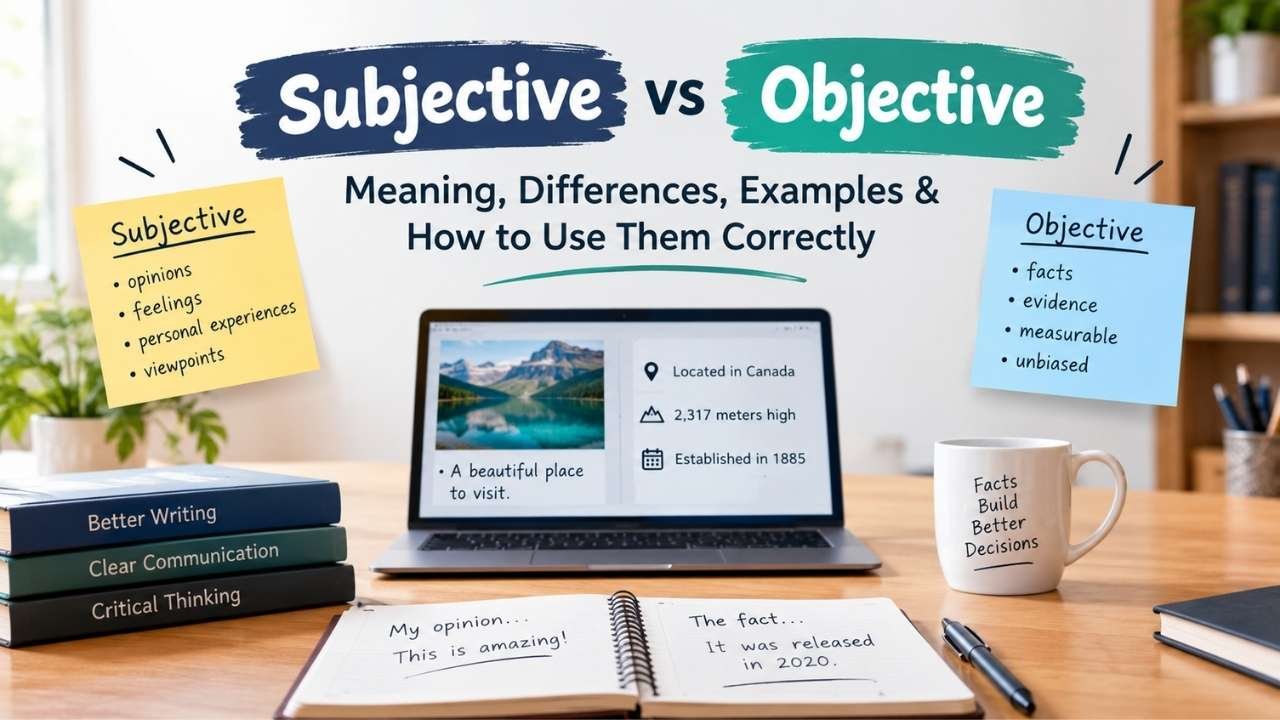
Understanding the difference between subjective vs objective can help you communicate more clearly in writing and everyday conversations. Many people confuse these two terms because both describe the way we look at information, but they represent completely different perspectives.
Subjective meaning is connected to personal opinions, feelings, experiences, and viewpoints, while objective meaning focuses on facts, evidence, and information that can be verified. Knowing the difference between subjective and objective helps you identify opinions versus facts, improve your writing, and avoid misunderstandings.
Whether you are writing an essay, reviewing a product, reading news, or sharing an opinion, understanding subjective vs objective differences allows you to express ideas in a more accurate and effective way.
Quick Answer
Subjective vs objective refers to the difference between personal opinions and factual information. Subjective ideas are based on feelings, experiences, beliefs, or personal viewpoints, while objective information is based on facts, evidence, and details that can be proven. Understanding this difference helps you recognize opinions, analyze information, and improve clear communication.
What Does Subjective Mean?

Subjective means something that is based on a person’s opinions, feelings, experiences, or personal viewpoints. A subjective statement reflects how someone thinks or feels about a topic rather than information that can be proven.
For example, saying “This movie is the best I have ever watched” is a subjective opinion because it depends on personal taste. Different people may have different views about the same movie.
Subjective language is common in reviews, personal stories, conversations, and creative writing. Understanding the subjective meaning helps you recognize when someone is sharing a personal perspective instead of a fact. While subjective statements may not be proven, they can still be meaningful because they show individual experiences and emotions.
What Does Objective Mean?
Objective means something that is based on facts, evidence, measurements, or information that can be verified. An objective statement does not depend on personal feelings or opinions. Instead, it focuses on details that can be checked and confirmed by others. For example, “The
Earth revolves around the Sun” is an objective fact because it can be supported by scientific evidence. Objective language is often used in research, news reports, academic writing, and professional communication.
Understanding the objective meaning helps you identify information that is neutral and reliable. When writing objectively, people usually avoid emotional words and focus on accurate details. This creates clear, fair, and trustworthy communication.
Subjective vs Objective: What Is the Main Difference?
The main difference between subjective vs objective is the source of information. Subjective ideas come from personal thoughts, feelings, and experiences, while objective ideas come from facts, proof, and evidence. A subjective statement may change from person to person because everyone has different opinions.
An objective statement remains the same because it is based on information that can be checked. For example, “Chocolate ice cream tastes better than vanilla” is subjective because it is a personal preference.
However, “Ice cream contains dairy ingredients” is objective because it can be verified. Understanding the difference between subjective and objective helps you separate personal opinions from factual information in writing, discussions, and everyday situations.
Subjective vs Objective Examples in Everyday Life
Learning through examples makes the difference between subjective and objective easier to understand. In daily life, people often mix opinions with facts without realizing it. A statement like “This restaurant has the most delicious food in town” is subjective because it expresses a personal opinion.
Someone else may disagree based on their own taste. On the other hand, “This restaurant opened in 2020” is objective because the information can be confirmed. Product reviews, social media posts, and personal recommendations often include subjective opinions.
News reports, research findings, and official records usually focus on objective facts. Knowing these examples helps you identify whether information comes from personal feelings or reliable evidence.
How to Identify Subjective and Objective Statements
To identify subjective and objective statements, ask a few simple questions. First, check whether the statement includes personal feelings, preferences, or judgments. If it does, it is likely subjective. Words such as “beautiful,” “amazing,” “terrible,” or “best” often show personal opinions.
Next, ask whether the statement can be proven with evidence. If it can be measured, researched, or confirmed, it is usually objective. For example, “This book is interesting” is subjective because interest depends on the reader.“
This book has 250 pages” is objective because the number can be verified. Learning how to identify these differences improves reading skills, writing ability, and critical thinking.
Subjective vs Objective Writing: Which Style Should You Use?
Choosing between subjective writing and objective writing depends on your purpose. Subjective writing is useful when you want to share personal experiences, opinions, or emotions. It is common in blogs, reviews, stories, and opinion articles.
Objective writing focuses on facts, evidence, and neutral information, making it suitable for academic papers, reports, and professional documents. For example, a travel blogger may write a subjective review about a destination, while a travel guide may provide objective details about its location and history.
Both writing styles are valuable when used correctly. If you want to improve your writing skills, exploring topics like Verbs That Start With W can also help you choose stronger action words and express ideas more clearly.
Is Subjective Always Wrong and Objective Always Correct?
Many people think subjective means wrong and objective means always correct, but this is not true. Subjective opinions are based on personal experiences, and they can still provide valuable information. For example, a customer’s opinion about a product may help others decide whether to buy it.
However, subjective views may differ because people have different preferences and backgrounds. Objective information is usually more reliable for facts, but it also depends on accurate sources and evidence.
The goal is not to choose one over the other but to understand when each type of information is useful. Recognizing the value of both perspectives helps people communicate better and make smarter decisions.
Subjective vs Objective in Academic and Professional Communication
Understanding subjective vs objective communication is important in schools, workplaces, and professional settings. In academic writing, researchers and students usually use objective language because they need to present facts, evidence, and reliable information. For example, a research paper should explain results based on data instead of personal feelings.
In professional communication, objectivity helps people make fair decisions and avoid misunderstandings. Reports, business documents, and official messages often require a neutral tone.
However, subjective opinions can still be useful in situations like brainstorming, feedback, and creative discussions. Knowing when to use subjective statements and when to use objective statements allows you to communicate ideas more clearly and effectively.
How Bias Affects Subjective and Objective Thinking
Bias can influence the way people understand information and form opinions. Since subjective thinking is connected to personal experiences and beliefs, it can sometimes include personal bias. For example, someone may think a product is the best because they had a positive experience with it.
Objective thinking tries to reduce bias by focusing on facts, evidence, and reliable information. However, being completely free from bias can be challenging because people naturally have different backgrounds and viewpoints.
Learning to recognize bias helps you evaluate information more carefully. By comparing different sources and looking for evidence, you can develop stronger critical thinking skills and make more balanced judgments.
Common Mistakes When Using Subjective and Objective
People often make mistakes when they confuse subjective vs objective information. One common mistake is believing that every opinion is wrong. A subjective opinion may not be a fact, but it can still provide useful insight or personal experience.
Another mistake is treating every statement that sounds confident as objective. A claim needs evidence and proof to be considered objective. People also sometimes use emotional words in situations that require objective language, such as reports or research papers.
For example, saying “This is the worst product ever” is subjective, while “The product received 500 customer reviews” is objective. Understanding these mistakes helps you use both styles correctly.
Subjective vs Objective: Understanding Facts and Opinions
The connection between facts and opinions is one of the easiest ways to understand the difference between subjective and objective ideas. Facts are usually connected with objective statements because they can be checked and supported with evidence.
Opinions are usually connected with subjective statements because they represent personal beliefs or feelings. For example, “The Earth has one moon” is an objective fact because it can be verified. “
The moon is beautiful” is a subjective opinion because beauty depends on personal preference. Both facts and opinions are important, but they serve different purposes. Learning to separate facts vs opinions helps you understand information better and communicate your ideas more accurately.
Subjective and Objective Examples in Different Fields
The use of subjective and objective statements varies depending on the field. In journalism, objective writing focuses on presenting facts, whereas opinion articles may include personal views and interpretations. Science, on the other hand, relies heavily on objective information, including data, measurements, and test results.
Marketing also uses both approaches in different ways. Product descriptions typically provide objective details about features, sizes, or specifications, while customer reviews often express subjective opinions based on personal experiences. Similarly, education may require students to give objective answers on exams while allowing more subjective responses in essays, discussions, or personal reflections.
Recognizing these differences makes it easier to choose the appropriate communication style for each situation. Whether you are writing a report, describing an experience, or analyzing information, understanding when to use subjective and objective approaches can make your writing clearer, more accurate, and easier to understand.
Subjective vs Objective Language: Words That Show the Difference
The words people use can often reveal whether a statement is subjective or objective. Subjective language usually includes emotional or judgment-based words. Examples include amazing, boring, beautiful, horrible, delicious, and exciting. These words express personal feelings and opinions.
Objective language uses words that describe facts, measurements, or verified details, such as recorded, measured, confirmed, documented, and tested. For example, “This phone is incredible” is subjective because it shows an opinion. “
This phone has a 5000 mAh battery” is objective because it provides a specific fact. Recognizing these language patterns can help you identify opinions and facts more easily in articles, conversations, and written content.
How to Make Your Writing More Objective
Writing objectively means presenting information in a fair and balanced way. To create objective writing, focus on facts instead of personal opinions. Use evidence, examples, statistics, and reliable sources to support your ideas. Avoid emotional words that may influence the reader’s opinion.
For example, instead of writing “This is the most amazing invention,” write “This invention improved performance by 30%.” Using a neutral tone makes your content more trustworthy and professional.
Objective writing is especially important for academic papers, business reports, and informative articles. However, this does not mean your writing must feel boring. You can still make objective content engaging by explaining facts clearly and organizing information in a reader-friendly way.
When Should You Use Subjective Writing?
Subjective writing is useful when your goal is to share personal thoughts, experiences, or emotions. Writers often use this style in personal blogs, travel stories, product reviews, and opinion articles.
For example, a person describing their favorite vacation destination may explain how the place made them feel. These personal details create a connection with readers and make the content more relatable. Subjective writing is not about proving a fact; it is about sharing a unique viewpoint.
However, writers should make it clear when they are expressing opinions rather than presenting information as truth. Using subjective language correctly helps readers understand the difference between personal experience and verified facts.
When Should You Use Objective Writing?
Objective writing is best when you need to provide accurate, neutral, and trustworthy information. It is commonly used in research papers, news reports, instruction guides, business documents, and educational content.
The goal of objective writing is to explain information without adding personal feelings or bias. For example, a science article should focus on research findings rather than saying whether the writer likes or dislikes the results.
Using objective facts and clear evidence helps readers trust the information they receive. Although objective writing focuses on facts, it can still be interesting when ideas are explained with simple examples and clear organization. Choosing the correct writing style depends on your purpose and audience.
FAQs
What is the difference between subjective and objective?
Subjective is based on personal opinions, feelings, and experiences, while objective is based on facts, evidence, and information that can be verified.
Is subjective based on opinion?
Yes. A subjective statement usually reflects someone’s personal thoughts, beliefs, or feelings.
Is objective always factual?
Objective information is generally based on facts that can be checked, measured, or supported by evidence.
What is an example of a subjective statement?
“This restaurant has the best food in the city” is a subjective statement because it depends on personal taste.
What is an example of an objective statement?
“The restaurant opened in 2018” is an objective statement because it can be confirmed.
Can something be both subjective and objective?
Yes. A topic can include both factual information and personal opinions depending on the situation.
Why is objective writing important?
Objective writing helps readers receive clear, balanced, and trustworthy information without unnecessary bias.
Conclusion
Understanding subjective vs objective helps you recognize the difference between personal opinions and factual information. Subjective ideas come from feelings, experiences, and individual viewpoints, while objective ideas rely on facts, evidence, and information that can be proven.
Neither approach is always better because both have different purposes. Subjective writing is useful for sharing experiences and opinions, while objective writing is important for presenting accurate information.
Whether you are studying, writing, working, or communicating with others, knowing when to use each style improves clarity and understanding. By learning these differences, you can analyze information more carefully and express your ideas in a more effective way.