
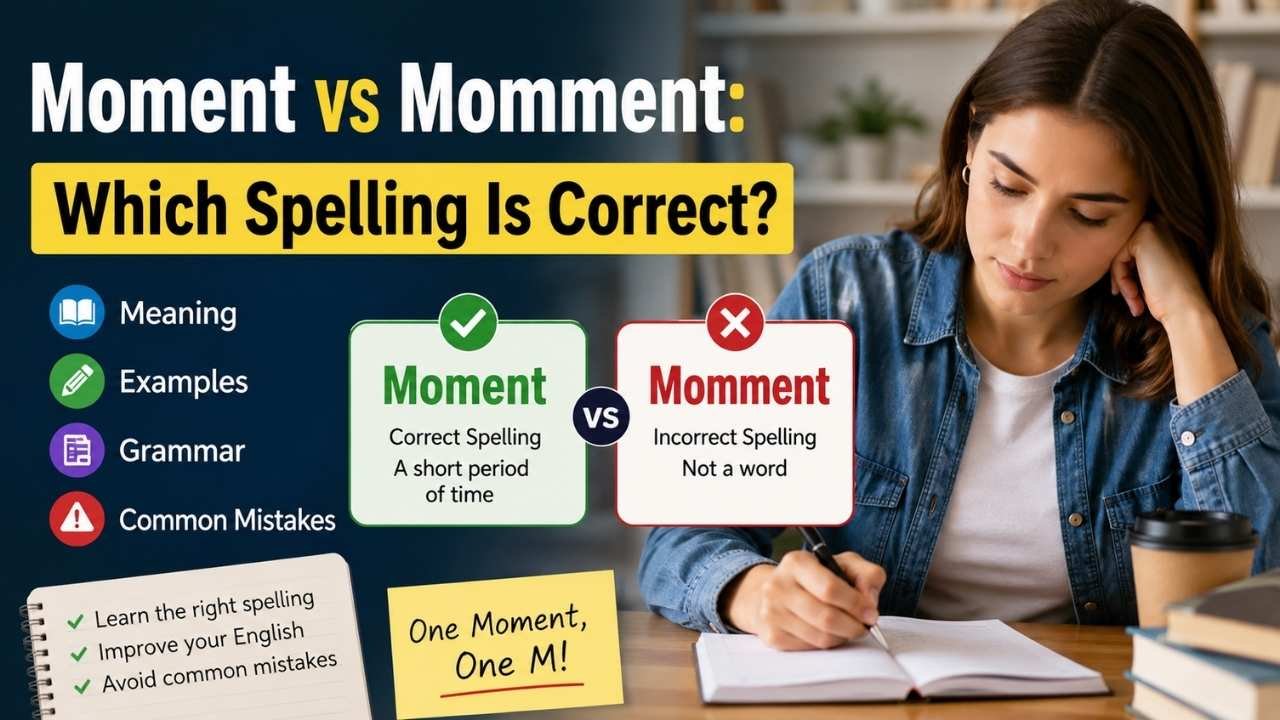
Have you ever paused while writing and wondered whether “moment” or “momment” is the correct spelling? You’re not alone. This small spelling mistake can be easy to make, especially when you type quickly or think the word should have a double m.
The good news is that the answer is simple: moment is correct, while momment is incorrect. The word moment is a common English noun used for a short period of time, a particular point in time, or an important occasion.
In this guide, we’ll explain the moment vs momment difference, show you the correct spelling, explore its meaning and usage, and provide clear examples. You’ll also learn why people write momment, common phrases with moment, and an easy trick to remember the correct spelling.
Quick Answer
Moment is the correct spelling, while momment is an incorrect spelling and is not a standard English word. If you’re wondering, “Is it moment or momment?” always choose moment. It means a short period, a particular point in time, or an important occasion. Remember: moment has only one middle “m.”
What Does Moment Mean?

The word moment has several simple meanings, depending on how it is used in a sentence. Most often, it means a short period of time. For example, “Please give me a moment” means “Please give me a short amount of time.” It can also mean a particular point in time, such as “At that moment, I knew I was right.” Another meaning is an important or special occasion.
For example, “Graduation was a proud moment for her.” The word is mainly used as a noun, and it appears in many common English expressions. Understanding these meanings makes it easier to use moment correctly in everyday writing and speaking. Whether you mean a brief time, a specific point, or a special event, the spelling remains moment, never momment.
Is “Momment” a Real Word?
Momment is not a standard English word. It is usually an incorrect spelling of moment. If you search for “momment meaning,” you may find examples of people using it online, but these uses do not make it a correct English spelling.
The main problem is the extra m in the middle. The correct form is M-O-M-E-N-T, with only one m between “mo” and “ent.” For example, write, “I will be there in a moment,” not “I will be there in a momment.” If you are asking, “Is momment a word?”, the simple answer is no in standard English. Always use moment in school, work, emails, articles, and other formal or everyday writing to avoid this common spelling mistake.
Why Do People Spell “Moment” as “Momment”?
People may spell moment as momment for several simple reasons. One common reason is that English contains many words with double consonants, so writers may add an extra m without noticing. Typing quickly can also cause this mistake, especially when someone is not checking their writing carefully. Another reason is that people sometimes spell words based on how they think they sound.
Since moment has two syllables, a writer may wrongly feel that the word needs another m. This is why the misspelling momment can look natural even though it is incorrect. The best way to avoid this error is to remember the correct spelling and check the word when you are unsure. Moment has one middle m, so there is no need to double it.
Moment vs Momment: Spelling Rule to Remember
The easiest spelling rule is simple: moment has only one middle “m.” You can break the word into two easy parts: mo + ment = moment. Do not add another m between these parts. The incorrect spelling looks like this: mo + mment = momment. A useful memory trick is: “One moment, one middle M.” This short sentence can help you remember the correct spelling whenever you hesitate.
For example, you should write, “Wait a moment,” rather than “Wait a momment.” You can also connect the spelling to familiar phrases such as at the moment or in a moment. Once you remember that moment uses one middle m, the spelling becomes much easier. This simple trick can prevent the mistake in everyday writing.
How to Use “Moment” Correctly in a Sentence
You can use moment in many everyday sentences because it describes a short time, a specific point, or an important occasion. Here are some simple examples: “Please wait a moment.” This means to wait for a short time. “I will call you in a moment.” Here, moment means a short period from now.
“At that moment, I understood everything.” In this sentence, it means a particular point in time. You can also use it for an important experience: “Winning the award was a proud moment.” These examples show how flexible the word moment can be. Remember that the correct spelling is always moment, not momment. Using the word correctly in different sentences will also make its meaning and spelling easier to remember.
Common Phrases and Expressions With “Moment”
The word moment appears in many common English phrases. One of the most common is “at the moment,” which means now or at the present time. For example, “I’m busy at the moment.” “In a moment” means after a short time, as in “I’ll help you in a moment.” “A moment ago” means a short time before now.
You may also hear “from moment to moment,” which describes something that changes as time passes. “Moment by moment” focuses on events as they happen one short period at a time. Other useful expressions include “moment of truth,” “defining moment,” and “spur-of-the-moment.” Learning these phrases can help you understand and use moment naturally in everyday English without confusing it with the incorrect spelling momment.
Moment vs Moments: Singular and Plural Forms
Moment is the singular form, while moments is the plural form. Use moment when you are talking about one short period, point in time, or occasion. For example, “Give me a moment.” Use moments when you are talking about two or more. For example, “We shared many happy moments together.”
The plural form is made by simply adding s to moment. You do not add another m when making it plural. Therefore, moment → moments is correct, while momment → momments is incorrect. Knowing the singular and plural forms can help you avoid spelling mistakes in your writing. If you are writing about several special occasions, memories, or short periods of time, moments is the form you need.
How Do You Pronounce “Moment”?
The word moment is usually pronounced with two syllables: MO-ment. The first part sounds stronger, while the second part is lighter. When speaking naturally, the word may sound quick and smooth, but its spelling does not change. Most importantly, the pronunciation does not require an extra m in the spelling. You should write moment, not momment. If you are learning English, saying the word while looking at its spelling can help you remember it.
Try saying, “One moment, please,” a few times. This common phrase connects the sound with the correct written form. Remember that pronunciation can vary slightly between English accents, but the standard spelling remains moment. Learning both the pronunciation and spelling together can make the word easier to use confidently.
Moment vs Momentum: Are They the Same?
Moment and momentum are different words, even though they look and sound somewhat similar. Moment usually refers to a short period of time, a point in time, or an important occasion. For example, “Please wait a moment.” Momentum, on the other hand, refers to a force or energy that helps something continue moving or developing. For example, “The team gained momentum after winning several games.”
These words should not be treated as interchangeable. This confusion is different from moment vs momment, because momment is simply an incorrect spelling. If you are learning commonly confused English words, understanding these small differences can improve your writing. The key point is simple: moment relates to time or an occasion, while momentum relates to movement, progress, or force.
Common Mistakes to Avoid With “Moment”
The most common mistake is adding an extra m and writing momment instead of moment. For example, “Please wait a momment” is incorrect, while “Please wait a moment” is correct. Another common mistake is writing “at the momment” instead of “at the moment.” You should also remember the correct plural form: moments, not momments. These errors are easy to make when typing quickly, but they are simple to fix.
Before submitting an email, article, school assignment, or message, quickly check words that you often misspell. Remember the basic rule: moment has one middle m. Avoiding this one extra letter will help your writing look cleaner and more professional. If you are interested in other word choices that can be confusing, girlie vs girly is another useful comparison to explore.
Moment vs Momment Examples: Correct and Incorrect
Seeing the correct and incorrect forms side by side makes the difference easy to understand. “Please wait a momment” is incorrect because momment contains an extra m. The correct sentence is, “Please wait a moment.” Similarly, write “It was a special moment,” not “It was a special momment.” You should also write “I’ll call you in a moment,” rather than “I’ll call you in a momment.”
Another common phrase is “At the moment, I’m busy.” Never write at the momment. These examples show that the same spelling rule applies in different sentences and expressions. Whenever you need this word, choose moment. Once you notice the extra m in momment, it becomes much easier to spot and correct the mistake.
Easy Ways to Remember the Correct Spelling
A simple memory trick can help you remember that moment has only one middle m. Think of the phrase: “One moment, one middle M.” You can also break the spelling into two parts: MO + MENT = MOMENT. This makes it easier to see why adding another m is unnecessary.
Another helpful idea is to remember a common phrase such as “at the moment.” Say it and picture the correct spelling in your mind. If you write momment, look for the two middle m’s and remove one. These small tricks can help you remember the correct spelling without having to check a dictionary every time. With regular use, moment will soon become a word you can spell naturally and confidently.
FAQs
Is it moment or momment?
Moment is correct, while momment is incorrect.
Is momment a word?
No, momment is not a standard English word; it is a common misspelling of moment.
How do you spell moment?
The correct spelling is M-O-M-E-N-T.
Does moment have one m or two?
It has one middle m.
What does moment mean?
It can mean a short period, a particular point in time, or an important occasion.
What is the plural of moment?
The plural is moments.
Is moment a noun?
Yes, moment is commonly used as a noun.
How do you pronounce moment?
It is commonly pronounced with two syllables, MO-ment.
Conclusion
The answer is clear: moment is the correct spelling, while momment is incorrect in standard English. The word moment can describe a short period, a particular point in time, or an important occasion.
You can use it in common phrases such as at the moment, in a moment, and moment of truth. When writing the word, remember that it has only one middle “m.” The easiest memory trick is “One moment, one middle M.”
So, whenever you wonder “moment or momment?”, choose moment. Using the correct spelling will make your writing clearer and help you avoid one of the common spelling mistakes associated with this everyday English word.