

Many English learners get confused by Business vs Busyness because the two words look and sound similar, yet they have completely different meanings. While business usually refers to a company, trade, or work, busyness describes the state of being busy. Knowing the difference between business and busyness helps you choose the correct word in conversations, emails, school assignments, and professional writing.
In this guide, you’ll learn the business meaning, busyness meaning, business definition, busyness definition, pronunciation, spelling differences, grammar rules, and correct usage of business and busyness.
You’ll also find simple explanations, comparison tables, and real-life business vs busyness examples to make these commonly confused words easy to understand and remember. By the end, you’ll know exactly when to use business and when to use busyness with confidence.
Quick Answer
Business and busyness are different nouns with different meanings. Business refers to commerce, a company, work, or professional activities, while busyness means the state of being busy or occupied. Although they sound similar, they are not interchangeable. Understanding the difference between business and busyness helps you use the correct word in writing, speaking, and everyday English with confidence.
Business vs Busyness at a Glance
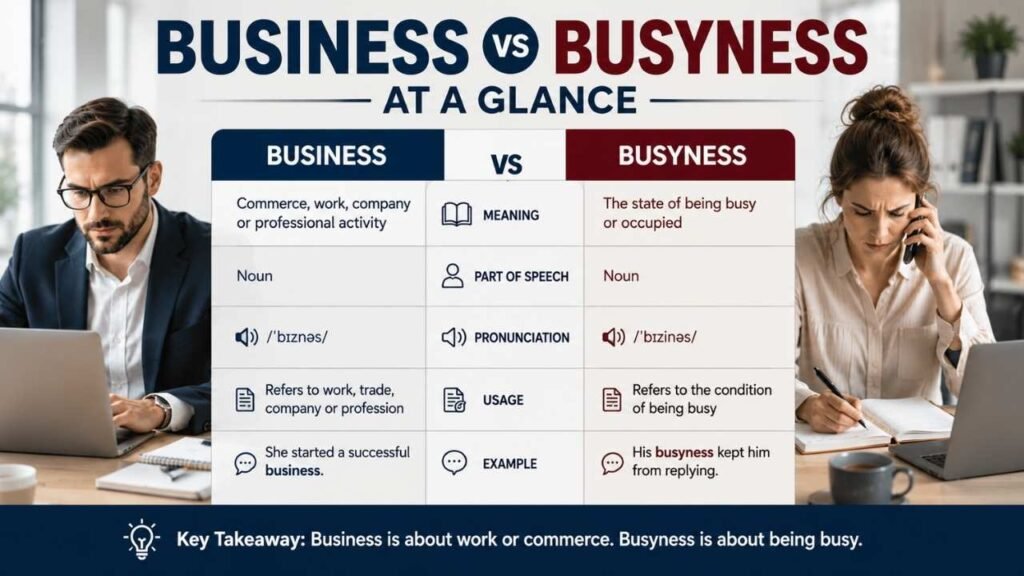
Many people mix up business and busyness because they look and sound alike. However, they have different meanings, different uses, and should not be used interchangeably.
Business usually refers to commerce, a company, work, or professional activities, while busyness means the state of being busy or occupied. Understanding the difference between business and busyness will improve your English grammar, writing, and speaking skills.
The comparison table below gives a quick overview of the business meaning, busyness meaning, pronunciation, spelling, and correct usage of business and busyness. If you enjoy learning about commonly confused English words, you may also like our guide on Freshman vs Freshmen, which explains another pair of words that often causes confusion.
| Feature | Business | Busyness |
| Meaning | Commerce, work, company, or professional activity | The state of being busy |
| Part of Speech | Noun | Noun |
| Pronunciation | /ˈbɪznəs/ | /ˈbɪzinəs/ |
| Usage | Refers to work or trade | Refers to being occupied |
| Example | She started a successful business. | His busyness kept him from replying. |
What Does “Business” Mean?
Business is a noun with several meanings, but it most often refers to commerce, trade, a company, or professional work. It can also describe someone’s job, responsibilities, or an organization that sells products or services.
Understanding the business definition helps you use the word correctly in conversations, emails, and formal writing. Unlike busyness, business is not about being occupied—it focuses on work or commercial activities.
For example, “She owns a small business” means she runs a company, while “Let’s get down to business” means it’s time to focus on an important task. Learning the business meaning and seeing business examples makes it easier to choose the correct word in different situations.
Examples:
- My parents own a family business.
- The meeting focused on business plans for next year.
- He studied business at university.
- We finished our business before lunch.
What Does “Busyness” Mean?
Busyness is a noun that describes the state of being busy. It means having many tasks, activities, or responsibilities that keep someone occupied. The busyness definition is different from the business definition, even though the words sound similar.
You might use busyness when talking about a packed schedule, a hectic day, or a lifestyle with little free time. It is commonly used in everyday English and personal conversations rather than in commercial contexts.
Knowing the busyness meaning helps you avoid confusing it with business. If you enjoy learning practical English expressions, you may also find our article on Respond To A Pity Invite helpful for improving everyday communication.
Examples:
- Her busyness made it hard to take a vacation.
- The holiday season brought extra busyness to the office.
- I apologized for my busyness last week.
- His constant busyness left little time for hobbies.
Business vs Busyness: What Is the Difference?
The difference between business and busyness is simple once you know what each word means. Business refers to work, commerce, a company, or professional activities, while busyness means the condition of being busy.
Although they have similar pronunciation, they describe completely different ideas. You should use business when talking about companies, jobs, trade, or official matters. Use busyness when describing a full schedule or a person who is occupied with many tasks.
Understanding business vs busyness improves your English vocabulary, grammar, and writing. The easiest way to remember them is to think of business as work and busyness as the feeling of always having something to do.
Pronunciation Differences Between Business and Busyness
The pronunciation of business and busyness is one reason many learners confuse these words. Business is commonly pronounced /ˈbɪznəs/, where the middle sound is shortened. Busyness is pronounced /ˈbɪzinəs/, keeping the sound of the word busy before adding -ness.
Even though the difference is small, listening carefully makes it easier to tell them apart. Practicing the business pronunciation and busyness pronunciation aloud will improve your speaking confidence.
Reading example sentences and repeating them can also help you remember the correct sound. Paying attention to pronunciation, along with meaning and context, makes choosing the right word much easier in everyday English.
Spelling Differences Explained
The spelling difference between business and busyness often surprises English learners. Business does not follow the expected spelling because it developed over time and kept its traditional form.
On the other hand, busyness is formed by adding the suffix -ness to the adjective busy, creating a word that means the state of being busy. This is why the two words look similar but are spelled differently.
Learning these spelling patterns helps you avoid common writing mistakes. Whenever you write about commerce, companies, or work, use business. When describing a packed schedule or someone who is occupied, choose busyness instead.
Grammar Rules for Using Business and Busyness
Both business and busyness are nouns, but they are used in different contexts. Business usually refers to commerce, work, trade, or an organization, while busyness refers to the condition of being busy.
These words are not interchangeable, so always choose the one that matches your meaning. For example, “She runs a successful business” is correct because it refers to a company. “Her busyness prevented her from attending the meeting” is also correct because it describes a busy schedule.
Following these simple grammar rules for using business and busyness will improve your writing, speaking, and overall understanding of commonly confused English words.
Business vs Busyness in Real-Life Examples
Seeing business vs busyness examples in real situations is one of the easiest ways to remember the difference. Use business when talking about commerce, work, a company, or professional activities.
Use busyness when describing someone who has a full schedule or many responsibilities. The context tells you which word is correct. For example, “Our business is growing every year” refers to a company, while “Her busyness kept her from joining the event” describes being occupied.
Reading and practicing these examples will improve your English vocabulary, grammar, and confidence. The more you use these words in everyday conversations and writing, the more natural their correct usage will become.
Examples:
- The family business has served customers for decades.
- His busyness caused him to miss the meeting.
- She is studying business at college.
- Weekend busyness left little time to relax.
Common Mistakes People Make
Many learners make mistakes because business and busyness have similar spelling and pronunciation. The most common error is using business when talking about being busy or using busyness when referring to a company or trade.
Another mistake is assuming the words can replace each other, but they have different meanings. Some people also struggle with the business pronunciation because it sounds different from its spelling.
To avoid these errors, always think about the context. If the sentence is about work, commerce, or a company, choose business. If it describes a person’s state of being busy, use busyness. Careful reading and regular practice make the correct choice much easier.
Easy Memory Tricks to Remember the Difference
A simple memory trick can help you remember business vs busyness every time. Think of business as something connected to a business owner, company, or job. If the sentence is about commerce or work, the correct word is business.
For busyness, focus on the word busy. Since busyness comes from busy + -ness, it means the state of being busy. Another helpful trick is to remember that business earns money, while busyness fills your schedule.
These easy associations make it much simpler to choose the right word. Using these memory tips while reading, writing, and speaking will help you avoid confusion and improve your English naturally.
Word Origin (Etymology) of Business and Busyness
The words business and busyness share the same root, busy, but they developed in different ways. The word business comes from an older form of English where it originally described being occupied with important work.
Over time, its meaning changed to include trade, commerce, and professional activities. Busyness, however, kept its direct connection to the adjective busy. It is created by adding the suffix -ness, which turns an adjective into a noun that describes a state or condition.
This explains why the two words have different spellings and meanings today. Understanding their history makes the difference between business and busyness easier to remember and apply correctly.
Related Confusing Words You Should Know
If you often confuse business and busyness, you may also mix up other similar English words. Learning these pairs can improve your English grammar and vocabulary. For example, busy describes a person with many tasks, while business refers to work or commerce.
Work is any effort you do, but a job is a specific position or role. Likewise, occupation refers to a profession, while profession often describes a career that requires special skills or training.
Studying commonly confused words together helps you notice small differences in meaning and usage. As a result, your writing becomes clearer, more accurate, and easier for others to understand.
Practice Quiz: Can You Choose the Correct Word?
Test your understanding of business vs busyness with this short quiz. Read each sentence and decide whether business or busyness is the correct choice. After answering, check the solutions below to see how well you did.
Choose the correct word:
- She started her own ________ last year.
- His ________ kept him from attending the party.
- They discussed ________ plans during the meeting.
- The holiday ________ made everyone feel tired.
Answers:
- Business
- Busyness
- Business
- Busyness
If you answered all four correctly, you now have a solid understanding of the correct usage of business and busyness.
FAQs
Is busyness a real word?
Yes. Busyness is a correct English noun that means the state of being busy.
What is the difference between business and busyness?
Business refers to commerce, work, or a company, while busyness means being occupied with many tasks.
Why is business spelled differently?
The spelling comes from its historical development in English, while busyness follows the standard busy + -ness pattern.
Can business and busyness be used interchangeably?
No. They have different meanings and should be used in different contexts.
How can I remember the difference?
Remember this simple rule: Business = work or commerce. Busyness = being busy.
Is busyness formal English?
Yes. It is a correct and accepted English word, although being busy is often more common in everyday conversation.
Which word should I use?
Use business when talking about work, trade, or companies. Use busyness when describing a full schedule or the condition of being busy.
Conclusion
Understanding Business vs Busyness is easier once you know what each word represents. Business is connected with commerce, companies, work, and professional activities, while busyness describes the state of being busy.
Although they look and sound similar, they should never be used interchangeably. By learning their meanings, pronunciation, spelling differences, grammar rules, and real-life examples, you can avoid common mistakes and communicate more clearly.
Keep practicing these words in everyday conversations and writing, and use the simple memory tricks from this guide whenever you are unsure. With regular practice, choosing between business and busyness will soon become natural and effortless.