

Choosing the correct English phrase can sometimes be confusing, especially when two expressions look almost the same. One common question is “Beside vs Besides the Point “—which one is correct? Although beside and besides differ by just one letter, they have different meanings and grammar roles.
In the well-known idiom, “beside the point” is the correct phrase, while “besides the point” is usually incorrect. Understanding the difference between beside and besides will help you avoid a common grammar mistake and improve your English writing and everyday conversations.
In this guide, you’ll learn the meaning of “beside the point,” simple grammar rules, real-life sentence examples, common errors to avoid, and an easy memory trick to remember the correct usage with confidence.
Quick Answer
The correct phrase is “beside the point,” not “besides the point.” “Beside the point” is a common English idiom that means irrelevant or not related to the main issue. While beside and besides have different meanings, only “beside the point” is grammatically correct in this expression. Learning the difference between beside and besides helps you use the phrase confidently in speaking and writing.
Beside the Point vs. Besides the Point at a Glance
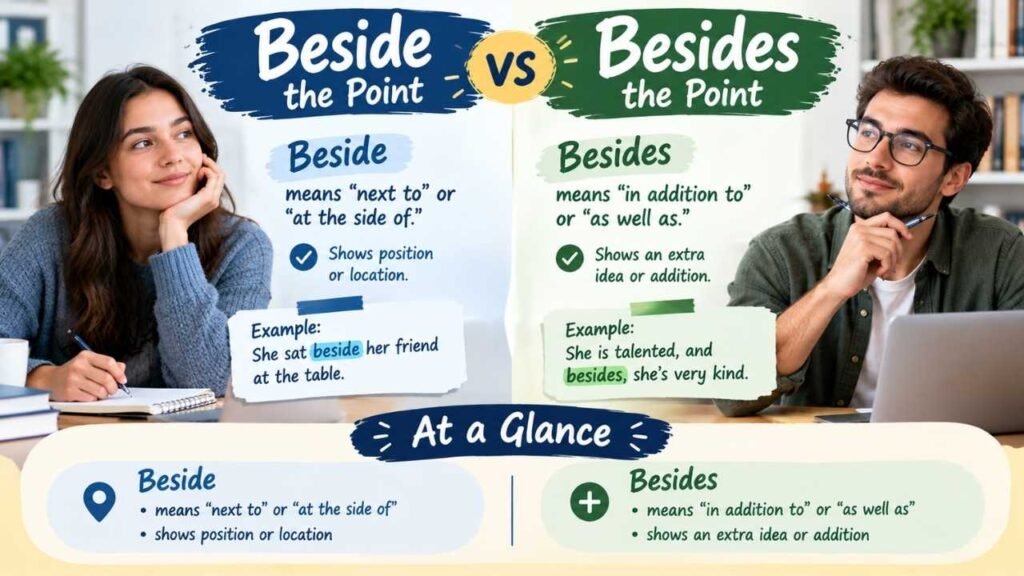
Many people wonder whether they should write “beside the point” or “besides the point.”
The correct expression is “beside the point.” It is a common English idiom that means something is irrelevant or does not relate to the main topic. Although beside and besides look similar, they have different meanings and grammar roles. The table below makes the difference between beside and besides easy to understand.
Learning this simple rule will improve your English grammar, writing, and everyday conversations. If you enjoy learning about commonly confused words, you may also like our guide on Business vs Busyness, which explains another pair of words that often cause confusion.
| Feature | Beside the Point | Besides the Point |
| Correctness | Correct idiom | Usually incorrect |
| Meaning | Irrelevant or not related to the main issue | Not the accepted idiomatic expression |
| Grammar | Uses beside as part of an idiom | Uses besides, which changes the meaning |
| Example | Your excuse is beside the point. | Your excuse is besides the point. (Incorrect) |
Which Is Correct: Beside the Point or Besides the Point?
The correct phrase is “beside the point.” If you are asking, “Is it beside the point or besides the point?” the answer is simple: always use “beside the point” when you mean something is not relevant to the discussion.
This expression has been part of standard English for many years and is accepted in both speaking and writing. Many people mistakenly write “besides the point” because besides is a familiar word that often means “in addition to.”
However, that meaning does not fit this idiom. Understanding the difference between beside and besides helps you avoid a common grammar mistake and write with more confidence. If you enjoy grammar guides like this, you may also find our article on Have Vs Had helpful for mastering another common English confusion.
What Does “Beside the Point” Mean?
The phrase “beside the point” means something is not important to the current discussion or does not help answer the main question. It is a popular English expression used in everyday conversations, school, work, and even professional writing.
For example, if two people are discussing the cause of a problem and someone mentions an unrelated fact, another person might say, “That’s beside the point.” In other words, the comment is irrelevant.
This idiom does not mean physically next to the point. Instead, it has a figurative meaning that English speakers understand through common usage. Learning the meaning of “beside the point” makes it easier to use the phrase naturally in different situations.
Why “Besides the Point” Is Usually Incorrect
Many learners ask, “Can you say ‘besides the point’?” In most cases, the answer is no. The phrase “besides the point” is considered incorrect because the established English idiom is “beside the point.”
The word besides usually means “in addition to” or “also,” which creates a different meaning that does not match the idiom. This is why grammar experts recommend avoiding “besides the point” when referring to something irrelevant.
Knowing this simple grammar rule helps you choose the correct phrase every time. Once you understand why “beside the point” is correct, you’ll find it much easier to avoid this common error in both speaking and writing.
Beside vs. Besides: What’s the Difference?
Although beside and besides differ by only one letter, they have different meanings. Beside is a preposition that usually means next to or at the side of someone or something. Besides can be a preposition or an adverb, and it often means in addition to or also.
This difference is the main reason people confuse the two words. The idiom “beside the point” keeps the original form that has been accepted in English usage for years.
Remember this simple rule: use beside in the idiom and besides when you want to add extra information. Understanding this difference between beside and besides will improve both your grammar and vocabulary.
Grammar Rules You Should Remember
Learning a few simple grammar rules will help you use “beside the point” correctly every time. First, remember that “beside the point” is a fixed English idiom, so you should not replace beside with besides.
Second, beside is mainly a preposition meaning next to, while besides usually means in addition to or also. Because these words have different meanings, they cannot be swapped in this expression.
If you are unsure, ask yourself whether you mean “irrelevant” or “also.” If you mean something is not related to the main topic, the correct phrase is always “beside the point.” This easy rule helps you avoid a common grammar mistake.
Common Situations Where You Can Use “Beside the Point”
The phrase “beside the point” is useful in many everyday situations. You can use it during a work meeting when someone brings up an unrelated idea. Teachers may say it in the classroom if a student’s comment does not answer the question.
Friends often use it in casual conversations to bring the discussion back to the main topic. It also appears in emails, articles, presentations, and online discussions.
For example, if people are debating the best solution to a problem, mentioning an unrelated event is beside the point. Knowing how to use “beside the point” in different contexts will make your English writing and speaking sound more natural and confident.
Examples of “Beside the Point” in Sentences
Reading examples is one of the best ways to understand how to use “beside the point.” Here are a few simple sentences:
- Your excuse is beside the point; we need a solution now.
- Whether it was expensive is beside the point because it doesn’t work.
- His personal opinion is beside the point in this discussion.
- The weather is beside the point; the event will continue indoors.
- Who arrived first is beside the point because everyone completed the task.
Each example shows that the phrase means irrelevant or not connected to the main issue. Using these sentence patterns will help you remember the meaning of “beside the point” and apply it correctly in everyday conversations and writing.
Common Mistakes People Make
Many English learners make the same mistakes when using “beside the point.” The most common error is writing “besides the point,” even though it is not the accepted idiomatic expression.
Another mistake is thinking that beside and besides always have the same meaning. They do not. Some people also confuse the idiom with the literal meaning of beside, which means next to. To avoid these problems, remember that “beside the point” is a fixed phrase that means irrelevant. Reading and practicing correct sentence examples will help you recognize the proper form quickly and avoid repeating this common grammar mistake in your writing.
Easy Memory Trick to Remember the Correct Phrase
A simple memory trick can help you remember the correct expression. Think of “beside the point” as meaning something is off to the side of the main point, so it is not important to the discussion. Even though the idiom is figurative, this picture makes it easy to remember.
Another helpful tip is to connect besides with the words “also” or “in addition to.” If those meanings do not fit your sentence, then besides is probably the wrong choice. This quick trick works well for students, professionals, and anyone learning English grammar, making it easier to choose the correct phrase without stopping to think.
Similar English Expressions You Should Know
If you understand “beside the point,” you may also find these expressions useful. “Neither here nor there” means something is not important to the current discussion. “Off topic” describes comments that are unrelated to the subject.
“Missing the point” means someone has failed to understand the main idea. “Irrelevant” is another word that has a similar meaning in formal writing. Learning these related English expressions will expand your vocabulary and help you communicate more clearly.
Since these phrases are often used in conversations, meetings, and writing, knowing when to use each one will make your English sound more natural and confident.
FAQs
Is it beside the point or besides the point?
The correct phrase is “beside the point.” It is the accepted English idiom meaning irrelevant or not related to the main issue.
What does “beside the point” mean?
It means that something is not important or does not relate to the topic being discussed.
Is “besides the point” ever correct?
Not as the idiom. In most situations, “besides the point” is considered incorrect because the accepted expression is “beside the point.”
What is the difference between beside and besides?
Beside usually means next to, while besides means also or in addition to.
Is “beside the point” an idiom?
Yes. It is a well-known English idiom used to describe something that is irrelevant.
Can I use “beside the point” in formal writing?
Yes. The phrase is appropriate in both formal and informal English when used correctly.
How can I remember the correct phrase?
Remember that “beside the point” means something is off to the side of the main point, making it easy to recall the correct wording.
Conclusion
Knowing the difference between “beside the point” and “besides the point” will help you avoid a common English grammar mistake. The correct idiom is always “beside the point,” which means irrelevant or not connected to the main issue.
Although beside and besides look similar, they have different meanings and should not be used interchangeably in this expression.
By learning the grammar rules, reviewing sentence examples, and using the memory trick, you can use the phrase with confidence in everyday conversations, academic work, and professional writing. The more you practice, the more natural the correct usage will become, improving both your writing and spoken English.