
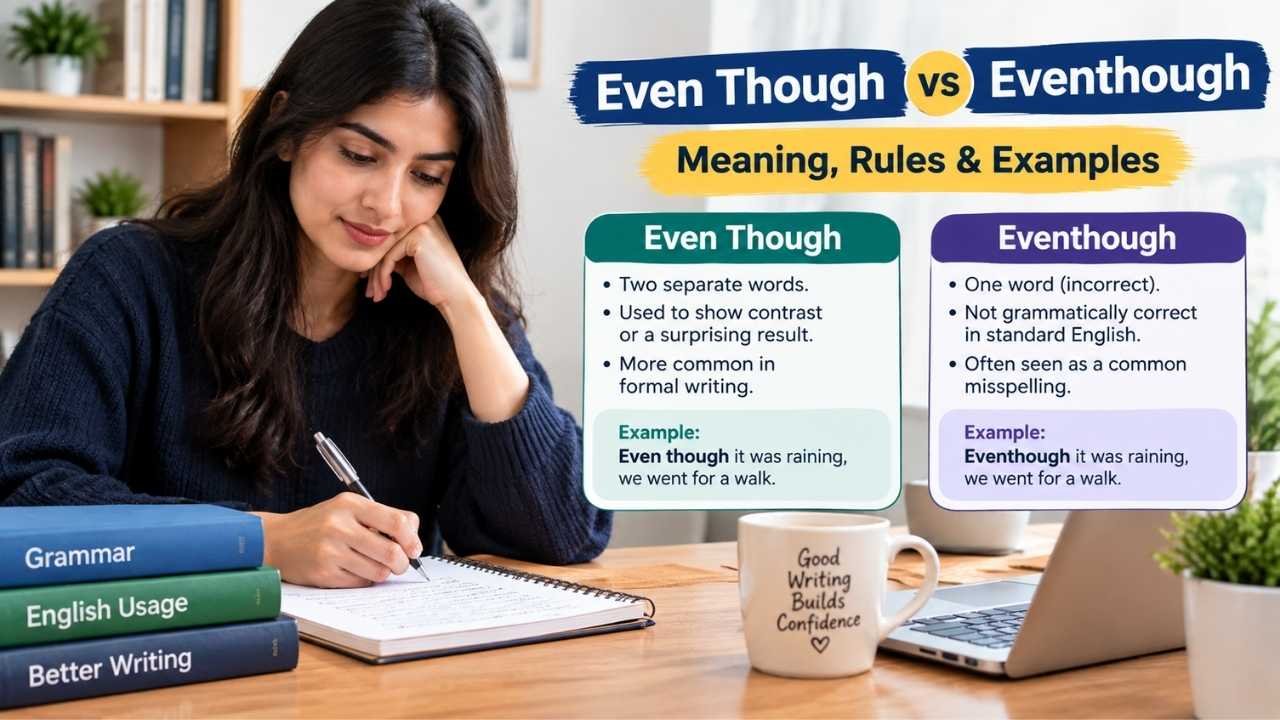
Have you ever wondered whether “eventhough” vs “even though” is the correct spelling? Many English learners and writers get confused because both versions sound the same when spoken. However, only one form is accepted in standard English.
Understanding the difference between eventhough vs even though can help you avoid common grammar mistakes and improve your writing. In this guide, we will explain why “even though” is correct, whether “eventhough” is a word, and how to use even though properly in sentences.
You will also learn the meaning of even though, grammar rules, examples, and differences between similar phrases like although, though, and even if.
Quick Answer
Even though is the correct phrase, while eventhough is not a standard English word. The phrase even though is always written as two separate words and is used to show contrast between two ideas. For example, “Even though it was raining, we went outside.” Avoid using eventhough in formal or everyday writing.
Eventhough Vs Even Though: What Is the Difference?
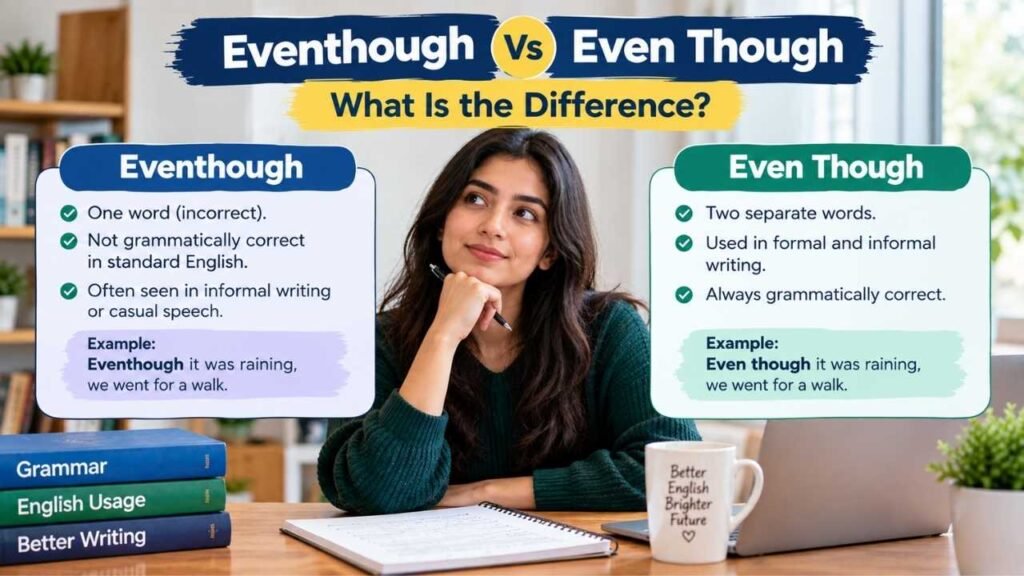
The main difference between eventhough vs even though is that one is correct and the other is not. Even though is a commonly used English phrase that shows a contrast between two situations. It means “despite the fact that” or “although.”
On the other hand, eventhough is an incorrect spelling and should not be used in writing. Many people make this mistake because the two words sound connected when spoken. However, English grammar requires them to stay separate.
For clear and correct writing, always use even though as two words. Understanding this small difference can help improve your grammar and prevent common spelling mistakes in emails, essays, and everyday conversations.
Is Eventhough a Word?
Many people ask, “Is eventhough a word?” because they often see this spelling used online or in casual writing. The answer is no. Eventhough is not recognized as a correct English word in standard dictionaries and should be avoided.
The correct form is even though, which is made up of two separate words working together as a phrase. This confusion usually happens because some English words are written together, such as “although” or “however.”
However, even though follows a different rule. When writing professionally, academically, or for online content, always choose the correct spelling. Using even though will make your writing clearer and more natural for readers.
What Does Even Though Mean?
The phrase even though meaning is simple: it is used to introduce a situation that is surprising or opposite to another idea. It shows that something happened despite a condition or problem.
For example, “Even though he was tired, he finished his work.” This means he was tired, but he still completed the task. In grammar, even though works as a subordinating conjunction that connects two ideas with different results.
It is similar to words like although and though. You can use it at the beginning or middle of a sentence. Learning the meaning of even though makes it easier to use this phrase correctly in conversations and writing.
Why Is Even Though Written as Two Words?
A common question is “Why is even though two words?” The reason is that even and though are separate words that work together to create a special meaning. The word even adds emphasis, while though introduces contrast.
Together, they form the phrase even though, but they do not combine into one word. This is different from words like “although,” which are written as one word because they developed that way over time.
Remembering this rule can help you avoid the common mistake of writing eventhough. A simple trick is to think of even and though as two independent words that need their own space whenever you write the.
How to Use Even Though Correctly in a Sentence
Learning how to use even though correctly is important for both speaking and writing. The phrase can appear at the beginning or in the middle of a sentence. When it starts a sentence, it usually introduces a condition followed by the main result.
For example: “Even though she was nervous, she gave the presentation.” When used in the middle, the structure changes slightly: “She gave the presentation even though she was nervous.”
In both examples, the phrase connects two opposite ideas. You can use even though sentence examples in essays, emails, and conversations to make your writing more detailed. Just remember that even though should always remain two words.
(Similar phrases can sometimes create confusion, just like the difference explained in [Couch Or Coach] where two similar-sounding words have different meanings.)
Grammar Rule Behind Even Though
The even though grammar rule is based on using it as a subordinating conjunction. A subordinating conjunction connects a dependent clause with an independent clause. The dependent clause gives a condition, while the main clause explains the result. The basic pattern is:
Even though + condition, result
Example:
Even though it was expensive, she bought the dress.
The phrase shows that the high price was a surprising condition, but it did not stop the action. You can also place even though after the main clause:
She bought the dress even though it was expensive.
Understanding this grammar structure helps you create correct sentences and use even though naturally in different types of writing.
Common Mistakes With Even Though
One of the most common mistakes is writing eventhough instead of even though. Since people often hear the phrase as one sound, they may incorrectly combine the words. However, correct English writing requires a space between them.
Incorrect:
- Eventhough I was busy, I helped my friend.
- She smiled eventhough she was upset.
Correct:
- Even though I was busy, I helped my friend.
- She smiled even though she was upset.
Another mistake is confusing even though with even if. Remember that even though talks about a real situation, while even if talks about a possible situation. Paying attention to these small grammar details can make your writing more accurate.
Even Though Vs Although: What Is the Difference?
The difference between even though vs although is small because both phrases show contrast. In many sentences, they can be used in the same way. For example:
- Even though it was cold, we went swimming.
- Although it was cold, we went swimming.
Both sentences have the same meaning. However, even though often adds stronger emphasis and highlights a surprising situation. Although may sound slightly more formal and is common in academic writing. Both are correct choices, but understanding their small difference helps you choose the right phrase based on the tone of your sentence.
Even Though Vs Though: When Should You Use Each?
When comparing even though vs though, both words can show contrast, but their usage is different. Even though is usually used before a clause and gives stronger emphasis. For example: “Even though he practiced, he was still nervous.”
Though is more flexible and can appear at the beginning, middle, or end of a sentence. For example:
- Though it was difficult, she continued.
- It was difficult, though.
In casual conversations, though is very common because it sounds natural and simple. However, when you want to clearly show a strong contrast, even though is often the better choice.
Even Though Vs Even If: A Common Confusion
Many writers confuse even though vs even if because both phrases begin with “even.” However, they have different meanings. Even though is used for a real situation or fact. It shows that something happened despite an existing condition.
Example:
- Even though he was sick, he went to work.
This means he was actually sick.
Even if is used for an imagined or possible situation.
Example:
- Even if he gets sick, he will go to work.
This means sickness may or may not happen. Understanding this difference helps you choose the right phrase and avoid changing the meaning of your sentence.
Alternatives to Even Though
Sometimes writers want to avoid repeating even though too often. There are several alternatives that can express a similar idea. Common options include:
- Although
- Though
- Despite the fact that
- In spite of
- Despite
For example:
Even though it was raining, we played outside.
You can rewrite it as:
Although it was raining, we played outside.
Each alternative has slightly different usage rules, so choose the one that fits your sentence best. Using different expressions can make your writing more natural and engaging while still showing contrast between ideas.
How to Remember the Correct Spelling of Even Though
A simple way to remember the correct spelling is to focus on the two separate meanings inside the phrase. Even adds extra emphasis, and though introduces contrast. Since both words have their own meaning, they stay separate.
A useful memory trick:
“Even” and “though” are friends, but they need their own space.
Whenever you write this phrase, check if you have accidentally joined the words together. This small habit can help you avoid the common mistake of writing eventhough. Correct spelling improves your writing quality and makes your message easier for readers to understand.
(Similar expressions can have meanings that are not obvious, like the phrase explained in Pennies On the Dollar.)
FAQs
Is eventhough one word?
No, eventhough is not a correct English word. The correct spelling is even though, written as two words.
Can I use eventhough in formal writing?
No. Avoid using eventhough in formal writing. Always use even though.
Is even though the same as although?
Yes, they have similar meanings, but even though often gives stronger emphasis.
Can even though start a sentence?
Yes. Example: Even though it was late, he continued working.
What type of word is even though?
Even though is a subordinating conjunction used to show contrast between ideas.
Conclusion
Understanding the difference between eventhough vs even though helps you avoid a common English writing mistake. The correct phrase is always even though, written as two separate words. It is used to show contrast between two ideas and works similarly to words like although and though.
While eventhough may look correct because it sounds like one word, it is not accepted in standard English. By remembering the grammar rule, practicing even though sentence examples, and knowing when to use similar phrases like even if, you can improve your writing skills.
Whether you are writing an email, essay, or online content, using even though correctly will make your sentences clearer, more natural, and grammatically accurate.