
Have you ever heard someone say they bought something “for pennies on the dollar” and wondered what it really means? This common English idiom is often used when talking about cheap purchases, huge discounts, or items sold below their original value.
However, the phrase does not usually refer to actual pennies or dollars. Instead, it describes paying or receiving a small amount compared with something’s true worth.
Understanding the pennies on the dollar meaning can help you use this expression correctly in everyday conversations, business discussions, and financial situations. In this article, we will explain what does pennies on the dollar mean, explore its origin, share examples, and show how to use this phrase naturally.
Quick Answer
“Pennies on the dollar” means paying or receiving a very small amount compared with something’s original value. This phrase is an English idiom used to describe items, properties, or assets sold at a much lower price than they are worth. For example, buying a $1,000 item for $100 means you purchased it for pennies on the dollar.
What Does “Pennies On the Dollar” Mean?
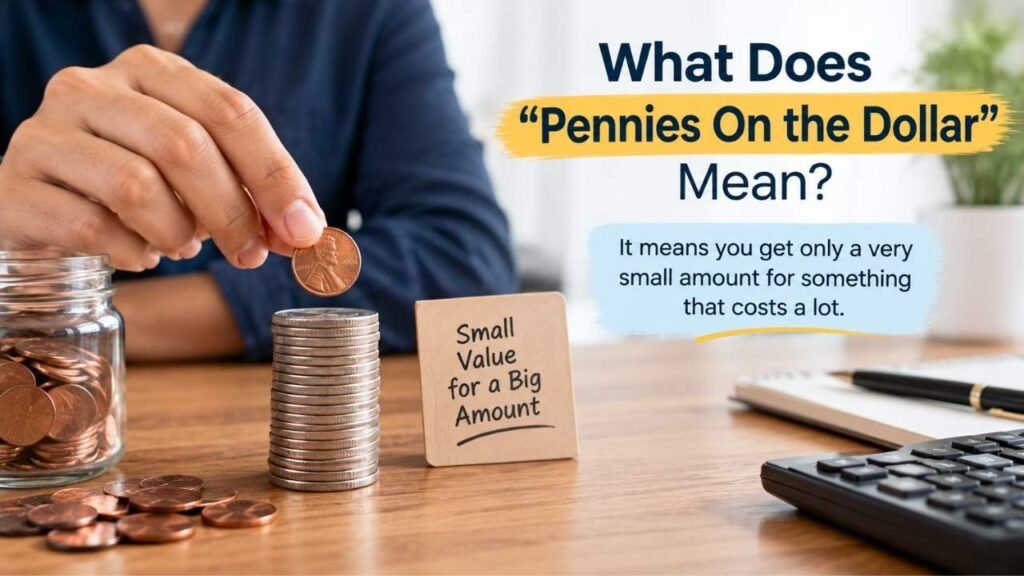
The phrase “pennies on the dollar” means paying or receiving a very small amount compared with something’s original value. In simple words, when someone buys an item for much less than it is worth, they may say they got it for pennies on the dollar. This phrase is commonly used in shopping, business, investments, and real estate.
The pennies on the dollar meaning is not about actual coins but about a large difference between the price paid and the item’s true value. For example, if a $1,000 product is sold for $100, someone may describe it as buying it for pennies on the dollar because they paid only a small part of its original cost.
Is “Pennies On the Dollar” an Idiom?
Yes, “pennies on the dollar” is an English idiom because its meaning is different from the literal words. If we look at the phrase literally, it sounds like it describes a few pennies compared with one dollar. However, the real phrase meaning is about getting something at a very low price compared with its actual worth.
Many English idioms use everyday words to express a deeper idea, and this phrase is a good example. It is often used when discussing bargains, discounts, or financial deals. Learning expressions like this can improve your vocabulary and help you understand natural conversations.
Similar to learning pronunciation through resources like R Tongue Twisters, understanding common phrases helps you communicate more clearly.
Literal Meaning vs Figurative Meaning of Pennies On the Dollar
Understanding the difference between the literal meaning and figurative meaning of “pennies on the dollar” makes the phrase easier to remember. The literal meaning would suggest paying a few pennies for something worth one dollar. However, people usually use this expression in a figurative way to describe a situation where something is sold for far less than its original value.
| Literal Meaning | Figurative Meaning |
| A few pennies compared with a dollar | Paying a very small amount for something valuable |
| Focuses on actual money | Focuses on price difference |
The phrase is commonly used for large discounts, damaged goods, old properties, or business deals where the buyer pays only a small fraction of the real value.
How Much Is “Pennies On the Dollar” Actually?
Many people ask, “How much is pennies on the dollar?” The answer is that it does not represent a fixed amount. The phrase does not mean exactly one penny or a specific percentage. Instead, it means paying a very small part of the original price.
For example, if a house worth $200,000 is purchased for $20,000, someone may say it was bought for pennies on the dollar. The same phrase can describe a $500 item bought for $50 or a valuable asset purchased at a huge discount. The main idea is the difference between the original value and the amount actually paid. It highlights a very low price compared with what something is worth.
Where Did the Phrase “Pennies On the Dollar” Come From?
The exact origin of the phrase “pennies on the dollar” is not linked to one specific person or event, but it developed from the way people compare small and large amounts of money. A penny represents a tiny amount, while a dollar represents a larger standard of value. Over time, the expression became popular in situations involving sales, auctions, business deals, and financial discussions.
Today, people use it to describe something purchased or sold at a very low price. The phrase is especially common when talking about discounted assets, old items, or opportunities where someone pays much less than the normal market value. It has become a widely understood expression in everyday English.
Examples of “Pennies On the Dollar” in Sentences
Seeing real examples can make the pennies on the dollar meaning much easier to understand. This phrase is often used when someone gets a valuable item, service, or asset at a much lower price than expected. Here are some examples:
- Shopping: “I bought a designer jacket for pennies on the dollar during the clearance sale.”
- Business: “The company purchased the struggling business for pennies on the dollar.”
- Real estate: “They bought the old house for pennies on the dollar and repaired it.”
- Investments: “The investor purchased the stocks for pennies on the dollar after the market dropped.”
These examples show that the phrase is not about small purchases only. It is about getting something for a price that is much lower than its original or expected value.
How to Use “Pennies On the Dollar” Correctly
Knowing how to use pennies on the dollar in a sentence helps you sound more natural when speaking or writing English. This expression is usually used when there is a major difference between the original value and the final price. It works well for expensive items, properties, businesses, and valuable assets.
For example:
- “The company bought the equipment for pennies on the dollar.”
- “She found rare books for pennies on the dollar at the auction.”
However, it is not usually used for small everyday savings. Saying you bought a $5 snack for pennies on the dollar may sound unnatural because the price difference is not significant. The phrase is best used when describing a large bargain or a major reduction in value.
Common Mistakes When Using “Pennies On the Dollar”
Although “pennies on the dollar” is a common English expression, some people use it incorrectly. One common mistake is using it for any cheap item without considering the original value. The phrase does not simply mean “cheap”; it means something was bought for a small fraction of what it was worth.
Incorrect:
❌ “I bought a coffee for pennies on the dollar.”
Correct:
✅ “The investor bought the property for pennies on the dollar.”
Another mistake is thinking the phrase refers to an exact amount. The expression is flexible and depends on the situation. Understanding the difference between a low price and a huge discount will help you use this idiom definition correctly in conversations.
“Pennies On the Dollar” in Business, Real Estate, and Investing
The phrase “pennies on the dollar” is frequently used in business and finance because many deals involve buying valuable things below their market price. Investors may purchase companies, properties, or assets for a small percentage of their original value. For example, a buyer may purchase a damaged property at a very low price, repair it, and later sell it for a profit.
In business discussions, this phrase can describe opportunities where someone gets a valuable asset at a discounted price. It may also describe situations where sellers receive much less than expected. Whether it is positive or negative depends on the person’s position. A buyer may see it as a great deal, while a seller may see it as a loss.
Synonyms and Similar Expressions for “Pennies On the Dollar”
There are several phrases with meanings similar to “pennies on the dollar.” These expressions can help you understand the idea of getting something at a very low price.
Some common alternatives include:
- For next to nothing – paying almost no money
- Dirt cheap – extremely inexpensive
- A fraction of the cost – paying much less than the original price
- Below market value – costing less than the normal selling price
- For a song – buying something at a surprisingly low price
- At a bargain price – getting a good deal
While these phrases are related, “pennies on the dollar” usually emphasizes the difference between the original value and the amount paid.
FAQs
What does “pennies on the dollar” mean?
“Pennies on the dollar” means paying a very small amount compared with something’s original value. It describes major discounts or purchases made below normal market value.
Is “pennies on the dollar” an idiom?
Yes, it is an English idiom because the phrase has a figurative meaning beyond the literal words.
How do you use “pennies on the dollar” in a sentence?
You can use it when describing something purchased for much less than it is worth, such as “They bought the property for pennies on the dollar.”
Does “pennies on the dollar” mean free?
No. It does not mean free. It means something was purchased for a very small fraction of its actual value.
What is another way to say “pennies on the dollar”?
Similar expressions include “for next to nothing,” “dirt cheap,” “below market value,” and “a fraction of the cost.”
Conclusion
Understanding the phrase “pennies on the dollar” helps you recognize one of the most useful money-related expressions in English. Whether you hear it in business, shopping, or everyday conversations, it usually means someone paid far less than something was worth.
By learning its meaning, examples, and correct usage, you can use this idiom naturally and confidently.
Learning common expressions, along with vocabulary skills like understanding confusing word pairs such as Couch Or Coach, can make your English communication clearer and more effective.