
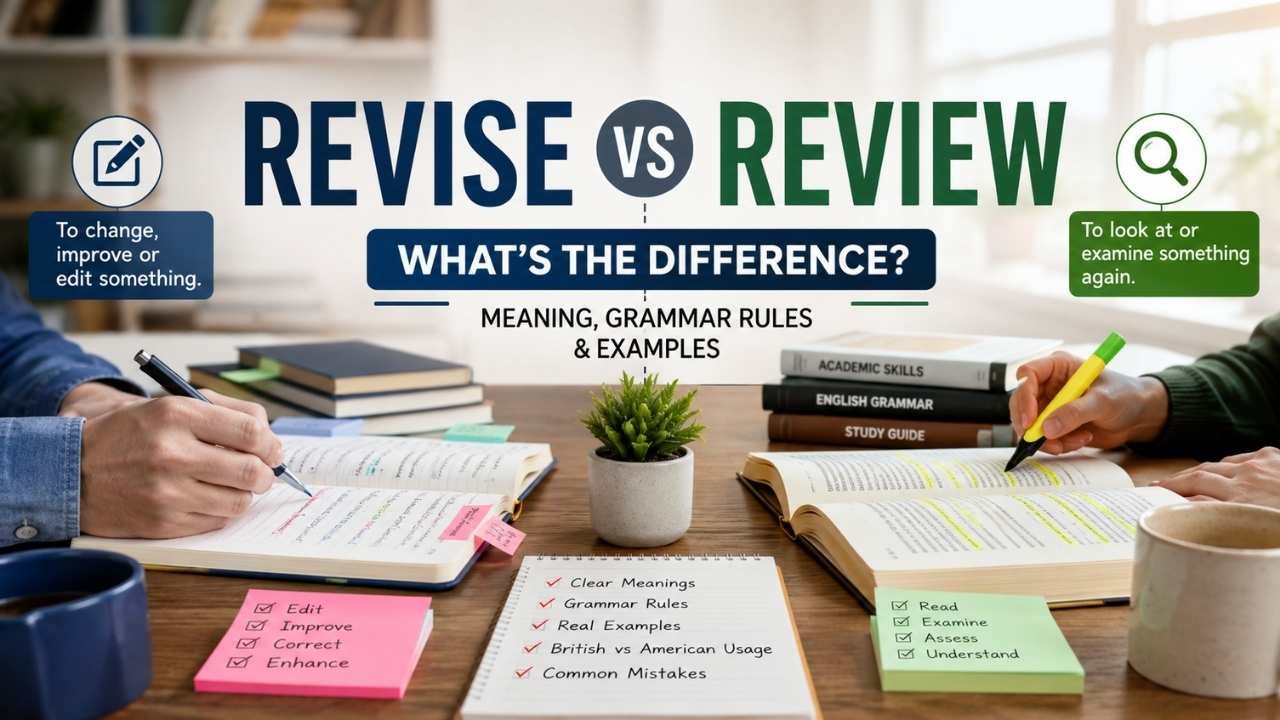
ou ever wondered whether you should revise vs review something? Although these words seem similar, they are not always interchangeable. Understanding the difference between revise and review can help you use the right word in academic writing, business communication, and everyday English.
In simple terms, review usually means to look over, evaluate, or study information again, while revise means to change, improve, correct, or update something. The choice between revise vs review often depends on the situation, whether you’re preparing for an exam, improving an essay, checking a document, or refreshing your study notes.
This guide explains review meaning, revise meaning, key grammar rules, British and American English usage, practical examples, and common mistakes, making it easy for English learners to choose the correct word with confidence.
Quick Answer
The difference between revise and review is simple. Review means to read, examine, evaluate, or study something again without necessarily making changes. Revise means to improve, correct, rewrite, or update something after reviewing it. In British English, students often revise for exams, while in American English, they usually review for exams. Choosing the right word depends on the context.
Revise vs Review at a Glance
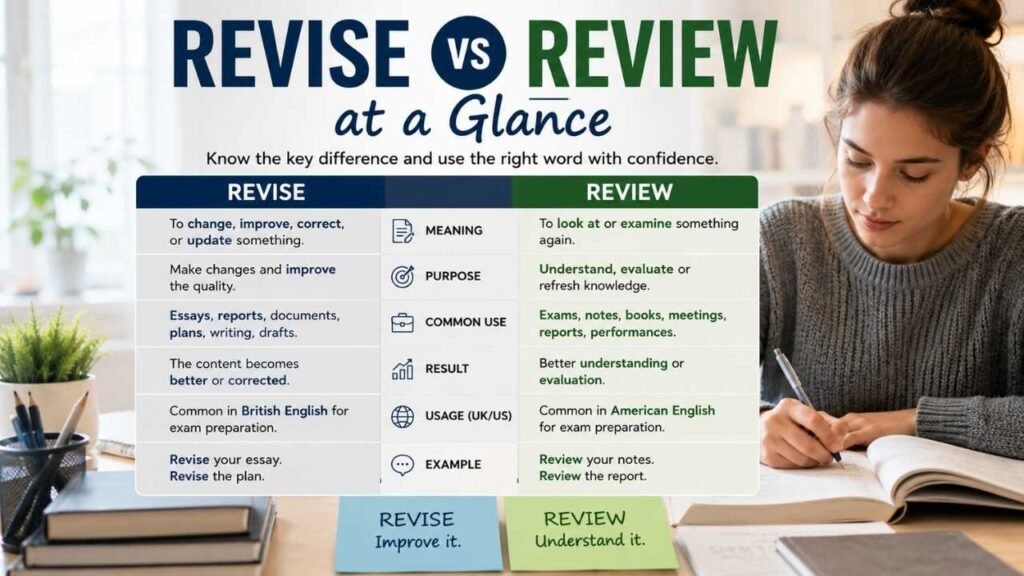
Although revise and review are closely related, they have different meanings and are used in different situations. Review means to read, examine, evaluate, or study something again to refresh your memory or check information. In contrast, revise means to change, improve, correct, or update something after reviewing it.
This is the main difference between revise and review. In American English, students usually review for an exam, while in British English, they often revise for an exam.
Understanding review meaning and revise meaning helps you choose the correct word in academic writing, business writing, and everyday communication. If you enjoy learning similar grammar topics, you may also like our guide on Ensure vs Make Sure.
| Feature | Revise | Review |
| Meaning | Improve, edit, or change something | Read, examine, or study again |
| Purpose | Make corrections or updates | Refresh memory or evaluate |
| Common Use | Essays, reports, documents, plans | Exams, notes, books, meetings |
| Result | Content becomes better | Better understanding of information |
| British English | Common for exam preparation | Less common for studying |
| American English | Usually means edit or improve | Common for studying before exams |
What Does “Revise” Mean?
The word revise means to improve, rewrite, correct, or update something after looking at it carefully. Before sharing a final version, you might revise a document, essay, report, or draft to make it clearer and more accurate. Students often revise their assignments by fixing grammar mistakes, improving word choice, and organizing their ideas more clearly.
The same process is common in the workplace. Professionals may revise business plans, reports, proposals, or presentations before submitting or sharing them. In British English, however, revise has another common use. Students say they revise for an exam when they study their notes and prepare for a test.
Understanding the correct revise definition makes it easier to tell the difference between revise vs review and avoid confusing these two common English verbs.
Examples:
- She revised her essay before submitting it.
- The company revised its safety policy.
- I need to revise my presentation before tomorrow’s meeting.
What Does “Review” Mean?
The word review means to read, examine, evaluate, or study something again without necessarily changing it. You can review notes, review a report, review a contract, or review information before an exam. A review also means giving an opinion about something, such as a book, movie, or product.
In American English, students commonly review for a test by reading their study material again. This helps improve memory and understanding. Unlike revise, reviewing does not always involve editing or correcting.
Knowing the correct review definition helps English learners use the word naturally in conversations, professional communication, and education. For another common word choice guide, you can also read Thanks God or Thank God.
Examples:
- I reviewed my class notes before the exam.
- The manager reviewed the monthly report.
- She wrote a positive review of the new restaurant.
Revise vs Review: Key Differences Explained
Understanding the difference between revise and review becomes easy once you know their purpose. Review focuses on examining, studying, or evaluating information again, while revise focuses on making improvements or corrections. For example, you review notes before an exam to refresh your memory, but you revise an essay to improve its quality.
Another important difference is regional usage. In British English, students often say they revise for exams, whereas American English speakers usually say they review for exams.
These words may seem similar, but they are not always interchangeable. Choosing the right one improves your English vocabulary, grammar accuracy, and confidence in both academic and business writing.
When Should You Use “Revise”?
You should use revise when you plan to change, improve, correct, or update something. This word is common in academic writing, business writing, and editing tasks. Students revise essays, assignments, and reports to fix grammar, improve vocabulary, and organize ideas more clearly.
Professionals also revise proposals, presentations, and company documents before sharing the final version. In British English, students often say they revise for an exam, meaning they study and improve their understanding of the subject.
If your goal is to make something better rather than simply read it again, revise is the correct choice. Knowing when to use revise helps you communicate more accurately and avoid common grammar mistakes.
Examples:
- Please revise your essay before submitting it.
- We revised the project plan after the meeting.
- She revised her speech to make it clearer.
When Should You Use “Review”?
Use review when you want to read, examine, evaluate, or study something again without making major changes. Students often review notes, textbooks, or study material before a test to refresh their memory.
At work, managers review reports, contracts, and performance records before making decisions. You can also review books, movies, products, or services by sharing your opinion about them. In American English, it is natural to say review for an exam, while in British English, people often say revise for an exam.
Understanding when to use review makes your English grammar and word usage more natural in everyday conversations, school, and professional communication.
Examples:
- I reviewed my notes before the final exam.
- The lawyer reviewed the agreement carefully.
- She reviewed the latest sales report yesterday.
British English vs American English Usage
One of the biggest differences between revise and review appears in British English and American English. In the UK, students usually say they revise for exams, which means they study their notes and prepare for a test. In the United States, students generally say they review for exams instead.
Outside of exam preparation, both varieties of English use revise to mean improving or editing a piece of writing and review to mean examining or evaluating something.
Knowing these regional differences helps English learners choose the right word depending on their audience. It also improves confidence in academic English, business English, and international communication.
| Situation | British English | American English |
| Preparing for an exam | Revise for an exam | Review for an exam |
| Improving an essay | Revise an essay | Revise an essay |
| Reading notes again | Revise notes | Review notes |
| Evaluating a report | Review a report | Review a report |
Can “Revise” and “Review” Be Used Interchangeably?
Sometimes revise and review can describe similar actions, but they are not always interchangeable. For example, if you read your notes before an exam, review is the preferred word in American English, while revise is more common in British English.
However, if you are correcting grammar, rewriting paragraphs, or improving a document, only revise is appropriate. Likewise, when someone examines a report, contract, or performance, review is usually the correct choice.
Understanding these differences helps you avoid confusing words and use accurate English vocabulary. The context determines whether you should review information or revise content, making your writing and speaking more precise.
Common Mistakes to Avoid
Many English learners confuse review and revise because both involve looking at something again. A common mistake is saying “I reviewed my essay” when you actually changed sentences, corrected grammar, and improved the content. In that situation, revised is the better choice.
Another mistake is saying “I revised for my math exam” in American English, where reviewed for my exam sounds more natural. Learning these small differences makes your communication clearer.
Always ask yourself one question: Are you reading and checking, or are you changing and improving? If you are making changes, use revise. If you are examining or studying, use review.
Easy Trick to Remember the Difference
A simple memory trick can help you remember revise vs review. Think of the letter “S” in revise as standing for “switch” or “something changes.”
When you revise, you edit, rewrite, or improve the content. Now think of review as “view again.” You simply look at the information another time to understand or evaluate it. This easy trick works well for students, professionals, and anyone learning English. Remember:
Review = Read Again. Revise = Change and Improve. Using this rule will help you choose the correct word whether you are preparing for an exam, editing a document, or checking important information.
Revise vs Review in Academic and Professional Writing
Both revise and review are important in schools and workplaces, but they serve different purposes. In academic writing, students usually review research, review study notes, and review course material before exams. They then revise essays, revise reports, or revise assignments to improve quality before submission.
In professional settings, employees review contracts, policies, and project reports to understand or evaluate them. After receiving feedback, they revise documents, presentations, or proposals to make them more accurate and effective.
Knowing the difference improves your business communication, writing skills, and professional English, helping you choose the right word in every situation.
Real-Life Examples in Everyday English
Learning through everyday examples makes revise vs review much easier to understand. Imagine you have an important exam tomorrow. You review your notes to remember key facts, but you revise your essay by fixing grammar and improving your ideas before submitting it.
At work, a manager may review a report to check the information, while the writer revises the report after receiving feedback.
Even in daily life, you might review travel plans before leaving home but revise your schedule if your plans change. These examples show that review is about checking or studying, while revise is about improving or updating something.
FAQs
What is the difference between revise and review?
Review means to read, examine, or study something again, while revise means to change, improve, or correct it.
Can revise and review be used interchangeably?
Sometimes, but not always. Their meaning depends on the context and the type of English being used.
Which word is correct before an exam?
In American English, people usually review for an exam. In British English, they commonly revise for an exam.
Is revising the same as editing?
Revising often includes editing, but it can also involve reorganizing, rewriting, and improving ideas.
Should I revise or review my essay?
If you are making corrections or improvements, you should revise your essay.
Should I review my notes before a test?
Yes. Reviewing notes helps refresh your memory and prepare for the exam.
Why do British and American English use different words?
The difference comes from regional language preferences. Both are correct within their respective varieties of English.
Conclusion
Understanding revise vs review helps you choose the right word with confidence. Although both involve looking at information again, review means to study, examine, or evaluate, while revise means to improve, correct, or update.
The distinction is especially important in academic writing, business communication, and exam preparation. Remember that British English commonly uses revise for exams, whereas American English usually prefers review for exams.
By learning these grammar rules, studying real-life examples, and practicing the correct usage, you can improve your English vocabulary, avoid common mistakes, and communicate more naturally in both writing and conversation.