
Whether you’re a student, writer, teacher, or English learner, building your vocabulary with verbs that start with A is a simple way to improve your communication skills. Verbs are action words that bring sentences to life, and learning new A verbs can make your writing and speaking more clear, engaging, and expressive.
From common verbs like accept and answer to powerful action verbs like achieve and advance, each word has a unique purpose in everyday English. In this guide, you’ll explore a complete list of verbs that start with A, along with their meanings, definitions, and example sentences to help you understand and remember them.
Whether you’re looking to improve your English vocabulary, complete a school assignment, prepare for an exam, or simply discover new verbs beginning with A, this resource will help you learn with confidence and use these words naturally in real-life situations.
Quick Answer
Verbs that start with A are action words or state-of-being words that begin with the letter A, such as accept, achieve, admire, allow, and answer. These A verbs help express actions, thoughts, feelings, or conditions in sentences. Learning verbs beginning with A can improve your English vocabulary, strengthen your writing, and make your everyday communication more clear and effective.
What Is a Verb? (Quick Refresher)
A verb is a word that shows an action, a state, or an occurrence in a sentence. It is often called an action word because it tells us what a person, animal, or thing does. For example, in the sentence “She accepts the offer,” the word accepts is the verb because it describes an action.
Learning verbs that start with A helps you build a stronger English vocabulary and improve both writing and speaking. Some verbs also describe feelings or conditions instead of physical actions.
Understanding how verbs work makes it easier to create correct sentences and communicate clearly. If you’re also exploring other letters, you may enjoy our guide on Verbs That Start With C to continue growing your vocabulary.
Why Learn Verbs That Start With A?
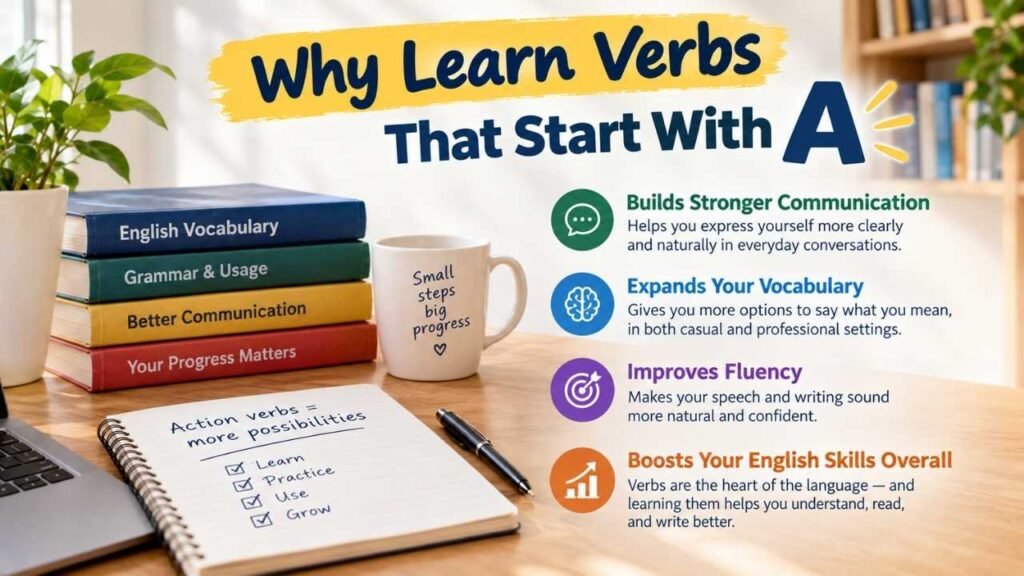
Learning verbs beginning with A can make your writing more interesting and your speech more natural. Many common verbs that start with A, such as accept, answer, allow, and arrive, are used every day.
Others, like achieve, advance, and adapt, are helpful in school, business, and professional writing. Knowing these action verbs also improves your grammar and helps you choose the right word for different situations.
As you expand your vocabulary, you become more confident in conversations, essays, emails, and presentations. While learning new words, it’s also useful to avoid common spelling mistakes, such as confusing Openned or Opened, so your writing stays clear, correct, and professional.
Complete List of Verbs That Start With A
Below is a complete list of verbs that start with A to help you improve your English vocabulary. These A verbs include common, positive, action, and advanced verbs used in everyday conversations, school assignments, business writing, and creative work. Each verb has its own meaning and purpose, making it easier to express ideas clearly.
In the following sections, you’ll also find meanings and example sentences to help you understand how each word is used in real life. Whether you’re looking for verbs that start with A with meanings, verbs beginning with A with examples, or simply want a handy A verbs list, this guide has everything organized in an easy-to-read format.
Common Verbs That Start With A
Common verbs that start with A are words you will hear and use regularly in daily life. They are useful for conversations, emails, stories, and schoolwork. Examples include accept, ask, answer, agree, arrive, allow, add, appear, avoid, and announce.
These English verbs starting with A help describe everyday actions, making your communication more natural and effective. Learning these frequently used verbs first gives you a strong vocabulary foundation before moving on to more advanced words.
As you practice using these A verbs in sentences, they become easier to remember and use correctly. This also improves your grammar, speaking confidence, and overall writing skills.
Positive Verbs That Start With A
Positive verbs that start with A express helpful, encouraging, or successful actions. These words are excellent for motivational writing, professional communication, resumes, and everyday conversations. Popular examples include achieve, admire, appreciate, assist, accept, applaud, advance, affirm, and accomplish.
Using these positive action verbs makes your writing sound confident, respectful, and inspiring. They are also valuable for students, job seekers, and professionals who want to describe achievements or positive behavior.
Learning these powerful verbs beginning with A allows you to replace simple words with stronger choices that leave a better impression. Regular practice with these verbs helps you build richer vocabulary and improve your communication skills naturally.
Action Verbs That Start With A
Action verbs that start with A describe something that a person, animal, or object does. They show movement, activity, or a clear action instead of a state of being. Examples include attack, arrive, assemble, ask, accelerate, apply, adopt, approach, announce, and adjust.
These action words make sentences more vivid and engaging because they clearly explain what is happening. Writers, students, and English learners use these verbs to create stronger and more interesting sentences.
Whether you are writing an essay, telling a story, or having a conversation, using the right verbs that start with A with examples helps make your message easier to understand and more enjoyable to read.
Strong & Powerful Verbs That Start With A
Strong and powerful verbs that start with A make your writing more lively and meaningful. Instead of using simple or repeated words, these verbs help you express ideas with greater impact. Examples include achieve, advance, accomplish, assert, activate, accelerate, amplify, adapt, attain, and advocate.
These powerful verbs beginning with A are useful in essays, speeches, business communication, and creative writing because they clearly describe success, progress, or determination.
Choosing the right A verbs can make your sentences more persuasive and engaging. As you practice these strong action verbs, you’ll improve your English vocabulary, become a more confident writer, and communicate your ideas in a clear and professional way.
Easy Verbs That Start With A for Kids and Beginners
If you’re just starting to learn English, easy verbs that start with A are the best place to begin. These simple English verbs starting with A are easy to understand, remember, and use in everyday conversations. Some common examples are ask, add, act, answer, allow, arrive, accept, agree, appear, and avoid.
These verbs that start with A for kids and beginners help learners build confidence while improving their grammar and vocabulary. Practice using each verb in a short sentence every day to remember it more easily.
Learning these common verbs that start with A creates a strong foundation before moving on to advanced vocabulary and more complex sentence structures.
Advanced & Rare Verbs That Start With A
Once you know the basics, learning advanced and rare verbs that start with A can make your vocabulary richer and more expressive. These words are often used in academic writing, literature, and professional communication.
Examples include abrogate, adjudicate, ameliorate, annul, approximate, authenticate, assimilate, allocate, ascertain, and acquiesce. Although these advanced verbs beginning with A are less common, they help you express ideas with greater accuracy.
Learning their meanings and using them in example sentences will improve your writing and reading skills. Adding these A verbs to your vocabulary is especially useful for students, writers, and English learners preparing for higher-level exams or professional work.
Business and Academic Verbs That Start With A
Many business and academic verbs that start with A are useful in workplaces, colleges, and professional writing. These verbs help you communicate ideas clearly in reports, presentations, emails, and research papers.
Popular examples include analyze, assess, allocate, approve, authorize, advise, assign, administer, audit, and adapt. These academic verbs and business verbs allow you to describe tasks, decisions, and processes in a professional way.
Whether you’re writing an essay, preparing a report, or sending a business email, using the right verbs beginning with A makes your writing more clear, confident, and organized. Learning these words also strengthens your overall English vocabulary and communication skills.
How to Use Verbs That Start With A in Sentences
The best way to remember verbs that start with A is by using them in everyday sentences. Reading a definition is helpful, but writing your own examples makes learning much easier. For example, accept: She accepted the invitation with a smile. Achieve: He achieved his goal through hard work. Ask:
Please ask your teacher if you need help. Allow: The school allows students to use the library after class. Admire: We admire her kindness and honesty. Creating simple sentences helps you understand the meaning and correct usage of each A verb. Regular practice improves grammar, expands your English vocabulary, and builds confidence in both writing and speaking.
Common Mistakes When Using A Verbs
When learning verbs that start with A, it’s important to avoid common mistakes. One frequent error is choosing a verb with the wrong meaning, such as confusing accept with agree. Another mistake is using the wrong verb tense, for example writing “He achieve yesterday” instead of “He achieved yesterday.” Some learners also forget subject-verb agreement, like writing “She ask” instead of “She asks.”
Always check the meaning, tense, and sentence structure before using a new A verb. Reading example sentences and practicing regularly will help you avoid these errors. Over time, your grammar, writing, and speaking skills will become more accurate and natural.
FAQs
What are verbs that start with A?
Verbs that start with A are words that begin with the letter A and describe an action, state, or occurrence. Examples include accept, act, ask, answer, and achieve.
What are some common verbs beginning with A?
Some common verbs beginning with A include accept, add, agree, allow, answer, arrive, ask, appear, avoid, and achieve.
Why should I learn A verbs?
Learning A verbs helps improve your English vocabulary, grammar, writing, speaking, and reading skills. They are useful for school, work, daily conversations, and exams.
What are positive verbs that start with A?
Some positive verbs that start with A are achieve, admire, appreciate, assist, advance, affirm, accept, and accomplish.
How can I remember new verbs more easily?
Practice using each verb in a sentence, review it regularly, and try using it in conversations or writing. Daily practice is the easiest way to remember new vocabulary.
Conclusion
Learning verbs that start with A is an excellent way to improve your English vocabulary and communicate with greater confidence. From common verbs used in daily conversations to positive, action, strong, and advanced verbs, each word helps you express ideas more clearly.
By understanding their meanings and practicing with example sentences, you’ll find it easier to write essays, speak fluently, and communicate in both academic and professional settings.
Keep reviewing these A verbs, use them in real-life situations, and challenge yourself to learn new words regularly. The more you practice, the more natural these verbs beginning with A will become, helping you become a stronger and more confident English user.