
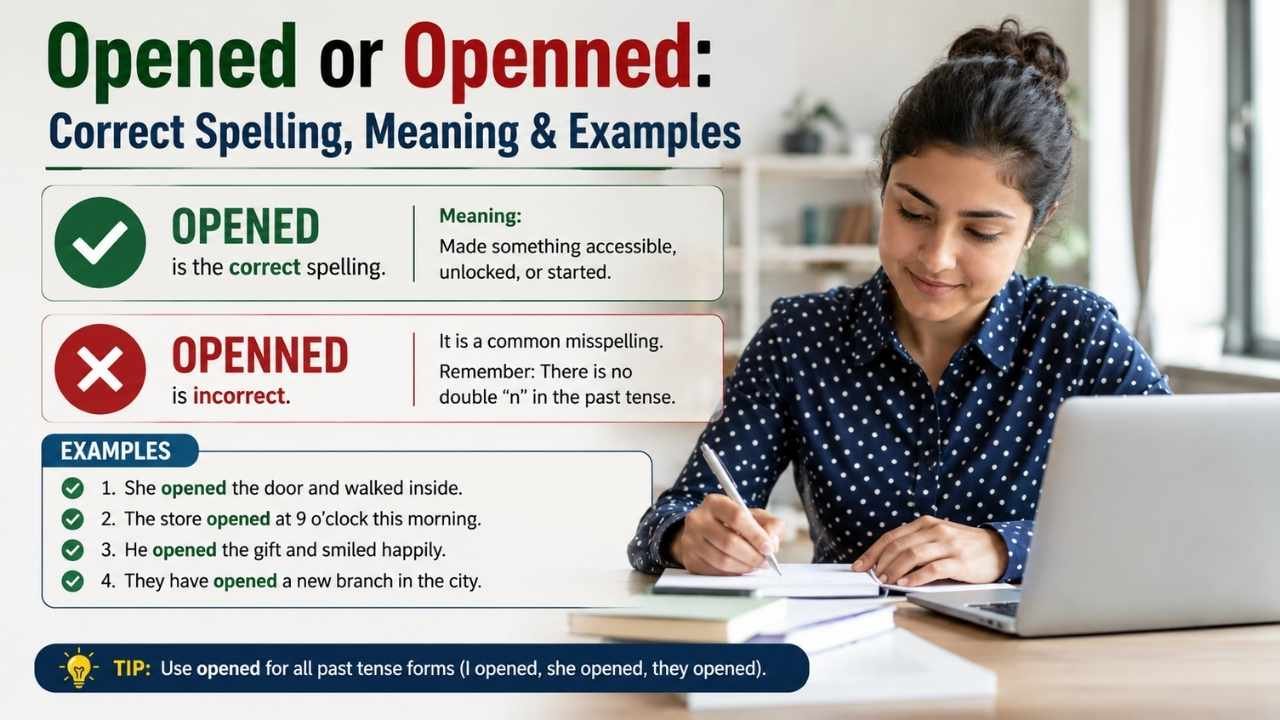
Have you ever wondered whether “openned” or “opened” is the correct spelling? You’re not alone. Many English learners and even native speakers get confused by this common spelling mistake because some verbs double their final consonant before adding -ed, while others do not.
If you’re asking “is it openned or opened?” or searching for the correct spelling of opened, you’ve come to the right place. The simple answer is that “opened” is the only grammatically correct form.
In this guide, you’ll learn why “opened” is correct, why “openned” is incorrect, the grammar rule behind the spelling, and how to use opened correctly with clear examples. By the end, you’ll know how to spell opened confidently and avoid this mistake in your writing every time.
Quick Answer
Opened is the correct spelling and the past tense as well as the past participle of the verb open. Openned is an incorrect spelling and is not recognized in standard English. If you’re wondering “is it openned or opened?”, always use opened in both formal and informal writing. It follows the standard English grammar and spelling rules for regular verbs.
What Does “Opened” Mean?
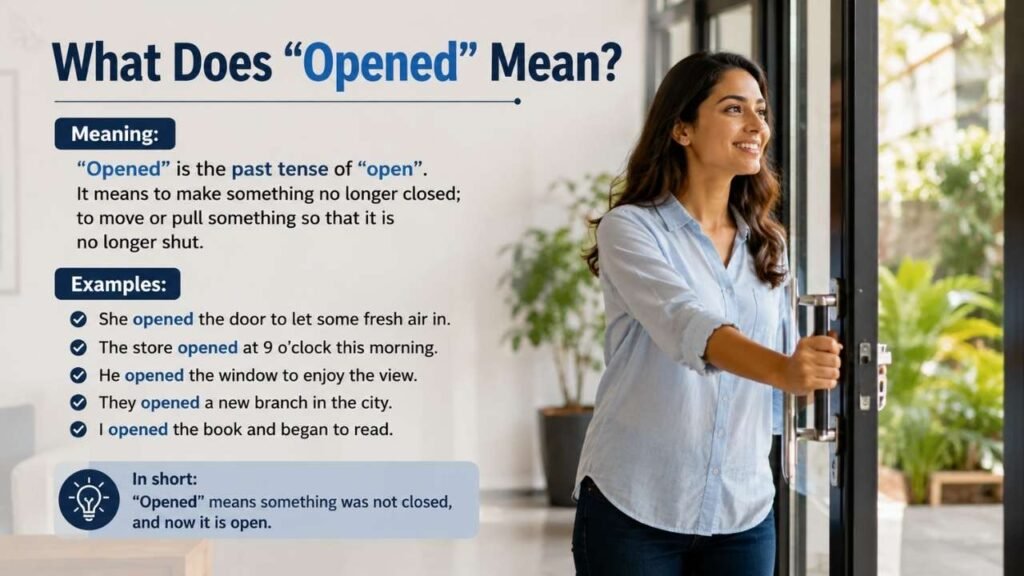
The word opened is the correct spelling of the past tense and past participle of the verb open. It means that something has already been made open or became open in the past. You can use opened when talking about doors, windows, stores, books, emails, conversations, or opportunities.
For example, “She opened the window to let fresh air in.” Many people search for the opened meaning or opened definition because they are unsure how to use it correctly. If you are wondering how to spell opened, remember that opened is the only correct form. Learning the right verb forms helps improve your English grammar and makes your writing clearer and more professional.
Is “Openned” a Real Word?
No, openned is not a real English word. It is a common spelling mistake that happens when people think the final n should be doubled before adding -ed. If you are asking “is openned correct?”, the answer is no.
Standard dictionaries do not recognize openned, and it should never be used in formal or informal writing. The correct spelling of opened is always opened with one n. This mistake is common among English learners because some verbs do double their final consonant, while others do not.
Understanding the proper spelling rules and grammar rules will help you avoid this error and write correct English with confidence every time.
Openned vs. Opened: What’s the Difference?
When comparing openned vs. opened, the difference is simple. Opened is the correct word, while openned is an incorrect spelling. If someone asks “which is correct, openned or opened?”, always choose opened.
It is the proper past tense of open and the correct past participle of open. On the other hand, openned is only a misspelling and has no place in standard English. Similar spelling mistakes appear in other words too.
For example, many writers also confuse Performed vs Preformed, even though each word has a different meaning and use. Learning these differences improves your writing correctly skills and helps you avoid common grammar mistakes.
Why Is “Opened” Spelled with One N?
Many learners ask, “Why is opened spelled with one N?” The answer comes from an important English spelling rule. The verb open has two syllables, and the stress is on the first syllable (O-pen), not the last.
Because the final syllable is not stressed, the last consonant is not doubled before adding -ed. That is why the correct form is opened, not openned. This explains why open doesn’t double the N and answers the common question, “Why isn’t it spelled openned?”
Understanding this consonant doubling rule makes it easier to spell many regular verbs correctly. If you enjoy learning word differences, you may also like Emersion vs. Immersion, another commonly confused pair.
The Grammar Rule Behind “Opened”
The word opened follows the standard grammar rule for regular verbs in English. To make the past tense and past participle, you usually add -ed to the base verb.
Since open ends with a consonant and has the stress on the first syllable, you simply add -ed without doubling the final n. This is why opened is correct and openned is incorrect. If you have ever wondered, “What is the correct past tense of open?”, the answer is opened.
Understanding English grammar, verb conjugation, and spelling rules will help you use many other regular verbs correctly and avoid similar spelling mistakes in everyday writing.
When Should You Use “Opened”?
You should use opened whenever you are talking about something that happened in the past or something that has already been made open. It works as the past tense of open and the past participle of open.
For example, “He opened the door yesterday,” and “The store has opened early today.” In some cases, opened can also describe the state of something, such as “The opened package was on the table.”
If you are asking “When should you use opened?”, remember that it is the only grammatically correct choice. Using the correct verb forms makes your sentences natural, accurate, and easy for readers to understand.
Examples of “Opened” in Sentences
Seeing opened in real sentences is one of the best ways to remember its correct use. Here are a few examples: “She opened the book before class started.” “The manager opened the meeting with a short welcome.”
“They opened a new café in our neighborhood.” “I have opened your email and will reply soon.” Each sentence uses the correct spelling and shows how opened fits naturally into different situations. If you are learning how to spell opened correctly, practicing with examples is very helpful.
Reading and writing sentences also improve your English grammar, expand your vocabulary, and help you avoid common spelling mistakes in the future.
Common Mistakes People Make with “Opened”
One of the most common mistakes is writing openned instead of opened. Another error is confusing opened with opening, even though these words have different uses. Some learners also think every verb should double its final consonant before adding -ed, but that is not true.
If you are wondering “Why is openned wrong?”, it is because it does not follow the correct English spelling rules for the verb open. Always check your writing if you are unsure about the correct spelling of opened. Reading more English, using a dictionary, and practicing writing correctly will help you avoid these common spelling mistakes and become more confident in your writing.
Memory Trick to Remember the Correct Spelling
A simple memory trick can help you remember the correct spelling every time. Think of the base word open first. Since open already ends correctly, you only need to add -ed to make the past tense. There is no reason to add another n, so opened is always the right choice. You can remember this easy formula: Open + ed = Opened.
Whenever you are unsure and ask yourself, “Is it openned or opened?”, repeat this formula before writing. This small habit will help you use the correct word, improve your English grammar, and reduce common grammar mistakes in school, work, emails, and everyday conversations.
Words That Follow the Same Grammar Rule
Many regular verbs follow the same spelling rule as open. Instead of doubling the final consonant, they simply add -ed to form the simple past and past participle. Examples include listen → listened, visit → visited, happen → happened, offer → offered, and enter → entered.
These words follow the same pattern because their final syllable is not stressed. Knowing these examples makes it easier to understand how English forms past tense and helps you recognize the correct verb forms. When you learn words in groups, remembering the correct spelling becomes much easier, and you are less likely to make similar mistakes with other common English verbs.
Words That Do Double the Final Consonant
Not every verb follows the same pattern. Some verbs do double their final consonant before adding -ed. Examples include stop → stopped, plan → planned, admit → admitted, and refer → referred. These verbs usually have one syllable or have the stress on the last syllable, so the consonant doubling rule applies.
This is why many people mistakenly write openned, thinking it follows the same pattern. However, open is different because the stress is on the first syllable. Understanding when consonants should be doubled and when they should not will help you spell many English words correctly and improve your confidence in everyday writing.
FAQs
Is it openned or opened?
Always use opened, because it is the correct spelling. Openned is a misspelling.
Is openned a real word?
No. It is not recognized in standard English dictionaries.
What is the past tense of open?
The past tense of open is opened.
What is the past participle of open?
The past participle is also opened.
Why isn’t it spelled openned?
The verb open does not meet the conditions for doubling the final consonant before adding -ed.
How do you spell opened correctly?
Write open + ed = opened with only one n.
Conclusion
The final answer is simple: opened is the only correct spelling in standard English. It is the correct past tense and past participle of the verb open, while openned is an incorrect spelling that should always be avoided.
If you understand the basic grammar rule, the consonant doubling rule, and the pattern used by regular verbs, remembering the right form becomes much easier.
Whenever you are unsure whether to write openned or opened, choose opened with confidence. Following the correct English grammar and spelling rules will make your writing clearer, more professional, and free from common mistakes.